by Akash Raj, Harshita Yadav, Ettem Abhignu Yadav, Aayushi Khandelwal, Anoop K Suresh, and Shromona Ganguly^ The Union Budget 2026–27 strikes a careful balance between growth augmentation and fiscal consolidation, with a strong emphasis on infrastructure, manufacturing, and technology-led development. It reinforces India’s medium-term growth outlook through higher capital expenditure and targeted sectoral initiatives in healthcare, MSMEs, and green transition. At the same time, it maintains a credible path of fiscal deficit reduction to preserve macro-economic stability. Overall, the Budget reflects a forward-looking strategy aimed at strengthening resilience, innovation, and inclusive growth in the Indian economy. Introduction The Union Budget 2026-27 reaffirms the Government’s commitment to fiscal discipline while reinforcing the aspiration of Viksit Bharat. At a time of global economic uncertainty, the Budget demonstrates strategic foresight by prioritising infrastructure investment, technological self-reliance, and human capital development while maintaining a credible path of fiscal consolidation. The emphasis on innovation, manufacturing, healthcare, and climate-conscious development underscores a long-term vision for building a resilient and inclusive Indian economy. By combining macro-economic stability with targeted sectoral support, this Budget sends a strong signal of policy continuity and commitment to reform. On the receipts front, the gross tax revenue is budgeted to increase by 8.0 per cent in 2026-27, largely due to accelerated growth in income tax collections and sustained growth of union excise duties over 2025-26 (Revised Estimates, RE). On the expenditure side, the thrust on capex continues. Notwithstanding the fiscal consolidation, the capital expenditure as per cent of GDP will be maintained at 3.1 per cent in 2026-27 (Budget Estimates, BE). The effective capital expenditure1 would increase to 4.4 per cent of GDP in 2026-27 (BE) from 3.9 per cent of GDP in 2025-26 (RE), reflecting the focus on growth-enhancing spending. Simultaneously, the revenue expenditure has been contained at 10.5 per cent of GDP in 2026-27 (BE) from 10.8 per cent of GDP in 2025-26 (RE). To further encourage State governments to augment their capital spending, the ‘Special Assistance as Loans to States/ UTs (with legislature) for Capital Investment’ has been extended with an enhanced provision of ₹2.0 lakh crore in 2026-27 (BE), higher than ₹1.5 lakh crore in 2025-26 (RE). The Government has fulfilled its commitment made in the financial year 2021-22 regarding bringing down the gross fiscal deficit (GFD) to below 4.5 per cent of GDP by 2025-26. This stands as a testimony to the Government’s vision of enabling sound public finances while securing growth. For 2026-27, the GFD is budgeted at 4.3 per cent of GDP, in line with the Government’s target of reaching a debt-to-GDP ratio of 50(+/-1) per cent by 2030-31. Going forward, the targeted glide path of debt-to-GDP ratio would help gradual freeing up of resources for other sectoral expenditure. Against this backdrop, the rest of the article is divided into eight sections. Section II discusses the underlying drivers of fiscal deficit, followed by analyses of revenue and expenditure trends in Sections III and IV, respectively. Section V outlines the Government’s outstanding debt position, while Section VI focuses on the major sources of fiscal deficit financing. Section VII examines the transfer of resources to States and Section VIII presents the concluding observations. II. Fiscal Deficit – The Underlying Dynamics As envisaged in the Union Budget 2021-22, the central government has adhered to its medium-term fiscal consolidation path by bringing the GFD below 4.5 per cent of GDP by 2025-26. For 2026-27, the GFD is budgeted at 4.3 per cent of GDP (as against 4.4 per cent in the RE for 2025-26), in line with the Government’s target of debt-to-GDP ratio of 50±1 per cent by 2030-31. The budgeted consolidation of GFD in 2026-27 over 2025-26 (RE) is envisaged by containment of revenue expenditure at 10.5 per cent of GDP [10.8 per cent in 2025-26 (RE)], while capital expenditure is retained at 3.1 per cent of GDP. Gross tax revenue is budgeted at 11.2 per cent of GDP, marginally lower than 11.4 per cent in 2025-26 (RE). The revenue expenditure to capital outlay (RECO) ratio – a summary indicator of the quality of expenditure – is budgeted to remain steady at 4.4 in 2026-27 (BE). Effective capital expenditure is budgeted at 4.4 per cent of GDP in 2026-27, higher than 3.9 per cent of GDP in 2025-26 (RE) [Table 1]. Decomposition of GFD Capital outlay remains as the primary component of GFD in 2026-27 (BE). However, the share of capital outlay in GFD, which increased from an average of 37.1 per cent during 2019-20 to 2024-25 to 56.9 per cent in 2025-26 (RE), is budgeted to marginally decline to 55.6 per cent of GFD in 2026-27. The share of GFD pre-empted by revenue deficit (RD), which had declined from an average of 60.0 per cent during 2019-20 to 2024-25 to 33.8 per cent in 2025-26 (RE), is budgeted to increase marginally to 34.9 per cent in 2026-27 (Chart 1). | Table 1: Key Indicators2 | | (Per cent of GDP) | | Item | 2024-25 | 2025-26 | 2026-27 | | Actuals | BE | RE | BE | | 1 | 2 | 3 | 4 | 5 | | 1. Fiscal Deficit | 4.8 | 4.4 | 4.4 | 4.3 | | 2. Primary Deficit | 1.4 | 0.8 | 0.8 | 0.7 | | 3. Revenue Deficit | 1.7 | 1.5 | 1.5 | 1.5 | | 4. Effective Revenue Deficit | 0.9 | 0.3 | 0.6 | 0.3 | | 5. Gross Tax Revenue | 11.5 | 12.0 | 11.4 | 11.2 | | 6. Non-Tax Revenue | 1.6 | 1.6 | 1.9 | 1.7 | | 7. Revenue Expenditure | 10.9 | 11.0 | 10.8 | 10.5 | | 8. Capital Expenditure | 3.2 | 3.1 | 3.1 | 3.1 | | of which: | | | | | | (i) Capital Outlay | 2.6 | 2.5 | 2.5 | 2.4 | | 9. Effective Capital Expenditure | 4.0 | 4.3 | 3.9 | 4.4 | | 10. Debt | 56.5 | 56.1 | 56.1 | 55.6 | Notes: 1. Effective revenue deficit is the difference between revenue deficit and grants-in-aid for creation of capital assets.
2. Capital outlay is capital expenditure less loans and advances.
3. Effective capital expenditure is capital expenditure plus grants-in-aid for creation of capital assets.
4. External Debt is taken at current exchange rate.
Sources: Union budget documents; and RBI staff estimates. | III. Receipts Total non-debt receipts recorded a growth of 10.7 per cent in 2025-26 (RE) [accounting for 9.5 per cent of GDP] as compared to 10.4 per cent in 2024-25. During 2025-26, the government’s receipts were supported by strong growth in non-debt capital receipts, and non-tax revenue. For 2026-27 (BE), the government has projected a slight moderation in the growth of total non-debt receipts, primarily accounting for a contraction in receipts from goods and services tax (GST) and a marginal decline in non-tax revenue. Gross tax revenue is budgeted to grow by 8.0 per cent in 2026- 27, along with 9.6 per cent growth in devolution to the States, resulting in 7.2 per cent uptick in net tax revenue for 2026-27 (BE). Tax Revenues Gross tax revenue recorded a moderate growth of 7.4 per cent in 2025-26 (RE) over 2024-25, on account of slowdown in income tax and GST collections. However, it is budgeted to rise by 8.0 per cent in 2026-27. Notably, direct taxes continue to remain buoyant in 2025-26 (RE) and 2026-27 (BE) [Chart 2].
The tax-GDP ratio is budgeted at 11.2 per cent in 2026-27 which is marginally lower than 11.4 percent in 2025-26 (RE), primarily attributable to moderation in indirect taxes (Chart 3). However, direct tax to GDP ratio is budgeted to increase to 6.9 per cent in 2026-27 from 6.8 per cent in 2025-26 (RE). Direct Taxes With a decelerated growth of 9.0 per cent, the direct taxes in 2025-26 (RE) remained below the budgeted estimates for 2025-26, primarily due to slowdown in income tax collections. The corporation tax collections, however, exceeded the budgeted amount by ₹27,000 crore. For 2026-27, the direct taxes are budgeted to sustain their growth momentum, with income tax and corporation tax increasing by 11.5 per cent and 11.0 per cent, respectively (Chart 4). Indirect Taxes Receipts from indirect tax rose (y-o-y) by 5.2 per cent in 2025-26 (RE) but remained below the budgeted amount, primarily on account of slowdown in GST collections. Notably, the receipts from union excise and custom duty exceeded their respective budgetary estimates for 2025-26. In 2026-27, the growth in indirect tax collections is budgeted to moderate to 3.0 per cent reflecting contraction in GST collections (accounting for the impact of GST rate rationalisation) and deceleration in growth in customs duty (Chart 5 and Annex I). However, reforms in GST framework in terms of simplification of compliance and rate structure is expected to broaden the tax base going forward.
Non-Tax Revenue In 2025-26 (RE), the non-tax revenue rose sharply by 24.4 per cent largely driven by the higher than budgeted surplus/dividend transfer from the Reserve Bank/nationalised banks, and other financial institutions. For 2026-27 (BE), the collections from non-tax revenue (accounting for 1.7 per cent of GDP) are expected to register marginal decline over the collections of 2025-26 (RE) [Chart 6]. However, in contrast, the dividend from public sector enterprises are budgeted to grow by 5.6 per cent in 2026-27, after recording a contraction in 2025-26 (RE). Non-Debt Capital Receipts Notwithstanding a high growth (y-o-y), non-debt capital receipts fell short of budgeted estimates by ₹11,974 crore in 2025-26 (RE), due to a shortfall in miscellaneous capital receipts (including disinvestment proceeds). In 2026-27, non-debt capital receipts are budgeted to sustain the growth momentum, mainly through an elevated miscellaneous capital receipts target of ₹80,000 crore.3 IV. Expenditure During 2025-26 (RE), the total expenditure of the Union government grew by 6.7 per cent against the budgeted growth of 7.4 per cent. Nonetheless, it remained higher than the growth of 4.7 per cent attained in 2024-25. The fall in total expenditure in 2025-26 (RE) below its budgeted amount was on account of rationalisation in revenue expenditure to the tune of ₹75,168 crore, and underutilisation of the allocated capital expenditure by ₹25,335 crore. For 2026-27, the total expenditure is budgeted for a slightly higher growth of 7.7 per cent, with increase in revenue and capital expenditure at 6.6 per cent and 11.5 per cent, respectively (Table 2). In addition to a higher budgeted capex, the allocation under ‘Special Assistance as Loans to States/UTs (with Legislatures) for Capital Investment’ has been enhanced to ₹2.0 lakh crore in 2026-27 (BE) from ₹1.5 lakh crore in 2025-26 (RE), to further encourage State governments to augment their capital spending. | Table 2: Expenditure of Central Government | | Item | ₹ Thousand Crore | Per cent of GDP | Growth Rate (per cent) | | 2024-25 | 2025-26 (BE) | 2025-26 (RE) | 2026-27 (BE) | 2024-25 | 2025-26 (BE) | 2025-26 (RE) | 2026-27 (BE) | 2024-25 | 2025-26 (RE) | 2026-27 (BE) | | 1 | 2 | 3 | 4 | 5 | 6 | 7 | 8 | 9 | 10 | 11 | 12 | | 1. Total Expenditure | 4,653 | 5,065 | 4,965 | 5,347 | 14.1 | 14.2 | 13.9 | 13.6 | 4.7 | 6.7 | 7.7 | | 2. Revenue Expenditure (RE) | 3,601 | 3,944 | 3,869 | 4,125 | 10.9 | 11.0 | 10.8 | 10.5 | 3.1 | 7.4 | 6.6 | | (i) Interest Payments (IP) | 1,116 | 1,276 | 1,274 | 1,404 | 3.4 | 3.6 | 3.6 | 3.6 | 4.9 | 14.2 | 10.2 | | (ii) Total Subsidies (TS) | 423 | 426 | 470 | 455 | 1.3 | 1.2 | 1.3 | 1.2 | -2.8 | 11.1 | -3.1 | | of which : | | | | | | | | | | | | | Food | 200 | 203 | 228 | 228 | 0.6 | 0.6 | 0.6 | 0.6 | -5.6 | 14.2 | -0.2 | | Fertiliser | 171 | 168 | 186 | 171 | 0.5 | 0.5 | 0.5 | 0.4 | -9.4 | 9.2 | -8.4 | | Petroleum | 14 | 12 | 15 | 12 | 0.04 | 0.03 | 0.04 | 0.03 | 18.3 | 4.4 | -20.1 | | (iii) RE-IP-TS | 2,063 | 2,242 | 2,125 | 2,267 | 6.2 | 6.3 | 6.0 | 5.8 | 3.4 | 3.0 | 6.7 | | (iv) Pension and Retirement Benefits | 274 | 277 | 287 | 296 | 0.8 | 0.8 | 0.8 | 0.8 | 14.9 | 4.7 | 3.3 | | (v) Defence (Revenue) | 291 | 312 | 350 | 365 | 0.9 | 0.9 | 1.0 | 0.9 | 0.2 | 20.2 | 4.5 | | 3. Capital Expenditure | 1,052 | 1,121 | 1,096 | 1,222 | 3.2 | 3.1 | 3.1 | 3.1 | 10.8 | 4.2 | 11.5 | | (i) Capital Outlay | 855 | 895 | 887 | 943 | 2.6 | 2.5 | 2.5 | 2.4 | 8.5 | 3.8 | 6.3 | | (ii) Loans and Advances | 197 | 226 | 208 | 279 | 0.6 | 0.6 | 0.6 | 0.7 | 22.1 | 5.9 | 33.8 | | Source: Union budget documents. | Capital Outlay There was a moderation in growth of capital outlay from 8.5 per cent in 2024-25 to 3.8 per cent in 2025-26 (RE). Nonetheless, it is budgeted for a higher growth of 6.3 per cent in 2026-27 over 2025-26 (RE) [Table 3]. The emphasis laid on capital outlay in the recent years is reflected in its 20.0 per cent compounded annual growth rate (CAGR) recorded during 2020-21 to 2026-27 (BE), in comparison to its CAGR of 13.2 per cent registered during 2014-15 to 2019-20. Major infrastructure (transport, communication, energy and irrigation) remained the thrust of capital outlay and clocked in a CAGR of 29.3 per cent during 2020-21 to 2026-27 (BE). | Table 3: Capital Outlay | | Item | ₹ Thousand Crore | Growth Rate (per cent) | | 2024-25 | 2025-26 (BE) | 2025-26 (RE) | 2026-27 (BE) | 2024-25 | 2025-26 (RE) | 2026-27 (BE) | | 1 | 2 | 3 | 4 | 5 | 6 | 7 | 8 | | 1. Total Capital Outlay | 855 | 895 | 887 | 943 | 8.5 | 3.8 | 6.3 | | 2. Defence Services | 160 | 180 | 218 | 229 | 3.6 | 36.5 | 5.1 | | 3. Capital Outlay (excluding defence) | 695 | 715 | 669 | 714 | 9.7 | -3.8 | 6.7 | | (i) Major Infrastructure (of which): | 624 | 574 | 542 | 609 | 8.0 | -13.2 | 12.4 | | a. Transport (of which): | 545 | 513 | 512 | 561 | 6.0 | -6.1 | 9.6 | | Indian Railways | 252 | 252 | 252 | 278 | 3.9 | 0.02 | 10.3 | | Roads & Bridges | 292 | 259 | 259 | 282 | 8.1 | -11.3 | 9.1 | | b. Communications | 75 | 50 | 24 | 46 | 23.5 | -67.6 | 91.4 | | (ii) Industry & Minerals | 13 | 12 | 11 | 10 | 102.1 | -13.1 | -8.7 | | (iii) Science, Technology, and Environment | 5 | 8 | 7 | 8 | -23.8 | 26.2 | 21.8 | | (iv) Others | 53 | 121 | 110 | 87 | 24.3 | 105.1 | -21.0 | | Source: Union budget documents. | Quality of Expenditure In the post-COVID period, the Union government has focused on rationalisation of revenue expenditure while providing continuous impetus to capital expenditure. During 2020-21 to 2026-27 (BE), the CAGR of revenue expenditure declined to 5.0 per cent from a CAGR of 9.9 per cent during 2014-15 to 2019-20. The ratio of revenue expenditure to capital outlay (RECO), an indicator of the quality of expenditure of the Government has been falling consistently in the recent years4 (Chart 7a). Similarly, the share of revenue deficit (RD) in GFD has been declining in recent years (Chart 7b). This improvement in public expenditure quality as reflected in downward trend in RECO ratio and RD-GFD ratio bodes well for fiscal sustainability. Major Government Schemes The outlay on the central sector schemes and centrally sponsored schemes is budgeted to increase by 8.2 per cent and 30.6 per cent, respectively, in 2026-27 over 2025-26 (RE). The highest allocation amongst the central sector schemes has been made for Pradhan Mantri Garib Kalyan Anna Yojana, followed by Pradhan Mantri Kisan Samman Nidhi. Under the centrally sponsored schemes, the highest outlay has been accorded to Viksit Bharat-Guarantee for Rozgar and Ajeevika Mission (Gramin) followed by Pradhan Mantri Awas Yojna (Rural and Urban combined). Notably, the allocation for Jal Jeevan Mission has recorded an increase of nearly 300 per cent in 2026-27 (BE), after contraction in the previous two years (Table 4). The outlay on centrally sponsored schemes constitutes a major part of the resources transferred to the States. With the objective of enhancing visibility and transparency in fund flows to States under these schemes, the Union government had implemented Single Nodal Agency (SNA) framework in 2021. It seeks to ensure just-in-time release of scheme funds to States based on the pace of expenditure, and avoid float/idle parking of funds which facilitates saving of interest cost and transparent budgeting (Box A). 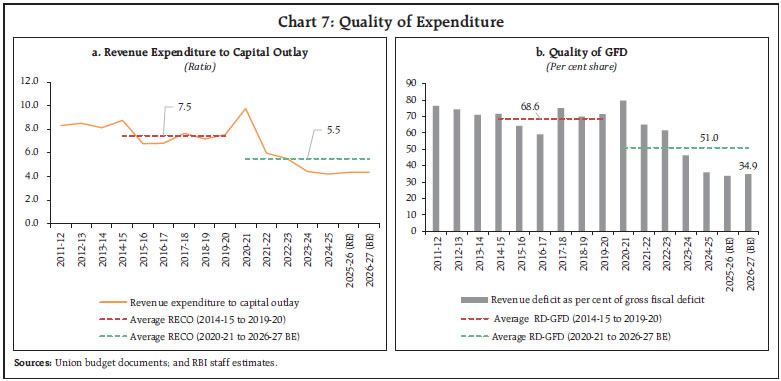
| Table 4: Expenditure on Major Government Schemes | | Item | ₹ Thousand Crore | Per cent of Total Expenditure | Growth Rate (per cent) | | 2024-25 | 2025-26 (BE) | 2025-26 (RE) | 2026-27 (BE) | 2024-25 | 2025-26 (RE) | 2026-27 (BE) | 2024-25 | 2025-26 (RE) | 2026-27 (BE) | | 1 | 2 | 3 | 4 | 5 | 6 | 7 | 8 | 9 | 10 | 11 | | A. Central Sector Schemes (of which) : | 1,494 | 1,622 | 1,637 | 1,772 | 32.1 | 33.0 | 33.1 | 5.0 | 9.6 | 8.2 | | 1. PM-KISAN | 66 | 64 | 64 | 64 | 1.4 | 1.3 | 1.2 | 7.6 | -4.0 | 0.0 | | 2. Pradhan Mantri Garib Kalyan Anna Yojana (PMGKAY) | 200 | 203 | 228 | 227 | 4.3 | 4.6 | 4.3 | - | 14.2 | -0.1 | | 3. Modified Interest Subvention Scheme (MISS) | 23 | 23 | 23 | 23 | 0.5 | 0.5 | 0.4 | 58.6 | 0.0 | 0.0 | | 4. PM Surya Ghar Muft Bijli Yojana | 8 | 20 | 17 | 22 | 0.2 | 0.3 | 0.4 | - | 117.5 | 29.4 | | 5. Crop Insurance Scheme | 14 | 12 | 12 | 12 | 0.3 | 0.2 | 0.2 | 11.8 | -15.2 | -0.5 | | B. Centrally Sponsored Schemes (ofwhich): | 402 | 542 | 420 | 549 | 8.6 | 8.5 | 10.3 | -9.5 | 4.4 | 30.6 | | 1. Mahatma Gandhi National Rural Employment Guarantee Programme (MGNREGA) | 86 | 86 | 88 | 30 | 1.8 | 1.8 | 0.6 | -3.7 | 2.5 | -65.9 | | 2. Viksit Bharat-Guarantee for Rozgarand Ajeevika Mission (Gramin) [VB-G RAM Scheme] | - | - | - | 96 | - | - | 1.8 | - | - | - | | 3. Jal Jeevan Mission (JJM) / National Rural Drinking Water Mission | 23 | 67 | 17 | 68 | 0.5 | 0.3 | 1.3 | -67.7 | -24.8 | 298.1 | | 4. Pradhan Mantri Awas Yojna (Rural and Urban) | 38 | 78 | 40 | 77 | 0.8 | 0.8 | 1.4 | -12.1 | 5.5 | 89.9 | | 5. Samagra Shiksha | 36 | 41 | 38 | 42 | 0.8 | 0.8 | 0.8 | 10.5 | 4.7 | 10.8 | | 6. National Health Programme* | 32 | 30 | 30 | 32 | 0.7 | 0.6 | 0.6 | 27.5 | -5.7 | 6.5 | | 7. Saksham Anganwadi and POSHAN 2.0 (Umbrella ICDS - Anganwadi Services, Poshan Abhiyan, Scheme for Adolescent Girls) | 21 | 22 | 21 | 23 | 0.5 | 0.4 | 0.4 | -3.6 | -0.3 | 10.3 | -: Not available.
*: pertains to Flexible Pool for Reproductive and Child Health (RCH) & Health System Strengthening, National Health Programme and National Urban Health Mission.
Note: While VB-G RAM G Scheme is to replace MGNREGA, the allocation has been made for both the schemes for 2026-27.
Source: Union budget documents. |
Box A: Treasury Single Account and Cash Management by Centre Following the recommendations of the Expenditure Management Commission (2015), Treasury Single Account (TSA) was first adopted in India during 2017-18 on pilot basis, for the central autonomous bodies which received grants-in-aid from the Centre. Subsequently, in 2021, the government implemented the Single Nodal Agency (SNA) model for the centrally sponsored schemes5. In 2022, the TSA framework was further extended to the central sector schemes with outlay of more than ₹500 crore, and in June 2024 this threshold was revised to ₹100 crore6. These reforms were aimed to minimise the borrowing costs of the government and enhance efficiency in fund flows by moving towards ‘just-in time7 release of funds from the relevant Ministry/Department to the beneficiaries/ vendors and avoiding float/ idle parking of funds. In this context, an attempt has been made towards assessing the impact of adoption of SNA on cash management practice of the central government using the monthly cash balance data8. Autoregressive conditional heteroskedasticity (ARCH) model is used to analyse the impact of SNA on cash balance volatility for the sample period April 1997 to December 2025. Cash balances (net of market borrowings)9 are calculated as the difference between cash inflows and outflows, wherein non-debt receipts and non-market borrowings together account for cash inflow and total expenditure is the cash outflow10 (Chander, 2014). To assess the impact of SNA on the cash balances, a dummy variable for July 2021 has been added which marks the wider adoption of TSA through implementation of SNA. The results of the regression indicate that the adoption of SNA had statistically significant and negative impact on the volatility of the cash balances, suggesting improvement in the effectiveness of cash management. Further, it was found that the non-debt receipts and total expenditure have statistically significant impact on the conditional variance. The volatility of cash balances declines as non-debt receipts increases, and it goes up as the expenditure increases. The regression coefficient of ARCH term is statistically significant suggesting that the volatility in cash balances is driven by past shocks and showcases volatility clustering (Table A.1). In recent years, the number of days for which the Centre has taken recourse to ways and means advances (WMA)/Overdraft (OD) facilities have declined indicating improved cash management practices adopted by the Centre (Chart A.1). | Table A.1: Regression Results | | (Dependent variable: Net cash balances) | | Independent Variables | Regression co-efficient | | Mean equation | | Constant | -10.943* | | | (2.166) | | ARMA structure | | | MA(1) | 0.204* | | | (0.029) | | MA(12) | 0.542* | | | (0.039) | | Conditional Variance | | ARCH(2) | 0.449* | | | (0.093) | | Multiplicative Heteroskedasticity | | Constant | 4.545* | | | (0.191) | | Dummy for SNA adoption | -1.821* | | | (0.473) | | Non-debt receipts | -0.004* | | | (0.001) | | Total expenditure | 0.020* | | | (0.002) | | Summary | | Number of observations | 345 | | Log likelihood | -1715.79 | Note: 1. The figures in parentheses are standard errors.
2. * represents significance level at 5 per cent. | Building on the success of TSA and SNA, the Centre has currently extended the implementation in several phases such as: (a) ‘SNA-Central’ module extending SNA to previously excluded centrally sponsored schemes (from April 2023); (b) ‘TSA hybrid’ for central sector schemes involving private sub-agencies which has been in effect since June 2024; and (c) SNA-SPARSH (System for Payments and Reporting across Sectors Holistically) which was initially rolled out for two centrally sponsored schemes (PM USHA and Swachh Bharat Mission- Gramin) in six states (viz., Rajasthan, Odisha, Karnataka, Telangana, Jharkhand and Chhattisgarh) on a pilot basis in 2023 and later extended to a wider set of schemes11. 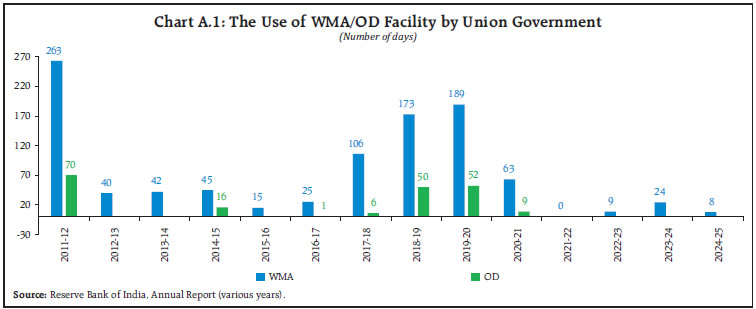 The TSA and SNA systems are complemented by monthly/ quarterly cash flow forecasts from various ministries, automated daily cash balance report as part of the Public Financial Management System and emphasis on reduction of off-budget borrowing (Fifteenth and Sixteenth Finance Commission). The ongoing extension of the SNA-SPARSH over a larger number of schemes would further strengthen the government’s effort towards establishing a transparent and efficient cash management system. References: Chander, J. (2014). Government Cash Operations: Volatility and Management in India. Reserve Bank of India Occassional Papers, Vol. 35 and 36, No 1 and 2: 2014 & 2015. | In recent years, the Union government has also enhanced the allocations of central sector schemes dedicated towards the new emerging strategic sectors such biotechnology, pharmaceuticals, and shipbuilding as well as sectors focused on cuttingedge technology such as artificial intelligence (AI), atomic research and space technology (Chart 8).
The expenditure towards new and renewable energy is budgeted to increase to 0.6 per cent of total expenditure in 2026-27, led by increased allocations towards PM Surya Ghar Muft Bijli Yojana (Chart 9). Overall, solar energy comprises 93.2 per cent of the total allocations towards the Ministry of New and Renewable Energy. The gender budget of the Union government as a per cent of total expenditure is budgeted at 9.4 per cent in 2026-27 as compared to 8.0 per cent in 2025-26 (RE) [Chart 10]. V. Outstanding Debt After peaking at 62.6 per cent of GDP in 2020-21 amidst the COVID-19 pandemic, the total outstanding debt of the Union government has been recording a consistent decline. Continuing with the debt-to-GDP ratio as the fiscal anchor12, the Union government reiterated its commitment to bring down the debt-to-GDP ratio to 50 (+/-1) per cent by March 2031. Debt-to-GDP ratio of the Union government is budgeted to consolidate to 55.6 per cent of GDP in 2026-27, lower than 56.1 per cent of GDP in 2025-26 (RE). The interest payment to revenue receipts ratio is budgeted at 39.7 per cent in 2026-27 in comparison to 38.1 per cent in 2025-26 (RE). The interest rate-growth differential (IRGD), an indicator of debt sustainability, remains favourable (Chart 11a and b). VI. Gross Fiscal Deficit Financing On the financing side, gross and net market borrowings for 2026-27 are budgeted at ₹17.2 lakh crore (4.4 per cent of GDP) and ₹11.7 lakh crore (3.0 per cent of GDP), respectively. Net market borrowings are estimated to finance 69.2 per cent of the GFD in 2026-27 (BE) as compared to 72.7 per cent of GFD in 2025-26 (RE). As per cent of GDP, the net market borrowings are budgeted to decline in 2026-27. Securities issued against small savings and net treasury bills amounting to ₹3.9 lakh crore and ₹1.3 lakh crore, respectively, are budgeted to finance 22.8 per cent and 7.7 per cent of GFD, respectively, in 2026-27 (Chart 12). The gradual reduction in the net market borrowing requirements (as per cent of GDP) of the Union government towards the pre-pandemic level is expected to facilitate greater availability of resources for the private sector (Table 5). VII. Resource Transfer from Centre to States The gross transfers to States have been budgeted to increase by 12.2 per cent in 2026-27 (BE) from 5.0 per cent during 2025-26 (RE), largely on account of transfers under centrally sponsored schemes and special assistance as loans to States/UTs (with legislature) for capital investment. The gross transfer of resources to States, as a share of GDP, is budgeted to increase marginally from 6.5 per cent during 2025-26 (RE) to 6.7 per cent during 2026-27 (BE). For 2026-27, the Budget has allocated ₹2 lakh crore as 50-year interest-free loans for States’ capital expenditure, representing a 33.3 per cent increase over 2025-26 (RE). Devolution of States’ share in taxes constitutes the largest component of gross transfers (Chart 13).13 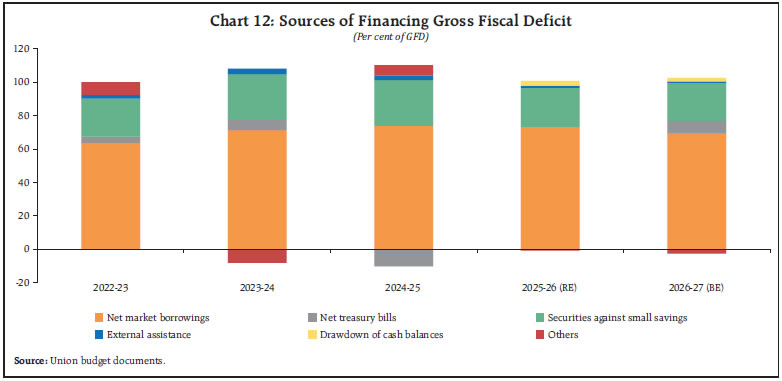
| Table 5: Market Borrowings of the Union Government | | (₹ crore) | | Financial Year | Gross Market Borrowings | Net Market Borrowings | | 1 | 2 | 3 | | 2019-20 | 7,10,000 | 4,73,968 | | | (3.5) | (2.4) | | 2020-21 | 12,60,116 | 10,32,907 | | | (6.3) | (5.2) | | 2021-22 | 9,68,382 | 7,04,097 | | | (4.1) | (3.0) | | 2022-23 | 14,21,000 | 11,08,259 | | | (5.3) | (4.1) | | 2023-24 | 15,43,000 | 11,80,458 | | | (5.1) | (3.9) | | 2024-25 | 14,00,697 | 11,62,878 | | | (4.2) | (3.5) | | 2025-26 (RE) | 14,61,000 | 11,32,834 | | | (4.1) | (3.2) | | 2026-27 (BE) | 17,20,000 | 11,73,210 | | | (4.4) | (3.0) | Notes: 1. Gross market borrowings comprise only fresh borrowings.
2. Net market borrowings are excluding the impact of buyback and switching of securities.
3. Figures in parentheses are as per cent of GDP.
Source: Union budget documents. | Finance Commission14 grants to States and Union Territories are budgeted to decline by 15.4 per cent in 2026-27. Within this, grants to urban and rural local bodies continue to grow, with a notable increase for urban local bodies, while disaster management grants see a decline. Post devolution revenue deficit grants have been discontinued (Table 6). The Centre has announced a multi-sectoral development push to strengthen regional growth, industrial capacity, and service delivery across States. It will support mineral rich States in establishing dedicated rare earth corridors to promote mining, processing, research and manufacturing of permanent magnets. A challenge-based scheme will be launched to help States set up three plug-and-play chemical parks to boost domestic chemical production and reduce import dependence. The Centre will also support the creation of five Regional Medical Hubs through public–private partnerships to promote medical tourism and generate employment for doctors and allied health professionals. In addition, five University Townships will be developed near major industrial and logistics corridors to integrate education, research, skills, and housing. The Centre will roll out a Coconut Promotion Scheme to enhance production and productivity in major coconut-growing States. Under the Purvodaya initiative, it will develop an integrated East Coast Industrial Corridor, create new tourism destinations, and provide e-buses. It has also announced a scheme to develop Buddhist circuits in select north-eastern States by preserving heritage sites, improving connectivity, and upgrading pilgrim amenities. 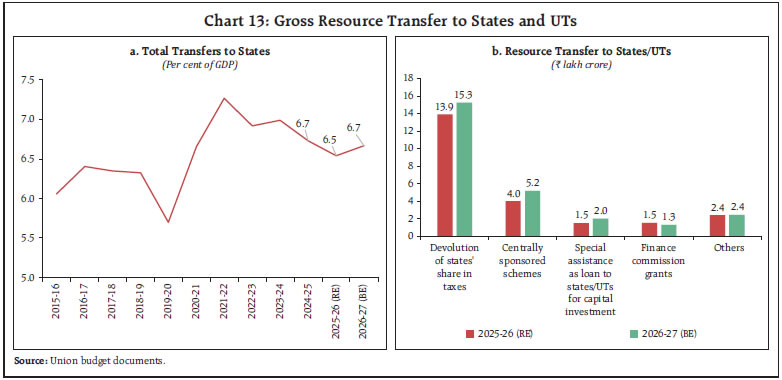
| Table 6: Finance Commission (FC) Grants to States and UTs | | Item | ₹ Lakh Crore | Share in Total FC Grants (per cent) | Growth (per cent) | | | 2025-26 (RE) | 2026-27 (BE) | 2025-26 (RE) | 2026-27 (BE) | 2025-26 (RE) | 2026-27 (BE) | | Finance Commission (FC) Grants | 1.5 | 1.3 | - | - | 26.6 | -15.4 | | 1. Grant for Local Bodies – Urban Bodies | 0.3 | 0.5 | 17.0 | 35.0 | 35.1 | 74.0 | | 2. Grant for Local Bodies – Rural Bodies | 0.5 | 0.6 | 35.5 | 43.2 | 31.6 | 2.9 | | 3. Grants for Disaster Management | 0.3 | 0.3 | 21.9 | 21.8 | 32.7 | -15.8 | | 4. Post Devolution Revenue Deficit Grants | 0.1 | - | 9.0 | - | -44.0 | - | | 5. Others* | 0.3 | - | 16.6 | - | 139.5 | - | *: Includes Grants for Health Sector and Grants for shared Municipal Services.
Source: Union budget documents. | VIII. Conclusion The Union Budget 2026-27 envisages a path towards Viksit Bharat balancing ambition with inclusion. While the Government continued its thrust on capital expenditure, it also delivered on its promise of fiscal consolidation, by attaining the gross fiscal deficit target of 4.4 per cent of GDP in 2025-26 (RE) and further reducing it to 4.3 per cent in 2026-27 (BE).
| Annex I: Union Budget 2026-27: Key Fiscal Indicators | | Item | ₹ Thousand Crore | Per cent of GDP | Growth Rate | | 2023-24 | 2024-25 | 2025-26 (BE) | 2025-26 (RE) | 2026-27 (BE) | 2024-25 | 2025-26 (RE) | 2026-27 (BE) | 2024-25 | 2025-26 (RE) | 2026-27 (BE) | | 1 | 2 | 3 | 4 | 5 | 6 | 7 | 8 | 9 | 10 | 11 | 12 | | 1. Direct Tax | 1,956 | 2,222 | 2,520 | 2,421 | 2,697 | 6.7 | 6.8 | 6.9 | 13.6 | 9.0 | 11.4 | | (i) Corporation Tax | 911 | 987 | 1,082 | 1,109 | 1,231 | 3.0 | 3.1 | 3.1 | 8.3 | 12.4 | 11.0 | | (ii) Income Tax | 1,011 | 1,184 | 1,360 | 1,248 | 1,392 | 3.6 | 3.5 | 3.5 | 17.1 | 5.4 | 11.5 | | (iii) Security Transaction Tax | 34 | 52 | 78 | 64 | 74 | 0.2 | 0.2 | 0.2 | 54.5 | 22.0 | 15.8 | | 2. Indirect Tax | 1,509 | 1,574 | 1,750 | 1,657 | 1,707 | 4.8 | 4.6 | 4.3 | 4.3 | 5.2 | 3.0 | | (i) GST | 957 | 1,027 | 1,178 | 1,046 | 1,019 | 3.1 | 2.9 | 2.6 | 7.3 | 1.9 | -2.6 | | (ii) Customs Duty | 233 | 233 | 240 | 258 | 271 | 0.7 | 0.7 | 0.7 | 0.04 | 10.8 | 5.0 | | (iii) Excise Duty | 309 | 304 | 322 | 342 | 407 | 0.9 | 1.0 | 1.0 | -1.8 | 12.8 | 18.8 | | 3. Gross Tax Revenue (1+2) | 3,466 | 3,796 | 4,270 | 4,078 | 4,404 | 11.5 | 11.4 | 11.2 | 9.5 | 7.4 | 8.0 | | 4. Assignment to States | 1,129 | 1,287 | 1,422 | 1,393 | 1,526 | 3.9 | 3.9 | 3.9 | 13.9 | 8.2 | 9.6 | | 5. NCCD Transfers | 9 | 9 | 10 | 10 | 11 | 0.03 | 0.03 | 0.03 | 7.8 | 7.2 | 7.6 | | 6. Net Tax Revenue (3-4-5) | 2,327 | 2,500 | 2,837 | 2,675 | 2,867 | 7.6 | 7.5 | 7.3 | 7.4 | 7.0 | 7.2 | | 7. Non-tax Revenue | 402 | 537 | 583 | 668 | 666 | 1.6 | 1.9 | 1.7 | 33.5 | 24.4 | -0.2 | | (i) Dividends and Profits | 171 | 308 | 325 | 376 | 391 | 0.9 | 1.1 | 1.0 | 80.5 | 21.8 | 4.1 | | (ii) Interest Receipts | 38 | 40 | 48 | 40 | 42 | 0.1 | 0.1 | 0.1 | 5.7 | -0.7 | 4.0 | | 8. Revenue Receipts (6+7) | 2,729 | 3,037 | 3,420 | 3,342 | 3,533 | 9.2 | 9.4 | 9.0 | 11.3 | 10.1 | 5.7 | | 9. Non debt Capital Receipts | 60 | 42 | 76 | 64 | 118 | 0.1 | 0.2 | 0.3 | -30.0 | 53.1 | 84.9 | | (i) Miscellaneous Capital Receipts | 33 | 17 | 47 | 34 | 80 | 0.1 | 0.1 | 0.2 | -48.1 | 96.7 | 136.4 | | (ii) Recovery of Loans | 27 | 25 | 29 | 30 | 38 | 0.1 | 0.1 | 0.1 | -7.6 | 22.6 | 27.2 | | 10. Total Receipts (ex. Borrowings) (8+9) | 2,789 | 3,078 | 3,496 | 3,406 | 3,652 | 9.3 | 9.5 | 9.3 | 10.4 | 10.7 | 7.2 | | 11. Revenue Expenditure (RE) | 3,494 | 3,601 | 3,944 | 3,869 | 4,125 | 10.9 | 10.8 | 10.5 | 3.1 | 7.4 | 6.6 | | (i) Interest Payments (IP) | 1,064 | 1,116 | 1,276 | 1,274 | 1,404 | 3.4 | 3.6 | 3.6 | 4.9 | 14.2 | 10.2 | | (ii) Total Subsidies (TS) | 435 | 423 | 426 | 470 | 455 | 1.3 | 1.3 | 1.2 | -2.8 | 11.1 | -3.1 | | of which: | | | | | | | | | | | | | Food | 212 | 200 | 203 | 228 | 228 | 0.6 | 0.6 | 0.6 | -5.6 | 14.2 | -0.2 | | Fertiliser | 188 | 171 | 168 | 186 | 171 | 0.5 | 0.5 | 0.4 | -9.4 | 9.2 | -8.4 | | Petroleum | 12 | 14 | 12 | 15 | 12 | 0.04 | 0.04 | 0.03 | 18.3 | 4.4 | -20.1 | | (iii) RE-IP-TS | 1,995 | 2,063 | 2,242 | 2,125 | 2,267 | 6.2 | 6.0 | 5.8 | 3.4 | 3.0 | 6.7 | | 12. Capital Expenditure (i + ii) | 949 | 1,052 | 1,121 | 1,096 | 1,222 | 3.2 | 3.1 | 3.1 | 10.8 | 4.2 | 11.5 | | (i) Capital Outlay | 788 | 855 | 895 | 887 | 943 | 2.6 | 2.5 | 2.4 | 8.5 | 3.8 | 6.3 | | (ii) Loans & Advances | 161 | 197 | 226 | 208 | 279 | 0.6 | 0.6 | 0.7 | 22.1 | 5.9 | 33.8 | | 13. Total Expenditure (11+12) | 4,443 | 4,653 | 5,065 | 4,965 | 5,347 | 14.1 | 13.9 | 13.6 | 4.7 | 6.7 | 7.7 | | 14. Fiscal Deficit (13-10) | 1,655 | 1,574 | 1,569 | 1,558 | 1,696 | 4.8 | 4.4 | 4.3 | -4.8 | -1.0 | 8.8 | | Source: Union budget documents. |
| Annex II: Resource Transfers from Centre to States and UTs with Legislature | | Item | ₹ Thousand Crore | Per cent of Gross Transfers | Growth Rate | | 2024-25 | 2025-26 (RE) | 2026-27 (BE) | 2024-25 | 2025-26 (RE) | 2026-27 (BE) | 2024-25 | 2025-26 (RE) | 2026-27 (BE) | | 1 | 2 | 3 | 4 | 5 | 6 | 7 | 8 | 9 | 10 | | I. Devolution of States' Share in Taxes | 1286.9 | 1393.0 | 1526.3 | 57.8 | 59.6 | 58.2 | 13.9 | 8.2 | 9.6 | | II. Finance Commission Grants | 120.9 | 153.0 | 129.4 | 5.4 | 6.5 | 4.9 | -18.6 | 26.6 | -15.4 | | of which: | | | | | | | | | | | 1. Grant for local bodies - Urban Bodies | 19.3 | 26.0 | 45.3 | 0.9 | 1.1 | 1.7 | -9.2 | 35.1 | 74.0 | | 2. Grant for local bodies - Rural Bodies | 41.3 | 54.3 | 55.9 | 1.9 | 2.3 | 2.1 | -12.7 | 31.6 | 2.9 | | 3. Grants for Health Sector | 10.6 | 25.2 | - | 0.5 | 1.1 | - | 126.0 | 137.4 | - | | 4. Grants-in-Aid for SDRF | 20.3 | 24.3 | 22.6 | 0.9 | 1.0 | 0.9 | 4.3 | 19.7 | -6.9 | | 5. Grants-in-Aid for State Disaster Mitigation Fund | 5.0 | 9.3 | 5.6 | 0.2 | 0.4 | 0.2 | 17.2 | 85.8 | -39.1 | | 6. Post Devolution Revenue Deficit Grants | 24.5 | 13.7 | - | 1.1 | 0.6 | - | -52.6 | -44.0 | - | | III. Some Important Items of Transfer | 202.7 | 230.1 | 279.1 | 9.1 | 9.9 | 10.6 | 26.5 | 13.6 | 21.3 | | of which: | | | | | | | | | | | 1. Externally Aided Projects-Loan | 34.4 | 47.2 | 47.8 | 1.5 | 2.0 | 1.8 | 9.9 | 37.1 | 1.2 | | 2. Special Assistance as Loan to States for Capital Expenditure | 149.5 | 150.0 | 200.0 | 6.7 | 6.4 | 7.6 | 36.4 | 0.3 | 33.3 | | 3. Special Assistance under the demand - Transfers to States | 3.4 | 10.0 | 15.0 | 0.2 | 0.4 | 0.6 | -71.4 | 198.5 | 50.0 | | IV. Total Transfer to States [other than I+II+III] | 555.1 | 498.2 | 609.0 | 24.9 | 21.3 | 23.2 | -2.8 | -10.3 | 22.3 | | 1. Centrally Sponsored Schemes (Revenue) | 382.3 | 399.9 | 520.3 | 17.2 | 17.1 | 19.9 | -10.1 | 4.6 | 30.1 | | 2. Central Sector Schemes | 19.2 | 67.9 | 77.4 | 0.9 | 2.9 | 3.0 | 27.0 | 254.2 | 14.0 | | 3. Other Categories of Expenditure | 153.6 | 30.4 | 11.2 | 6.9 | 1.3 | 0.4 | 17.3 | -80.2 | -63.2 | | 4. Capital Transfers | 0.0 | 0.0 | 0.1 | 0.0 | 0.0 | 0.0 | 100.0 | 0.0 | 5000.0 | | V. Transfer to Delhi, Puducherry and Jammu and Kashmir | 60.0 | 61.9 | 77.0 | 2.7 | 2.7 | 2.9 | 8.7 | 3.2 | 24.4 | | VI. Gross Transfers to States/UTs (I+II+III+IV+V) | 2225.5 | 2336.1 | 2620.8 | 100.0 | 100.0 | 100.0 | 7.8 | 5.0 | 12.2 | | VII. Less Recovery of Loans and Advances | 24.6 | 50.3 | 50.3 | 1.1 | 2.2 | 1.9 | 100.9 | 104.6 | 0.0 | | VIII. Net Transfers (VI-VII) | 2201.0 | 2285.9 | 2570.5 | 98.9 | 97.8 | 98.1 | 7.2 | 3.9 | 12.5 | | IX. Gross Transfers / GDP (per cent) | 6.7 | 6.5 | 6.7 | NA | NA | NA | NA | NA | NA | | X. Net Transfers / GDP (per cent) | 6.7 | 6.4 | 6.5 | NA | NA | NA | NA | NA | NA | | Source: Union budget documents. |
Annex III: Major Recommendations of the Sixteenth Finance Commission Relating to States The Sixteenth Finance Commission (FC-XVI), chaired by Dr. Arvind Panagariya, submitted its report on November 17, 2025. The report covers the award period from 2026-27 to 2030-31 and was laid before Parliament on February 1, 2026. The major recommendations of FC-XVI are outlined below: Tax Devolution -
The States’ share in the divisible pool has been retained at 41 per cent under vertical devolution. -
Under horizontal devolution, per capita GSDP distance continues to carry the highest weight in the sharing formula. The formula has been moderately recalibrated, with a higher weight assigned to population and marginal reductions in the weights for area and demographic performance. The forest cover criterion has been retained, while the tax effort criterion has been dropped. -
A new criterion, States’ contribution to GDP, has been introduced with a weight of 10 per cent. Grants-in-aid -
Revenue deficit grants to States have been discontinued, marking a significant departure from past practice. -
No sector specific or State specific grants have been recommended, representing a clear shift from the approach adopted in FC-XV. -
New components have been introduced under grants for urban local bodies, including the Special Infrastructure Component and the Urbanisation Premium. -
Disaster management grants place greater emphasis on pre-disaster mitigation and resilience building, with increased importance given to the State Disaster Mitigation Fund alongside the State Disaster Response Fund. Path to Macro and Fiscal Stability -
The Commission recommended capping the State’s gross fiscal deficit at 3 per cent of GSDP to enhance fiscal credibility and projected the central government’s fiscal deficit to decline to 3.5 per cent of GDP by 2030-31. -
States’ debt is expected to rise modestly to 27.2 per cent of GDP by 2030-31. Including special assistance to States for capital investment, consolidated State government debt is projected to increase to 29.9 per cent of GDP by 2030-31. While aggregate debt remains manageable, inter-State disparities underscore the need for strict fiscal discipline. -
States are advised to eliminate off-budget borrowings and ensure full disclosure through standardised budget reporting and CAG accounts. -
Fiscal Responsibility Legislations should be amended to align with the consolidation path, mandate reporting of breaches, and include off-budget borrowings within deficit and debt limits. Structural Transformation -
States should pursue DISCOM privatisation, with accumulated debt transferred to a special purpose vehicle. Prepayment or repayment of this debt would be made eligible for Union incentives, by linking it to the special capital investment incentive scheme. -
States should review and rationalise subsidies by retaining only well-targeted schemes, introducing sunset or exit clauses, discontinuing off-budget financing, and ensuring comprehensive disclosure through standardised CAG reporting. -
The Union and State Governments should evaluate the performance of Public Sector Enterprises, close inactive entities to reduce fiscal strain, and redeploy their land and buildings for alternative productive uses.
|