After remaining below 3 per cent of GDP for three successive years during 2021-22 to 2023-24, the consolidated gross fiscal deficit of States widened to 3.3 per cent of GDP in 2024-25. Slower revenue growth, coupled with higher capital expenditure contributed to the widening of deficit. For 2025-26, States have budgeted gross fiscal deficit at 3.3 per cent of GDP, while continuing to improve expenditure quality. Elevated debt level and growing contingent liabilities persist as key vulnerabilities, even as their debt-servicing pressures have eased due to interest-free loans from the Centre. 1. Introduction 2.1 The deficit indicators of States widened in 2024-25.1 Slower revenue growth, coupled with higher capital expenditure contributed to the widening of deficits. States’ continued thrust on capital expenditure augurs well for medium-term growth prospects. For 2025-26, States have budgeted gross fiscal deficit at 3.3 per cent of GDP, while continuing to improve expenditure quality. 2.2 This chapter evaluates the fiscal performance of States in 2023-24 and 2024-25 and analyses their budget estimates for 2025-26. The remainder of this chapter is organised into seven sections. Section 2 presents the key fiscal indicators. Sections 3 and 4 analyse receipts and expenditure patterns, respectively. Section 5 reviews fiscal outcomes in 2025-26 so far and presents the outlook for the rest of the year. Section 6 discusses the financing pattern of the consolidated fiscal deficit of States. Section 7 examines debt positions and contingent liabilities of States. Concluding remarks are presented in Section 8. 2. Key Fiscal Indicators 2.3 Finances of the State governments have recovered sharply in the post pandemic years as reflected in the moderation of their GFD-GDP ratio from 4.1 per cent in 2020-21 (Table II.1; Chart II.1). The improvement was driven by a broad-based recovery in revenue performance and enhanced expenditure quality through the rise in capital outlay2 and reduction in revenue expenditure. 2.4 Since 2023-24, the GFD-GDP ratio has moved upwards reaching 3.3 per cent in 2024-25 (Chart II.1). The rise in fiscal deficit in 2024-25 was driven primarily by lower revenue receipts largely attributed to lower grants from the Centre. Notwithstanding, the consolidated GFD-GDP ratio continued to remain within the Centre’s prescribed ceiling of 3.5 per cent (including 0.5 per cent linked to power sector reform). Sustained higher capital expenditure strengthens the quality of fiscal adjustment and augurs well for medium-term growth. | Table II.1: Major Deficit Indicators - All States and Union Territories with Legislature | | (₹ Lakh crore) | | Item | 2019-20 | 2020-21 | 2021-22 | 2022-23 | 2023-24 | 2024-25 (BE) | 2024-25 (RE) | 2024-25 (PA) | 2025-26 (BE) | | 1 | 2 | 3 | 4 | 5 | 6 | 7 | 8 | 9 | 10 | | Gross Fiscal Deficit | 5.2 | 8.0 | 6.5 | 7.2 | 8.8 | 10.4 | 11.6 | 10.8 | 11.8 | | (Per cent of GDP) | (2.6) | (4.1) | (2.8) | (2.7) | (2.9) | (3.2) | (3.5) | (3.3) | (3.3) | | Revenue Deficit | 1.2 | 3.7 | 1.0 | 0.6 | 0.9 | 0.8 | 1.9 | 2.1 | 0.8 | | (Per cent of GDP) | (0.6) | (1.9) | (0.4) | (0.2) | (0.3) | (0.2) | (0.6) | (0.6) | (0.2) | | Primary Deficit | 1.7 | 4.2 | 2.3 | 2.6 | 3.7 | 4.8 | 6.0 | 5.7 | 5.5 | | (Per cent of GDP) | (0.9) | (2.1) | (1.0) | (1.0) | (1.2) | (1.5) | (1.8) | (1.7) | (1.5) | BE: Budget Estimates. RE: Revised Estimates. PA: Provisional Accounts.
Note: GDP at current market prices is based on the National Statistics Office (NSO)’s National Accounts 2011-12 series.
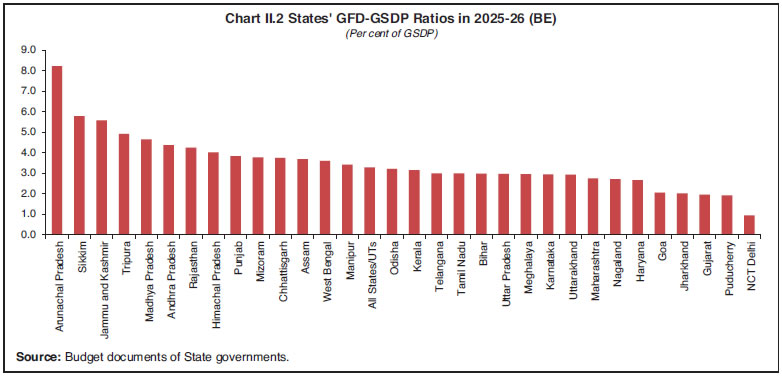
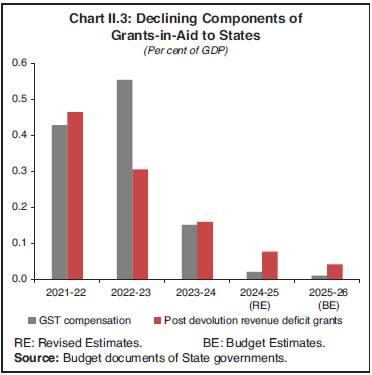
Sources: Budget documents of State governments; and Comptroller and Auditor General of India (CAG). | 2.5 For 2025-26, States have budgeted a GFD-GDP ratio of 3.3 per cent, maintaining the previous year’s level. An increase in revenue collection is expected to be offset by a corresponding rise in spending. While 16 States have budgeted a GFD exceeding 3.0 per cent of their gross state domestic product (GSDP), within these, 13 States have budgeted to surpass 3.5 per cent (Chart II.2). 3. Receipts 2.6 Revenue receipts of the States remained constrained in 2023-24 and 2024-25 due to sharp decline in grants-in-aid3 from the Centre on account of decline in GST compensation and post-devolution revenue deficit grants (Table II.2; Chart II.3). Tax receipts remained strong, largely driven by the robust devolution from the Centre. Non-tax revenues of States - a small component - also registered a marginal increase. 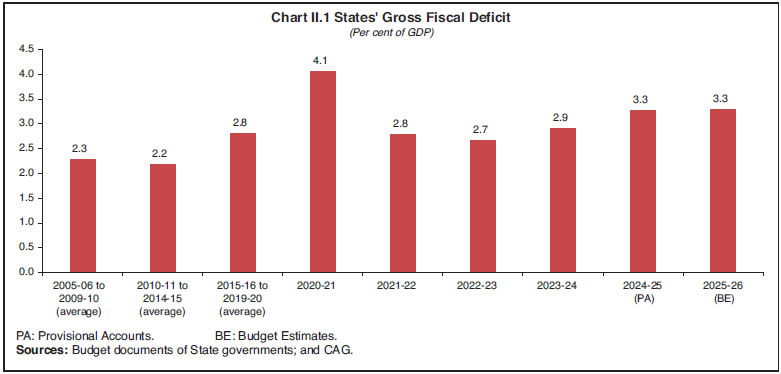
| Table II.2: Aggregate Receipts of State Governments and UTs | | (₹ Lakh crore) | | Item | 2020-21 | 2021-22 | 2022-23 | 2023-24 | 2024-25 (RE) | 2024-25 (PA) | 2025-26 (BE) | | 1 | 2 | 3 | 4 | 5 | 6 | 7 | 8 | | 1. Revenue Receipts (a+b) | 25.9 | 32.3 | 36.5 | 39.3 | 45.8 | 41.7 | 51.3 | | | (13.0) | (13.7) | (13.6) | (13.0) | (13.9) | (12.6) | (14.4) | | a. States’ Own Revenue (i+ii) | 13.5 | 17.2 | 20.4 | 22.7 | 26.1 | - | 29.8 | | | (6.8) | (7.3) | (7.6) | (7.5) | (7.9) | - | (8.4) | | i. States’ Own Tax | 11.7 | 14.7 | 17.6 | 19.5 | 22.3 | - | 25.5 | | | (5.9) | (6.2) | (6.6) | (6.5) | (6.8) | - | (7.1) | | ii. States’ Own Non-Tax | 1.8 | 2.5 | 2.8 | 3.2 | 3.7 | 3.4 | 4.4 | | | (0.9) | (1.0) | (1.0) | (1.1) | (1.1) | (1.0) | (1.2) | | b. Central Transfers (i+ii) | 12.4 | 15.1 | 16.1 | 16.6 | 19.8 | - | 21.5 | | | (6.2) | (6.4) | (6.0) | (5.5) | (6.0) | - | (6.0) | | i. Shareable Taxes | 6.0 | 8.8 | 9.5 | 11.3 | 12.9 | - | 14.2 | | | (3.0) | (3.7) | (3.5) | (3.8) | (3.9) | - | (4.0) | | ii. Grants-in-Aid | 6.4 | 6.2 | 6.6 | 5.3 | 6.9 | 4.5 | 7.2 | | | (3.2) | (2.6) | (2.5) | (1.8) | (2.1) | (1.4) | (2.0) | | 2. Non-Debt Capital Receipts (i+ii) | 0.2 | 0.2 | 0.1 | 0.2 | 0.2 | 0.2 | 0.5 | | | (0.1) | (0.1) | (0.0) | (0.1) | (0.1) | (0.1) | (0.1) | | i. Recovery of Loans and Advances | 0.1 | 0.2 | 0.1 | 0.2 | 0.2 | 0.2 | 0.2 | | | (0.1) | (0.1) | (0.0) | (0.1) | (0.1) | (0.1) | (0.1) | | ii. Miscellaneous Capital Receipts | 0.1 | 0.0 | 0.0 | 0.0 | 0.0 | 0.0 | 0.2 | | | (0.0) | (0.0) | (0.0) | (0.0) | (0.0) | (0.0) | (0.1) | RE: Revised Estimates. PA: Provisional Accounts. BE: Budget Estimates.
Note: 1. Figures in parentheses are per cent of GDP.
2. ‘-’ : not available.
3. Components may not add up to total due to rounding off.
Sources: Budget documents of State governments; and CAG. |
 2.7 States’ own tax base is highly concentrated, with goods and services tax (SGST), sales tax, excise duties, and stamp duties and registration fees together constituting about 90 per cent of total own tax collections (Chart II.4a). Within States’ own tax revenue, the collection varied across components. While growth in SGST and States’ excise duties remained robust, sales tax collection grew modestly in 2023-24 and 2024-25 (Chart II.4b). The efficiency in mobilising stamp duties and registration fees has steadily strengthened since 2021-22, reflecting administrative reforms and digitalisation, albeit with significant inter-State variation (Box II.1). 2.8 For 2025-26, States have budgeted a sharp rise in revenue receipts, underpinned by higher own tax collections and a rebound in grants. As per the Union budget, the tax devolution is expected to increase from 3.9 per cent of GDP in 2024-25 to 4.0 per cent in 2025-26. Non-tax revenue is also expected to improve, backed by a slew of measures across States. Following the Supreme Court’s decision on taxing of minerals, Karnataka has passed a legislation to levy tax on major minerals, in addition to the royalty and expects additional revenue from tax on mines in 2025-26. Rajasthan and West Bengal have announced reforms to bring transparency and start faceless management of mines to improve revenue collection. Rajasthan has proposed to set up a new company ‘Rajasthan Mineral Exploration Limited’ for prospecting of minerals. 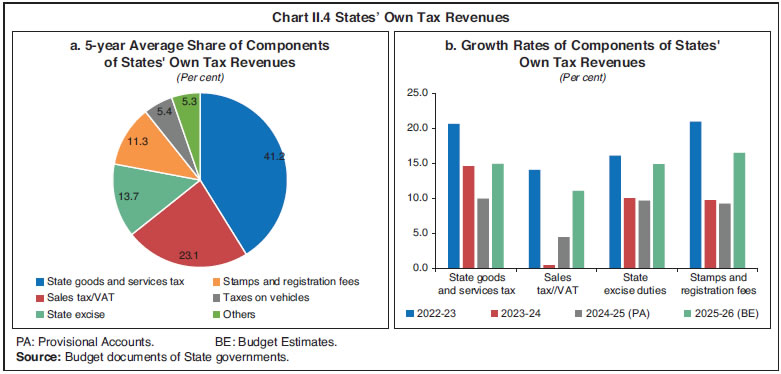
Box II.1: Stamp Duty and Registration Fees: Revenue Efficiency across States It is widely argued that the taxation power of States has declined following the implementation of the goods and services tax (GST), which has subsumed a wide range of their independent indirect taxes, such as value added tax (VAT), sales tax, octroi, and entry tax. Among the current State taxes, most prominent are the sales tax/ VAT on petroleum products, State excise duties on liquor, and stamp duties and registration fees (SDRF) on immovable property transactions. In the post GST period (2017-18 to 2022-23), SDRF collections have recorded a robust average buoyancy of 1.5 - significantly higher than sales tax and excise duties - highlighting its potential to augment fiscal capacity of States (Chart 1). Stamp duty and registration fees in India typically range between 4-10 per cent of the property value, depending on location, property type and buyer category. Nevertheless, a few large States continue to record buoyancy levels below the average, reflecting inter-State disparities and suboptimal mobilisation, often constrained by structural and administrative inefficiencies (Karnik and Raju, 2015; FC-XV). This box analyses (i) the factors influencing SDRF collection, and (ii) the efficiency of SDRF mobilisation over time and across States. 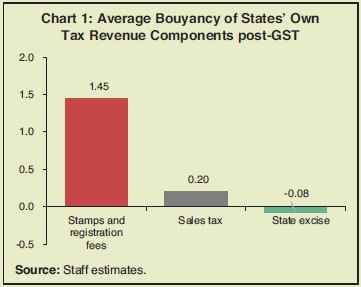 To assess tax efficiency empirically, following Battese and Coelli (1995), a stochastic frontier analysis (SFA)4 is applied to data for 17 major States during the period 2004-05 to 2022-23. The model includes five determinants: gross state domestic product (economic scale), capital outlay (role of public investment in augmenting the tax base), registered factories (industrialisation and depth of the formal sector), bank credit-GSDP ratio (financial penetration), and a debt dummy (debt-GSDP ratio above 25 per cent)5. The debt dummy tests whether higher indebtedness forces greater tax effort, consistent with evidence that debt levels above 25 per cent of GSDP may constrain growth (Bhattacharya et al., 2024). Results indicate that all five variables positively influence SDRF collections (Table 1). Based on the estimated coefficients presented in Table 1, tax capacity (the maximum SDRF revenue a State can achieve, given its economic and fiscal characteristics) is estimated for each State. Next, the tax efficiency of individual States is computed as the ratio of actual tax revenue to the corresponding stochastic tax frontier (tax capacity). Two key observations emerge. First, the average efficiency across States has moved upwards, with a steeper rise after 2021-22 (Chart 2a). This reflects post-pandemic recovery in property transactions, accelerated digitisation of land records, and renewed policy focus on revenue mobilisation. Second, efficiency varies widely across States, ranging from 0.3 to 0.9 (Chart 2b). Better performance in some States is partly attributable to improved digitisation, revision of fair value of land parcels, micro-zoning of ready reckoner values, and rationalised duty structures with targeted incentives. These measures may offer replicable pathways for other States to harness the full potential of this critical revenue source. | Table 1: Results from Stochastic Frontier Analysis | | Explanatory Variable | Dependant Variable: Ln Stamp Duty and Registration Fees | | Coefficient | z-value | | GSDP | 0.669*** | 11.15 | | Capital outlay | 0.181*** | 4.36 | | Number of factories | 0.199*** | 4.16 | | Bank credit share of GSDP | 0.359*** | 4.71 | | Debt burden dummy | 0.096** | 2.16 | | Constant | -5.186*** | -15.71 | | No. of observations | 313 | Notes: (i) *** indicates significance at 1 per cent level.
(ii) ** indicates significance at 5 per cent level.
(iii) All quantative variables are in natural log terms.
Source: Staff estimates. |
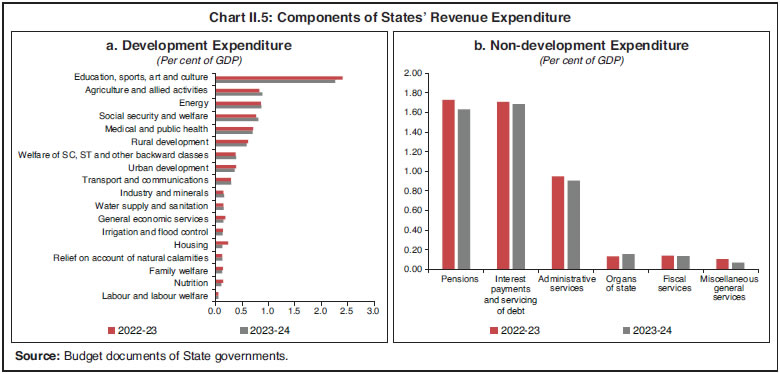
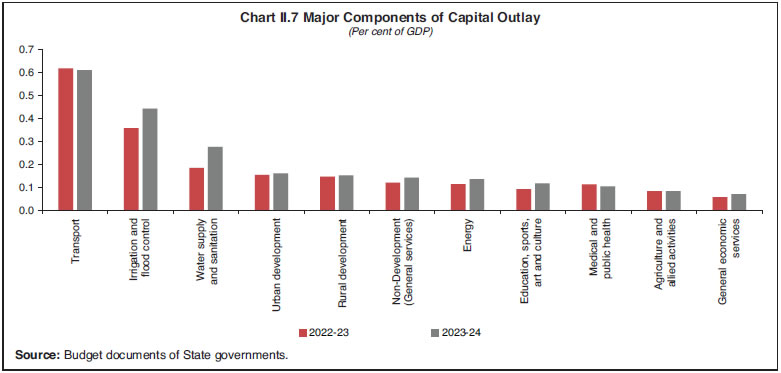
References Aigner, D., Lovell, C. A. K., & Schmidt, P. (1977). Formulation and estimation of stochastic frontier production function models. Journal of Econometrics, 6(1), 21–37. https://doi.org/10.1016/0304-4076(77)90052-5 Battese, G. E., & Coelli, T. J. (1995). A model for technical inefficiency effects in a stochastic frontier production function for panel data. Empirical Economics, 20(2), 325–332. https://doi.org/10.1007/BF01205442 Bhattacharya, R., Prasanth, C., & Rao, R. Kavita. (2024). How much Debt is Optimal for the Major Indian States? Economic Growth vs. Debt Sustainability (NIPFP Working Paper No. 411). National Institute of Public Finance and Policy. Karnik, A. V., & Raju, S. (2015). Efficiency of stamp duty and registration fee collection in Indian states. Indian Economic Journal, 63(1), 98–116. Rayudu, A. (2019). Tax revenue efficiency of Indian states: The case of stamp duty and registration fees. NIPFP Working Paper No. 278. | 2.9 States are increasingly turning to data driven administrative and policy reforms to strengthen revenue mobilisation. Recent initiatives include rationalisation of excise duty structures in Goa and reforms in motor vehicle taxation in Maharashtra. Assam has proposed to set up a Command Control Centre and Data Analytics Unit for better monitoring and enforcement of Excise Act. In addition, several States such as Delhi, Haryana, and Maharashtra have announced amnesty schemes to settle legacy disputes, while Rajasthan has announced additional revenue mobilisation plans through asset monetisation via land pooling, land aggregation and InvITs6. 4. Expenditure Revenue Expenditure 2.10 Revenue expenditure of States has moderated considerably, registering a sustained decline from 14.9 per cent of GDP in 2020-21 to 13.3 per cent in 2024-25 (Table II.3). This moderation has been achieved through expenditure rationalisation without any cut in their social sector spending. 2.11 The moderation in revenue expenditure in 2023-24 was achieved through a reduction in both development and non-development components (Table II.3). Within development expenditure, outlays on education and housing declined from the previous year, while spending on agriculture and social security and welfare increased (Chart II.5a). Non-development expenditure also moderated marginally, supported by lower interest payments and pension outgo (Chart II.5b). 2.12 The revenue expenditure declined further in 2024-25 (PA) but is budgeted to rise to 14.6 per cent of GDP in 2025-26 (Table II.3). Social sector expenditure is expected to be the major driver of revenue expenditure in 2025-26 with a budget estimate of 8.2 per cent of GDP (Chart II.6). Capital Expenditure 2.13 States’ capital expenditure has firmed up steadily since the pandemic, reflecting their growing emphasis on strengthening medium-term economic growth. The increase in spending during 2023-24 was partly supported by the Union Government’s 50-year interest-free loan scheme for capital expenditure, which incentivised States to prioritise asset creation. The composition of spending reveals that the expansion was led by irrigation and water supply projects, supported by continued thrust on transport and urban infrastructure (Chart II.7). | Table II.3: Expenditure Pattern of State Governments and UTs | | (₹ Lakh crore) | | Item | 2020-21 | 2021-22 | 2022-23 | 2023-24 | 2024-25 (RE) | 2024-25 (PA) | 2025-26 (BE) | | 1 | 2 | 3 | 4 | 5 | 6 | 7 | 8 | | Aggregate Expenditure (1+2 or 3+4+5) | 34.2 | 39.0 | 43.9 | 48.3 | 57.7 | 52.8 | 63.6 | | | (17.2) | (16.5) | (16.3) | (16.0) | (17.4) | (16.0) | (17.8) | | 1. Revenue Expenditure | 29.6 | 33.3 | 37.2 | 40.2 | 47.7 | 43.9 | 52.1 | | of which: | (14.9) | (14.1) | (13.8) | (13.4) | (14.4) | (13.3) | (14.6) | | Interest Payments | 3.9 | 4.3 | 4.6 | 5.1 | 5.6 | 5.1 | 6.2 | | | (1.9) | (1.8) | (1.7) | (1.7) | (1.7) | (1.5) | (1.8) | | 2. Capital Expenditure | 4.6 | 5.7 | 6.7 | 8.1 | 9.9 | 8.9 | 11.4 | | of which: | (2.3) | (2.4) | (2.5) | (2.7) | (3.0) | (2.7) | (3.2) | | Capital Outlay | 4.1 | 5.3 | 6.0 | 7.5 | 9.1 | 8.1 | 10.6 | | | (2.1) | (2.3) | (2.2) | (2.5) | (2.7) | (2.4) | (3.0) | | 3. Development Expenditure | 22.6 | 26.0 | 29.5 | 32.7 | 39.9 | - | 43.5 | | | (11.4) | (11.0) | (10.9) | (10.8) | (12.1) | - | (12.2) | | 4. Non-Development Expenditure | 10.6 | 12.0 | 13.3 | 14.5 | 16.4 | - | 18.5 | | | (5.4) | (5.1) | (4.9) | (4.8) | (4.9) | - | (5.2) | | 5. Others* | 0.9 | 1.0 | 1.1 | 1.2 | 1.4 | - | 1.5 | | | (0.4) | (0.4) | (0.4) | (0.4) | (0.4) | - | (0.4) | RE: Revised Estimates. PA: Provisional Accounts. BE: Budget Estimates.
*: Includes grants-in-aid and contributions including compensation and assignments to local bodies.
Notes: 1. Figures in parentheses are per cent of GDP.
2. Capital expenditure includes capital outlay and loans and advances by the State governments.
3. ‘-’ : not available.
4. Components may not add up to total due to rounding off.
Sources: Budget documents of State governments; and CAG. |
 2.14 In 2024-25, States broadly maintained capital expenditure at the previous year’s level. The moderation in spending during the first half of the year due to the Model Code of Conduct before the general elections was offset by a sharp acceleration in the second half, particularly in the fourth quarter. Budget estimates for 2025-26 envisage a further scaling up of capital expenditure to 3.2 per cent of GDP. A text mining analysis of States’ budget speeches also reflects their growing emphasis on infrastructure creation, capital expenditure and fiscal consolidation in recent years (Box II.2). 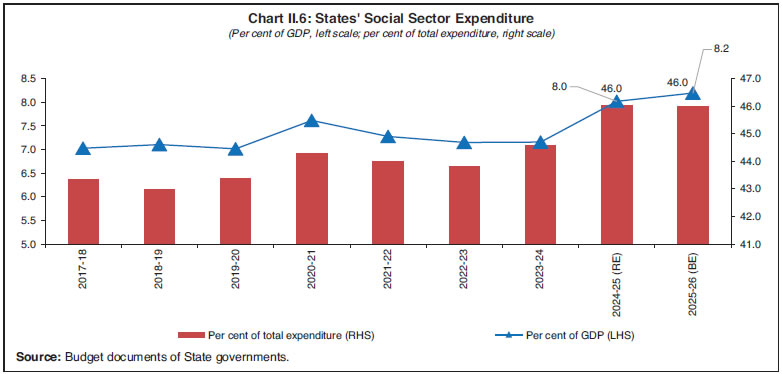
Box II.2: Evolution of States’ Fiscal Priorities: Text Mining of Budget Speeches Budget speeches reflect a government’s policy focus, priorities, and intent. They highlight the areas that policymakers choose to emphasise and the narrative through which developmental objectives are framed. Analysis of these speeches, therefore, can provide valuable insights into the State governments’ policy priorities and complement the conventional, data-based assessment of State finances. To this end, a text-mining framework was applied to a sample of budget speeches for 9 States using two different methods - an unsupervised topic-modelling approach7 and a supervised dictionary-based approach8. While the former is applied to the budget speeches of 2025-26, the latter is applied to the speeches over a period of ten years (2016-17 to 2025-26). Whereas text-as-data techniques are well established in the political economy literature (Grimmer and Stewart, 2013; Gentzkow, Kelly and Taddy, 2019), their application to Indian State budget documents remains limited. This analysis attempts to adapt and tailor these methods to the context of subnational public finance. The Latent Dirichlet Allocation (LDA) analysis for 2025-26 identified four broad fiscal themes. The resulting distribution of these themes indicate that infrastructure development and social welfare are dominant themes across States’ budget speeches, followed by agriculture and education and skill development (Chart 1). A longer-term view, based on the dictionary-based approach indicates that social welfare has consistently remained a key narrative across years, while infrastructure-related discussions have gained greater prominence in the post-pandemic period reflecting the policy focus on expanding capital expenditure. The emphasis on agriculture and rural development has moderated slightly, making space for education and health (Chart 2). There has been a notable transition in the mode of welfare delivery. The narrative has shifted from traditional subsidies and in-kind transfers towards direct benefit transfers (DBTs), as reflected in the rising frequency of terms such as cash assistance, financial support, and income transfer (Chart 3). The emphasis on fiscal prudence spiked during the pandemic years and moderated thereafter (Chart 4). The frequency of words such as discipline, responsibility, and sustainability peaked in 2020-21, amid heightened expenditure pressures. In subsequent years, the narrative shifted from fiscal prudence towards developmental and welfare priorities, although the commitment to fiscal responsibility continues to remain an integral part of State fiscal communication.
In sum, these insights highlight the value of supplementing quantitative analysis with speech content analysis. Tracking the narrative emphasis of budget speeches over time can serve as an early indicator of emerging priorities, provide a window into the political economy of fiscal choices, and help assess the fiscal priorities and policy thrusts across States. References: Grimmer, J., & Stewart, B. M. (2013). “Text as data: The promise and pitfalls of automatic content analysis methods for political texts”. Political Analysis, 21(3), 267-297. Gentzkow, M., Kelly, B., & Taddy, M. (2019). “Text as data”. Journal of Economic Literature, 57(3), 535-574. | 2.15 Different indicators of expenditure quality reflect a steady improvement. The share of capital expenditure in total expenditure (CE-TE) has improved gradually from 13.4 per cent in 2020-21 to 18.0 per cent in 2025-26 (BE) (Chart II.8a). Similarly, the ratio of revenue expenditure to capital outlay (RECO) has declined sharply, reflecting a shift from consumption-oriented spending towards capital formation. Accordingly, the share of revenue deficit in gross fiscal deficit has decreased from 46.1 per cent in 2020-21 to 6.9 per cent in 2025-26 (BE), indicating that a larger portion of borrowing is being deployed for productive investment (Chart II.8b). 2.16 The release of funds under the Centre’s Scheme for Special Assistance to States for Capital Investment has followed an upward trajectory since its inception in 2020-21. In 2024-25, against the budgeted allocation of ₹1.5 lakh crore, nearly the entire amount (₹1,49,484 crore or 99.7 per cent) was disbursed. The scheme has been instrumental in inducing reforms as most States availed the tied component by meeting the prescribed reform conditionalities (Chart II.9). Expenditure on Research and Development 2.17 Investments in science and technology are vital for building a nation’s capabilities to address developmental challenges and for securing its strategic future. State governments’ expenditure on research and development (R&D) however, has been limited. Available data for 11 States and UTs9 indicate that their consolidated expenditure on R&D is around 0.2 - 0.3 per cent of GSDP in recent years (2021-22 to 2025-26), with wide spatial variations (Annex II.1). The R&D expenditure of States has primarily been dominated by medical, health, family welfare, sanitation and agricultural research. Over time, the proportion of infrastructure and education related R&D spending has increased, while that of agricultural research has declined (Chart II.10).
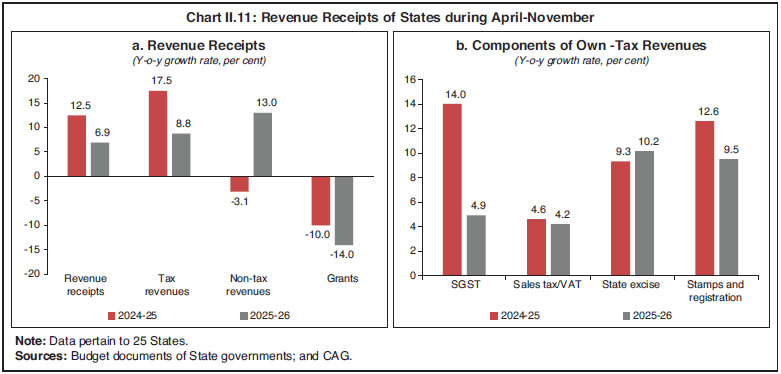
5. Actual Outcome in 2025-26 so far and Outlook 2.18 According to the provisional data for April-November 2025-26, States’ GFD remained lower at 42.8 per cent of BE as against 45.5 per cent in the corresponding period of the previous year. 2.19 The growth in revenue receipts moderated reflecting a slowdown in tax collections and a contraction in grants from the Centre, even as non-tax revenues expanded (Chart II.11a). Within own tax sources, most of the major components except State excise duties registered a loss of momentum (Chart II.11b). 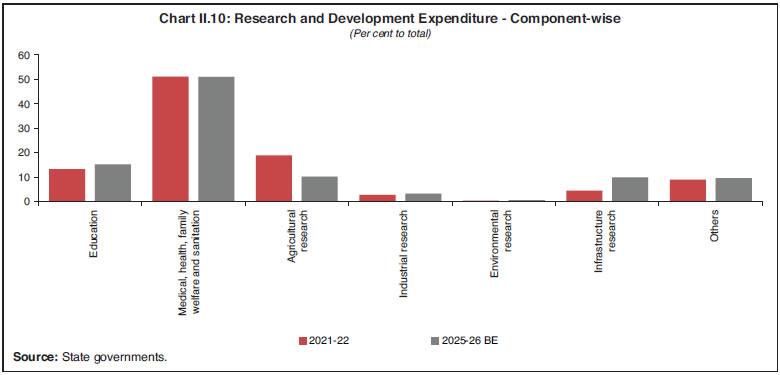
 2.20 States’ revenue expenditure grew by 6.6 per cent during April-November 2025-26, slower than last year (Chart II.12). Capital expenditure grew by 8.7 per cent during April-November 2025-26. As of October 21, 2025, the Centre has released ₹48,903 crore under the ‘Scheme for Special Assistance to States for Capital Investment’ roughly one-third of the ₹1.5 lakh crore allocated for the year. While the rollout has been relatively slow in the first half, disbursements are likely to gain momentum in the remaining months. The Centre has relaxed conditionalities under the scheme and enhanced the untied portion of loans, thereby providing States greater flexibility to accelerate project implementation and strengthen the quality of fiscal spending. 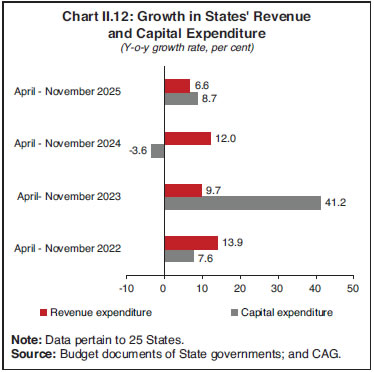 2.21 The fiscal outlook for States for the second half of the year remains positive. The temporary revenue loss on account of GST rate rationalisation may be offset by higher private consumption in the coming months. During April-November 2025-26, States’ revenue expenditure grew by 6.6 per cent as against the budgeted 19 per cent. If a similar trend continues, the States are likely to contain their revenue expenditure below the budgeted level. In contrast, Capital outlays are expected to gain momentum in the latter half of the year, aided by the relaxation of conditionalities under the 50-year interest-free loan scheme for capital investment. On balance, States are likely to keep their fiscal deficits within their budget estimates. 6. Financing GFD and Market Borrowings by State Governments and UTs GFD Financing 2.22 Historically, up to 2016-17, market loans financed a little over half of the consolidated GFD of States. Thereafter, States’ reliance on market borrowings has risen steadily. In 2025-26 (BE), market borrowings are expected to finance about 76 per cent of the consolidated GFD of States. In the post-COVID period, loans from Centre have assumed a larger role, primarily on account of back-to-back GST compensation loans and the 50-year interest-free loans provided for capital expenditure. In contrast, the share of loans from other sources, such as financial institutions, public accounts, and the national small savings fund (NSSF), has declined persistently, with only three States and one UT10 currently availing NSSF loans. Market Borrowings 2.23 During 2024-25, the gross market borrowing of States and UTs increased by 6.6 per cent to ₹10.73 lakh crore from ₹10.07 lakh crore in 2023-24. This expansion was much lower than the growth of 32.8 per cent recorded in the previous year (Table II.5). It is observed that market borrowings is not uniform throughout the year. As observed in the past, States continue to borrow more in the last quarter of financial year (Chart II.13). 2.24 At a disaggregated level, all major States except Bihar, Chhattisgarh, Goa, Punjab, and Uttar Pradesh saw an increase in market borrowings (Table II.4). Uttar Pradesh registered significant decline in gross borrowings in 2024-25. North-Eastern and hilly States11 along with UTs contributed 5.6 per cent to the total gross borrowings in 2024-25, as compared to 5.9 per cent in the previous year. 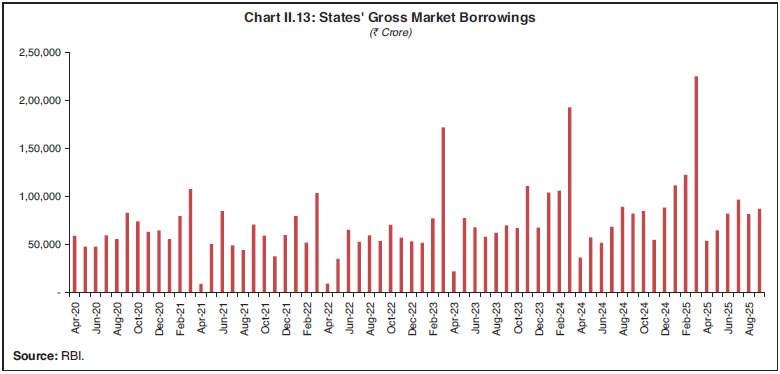
| Table II.4 Gross Market Borrowings across States | | (₹ Crore) | | States | 2022-23 | 2023-24 | 2024-25 | | 1 | 2 | 3 | 4 | | Andhra Pradesh | 57,478 | 68,400 | 78,205 | | Arunachal Pradesh | 559 | 902 | 1,010 | | Assam | 17,100 | 18,500 | 19,000 | | Bihar | 36,800 | 47,612 | 47,546 | | Chhattisgarh | 2,000 | 32,000 | 24,500 | | Goa | 1,350 | 2,550 | 1,050 | | Gujarat | 43,000 | 30,500 | 38,200 | | Haryana | 45,158 | 47,500 | 49,500 | | Himachal Pradesh | 14,000 | 8,072 | 7,359 | | Jammu & Kashmir UT | 8,473 | 16,337 | 13,170 | | Jharkhand | 4,000 | 1,000 | 3,500 | | Karnataka | 36,000 | 81,000 | 92,025 | | Kerala | 30,839 | 42,438 | 53,666 | | Madhya Pradesh | 40,158 | 38,500 | 63,400 | | Maharashtra | 72,000 | 1,10,000 | 1,23,000 | | Manipur | 1,422 | 1,426 | 1,500 | | Meghalaya | 1,753 | 1,364 | 1,882 | | Mizoram | 1,315 | 901 | 1,169 | | Nagaland | 1,854 | 2,551 | 1,550 | | Odisha | 0 | 0 | 20,780 | | Puducherry | 1,200 | 1,100 | 1,600 | | Punjab | 45,500 | 42,386 | 40,828 | | Rajasthan | 46,057 | 73,624 | 75,185 | | Sikkim | 1,414 | 1,916 | 1,951 | | Tamil Nadu | 87,000 | 1,13,001 | 1,23,625 | | Telangana | 40,150 | 49,618 | 56,209 | | Tripura | 0 | 0 | 0 | | Uttar Pradesh | 55,612 | 97,650 | 45,000 | | Uttarakhand | 3,200 | 6,300 | 10,400 | | West Bengal | 63,000 | 69,910 | 76,500 | | Grand Total | 7,58,392 | 10,07,058 | 10,73,310 | | Source: RBI. | 2.25 For 2025-26, States have budgeted their gross market borrowings at ₹12.45 lakh crore. As at end-September 2025, they had raised ₹4.67 lakh crore, which was 37.5 per cent of the budgeted amount and 21 per cent higher than the corresponding period of the previous year (Chart II.14). 2.26 The net market borrowing of States/UTs increased by 5.0 per cent to ₹7.53 lakh crore in 2024-25 from ₹7.17 lakh crore in 2023-24 (Table II.5). 2.27 There were 835 issuances in 2024-25, of which 100 were re-issuances (12.0 per cent) as compared with 782 issuances in 2023-24 with 49 re-issuances (6.3 per cent). Chhattisgarh, Jammu and Kashmir, Karnataka, Maharashtra, Puducherry, Punjab, Rajasthan, Tamil Nadu, Uttar Pradesh and West Bengal undertook reissuances during the year. During 2025-26 (up to end-September 2025), there were 72 re-issuances out of 405 total issuances. | Table II.5 Market Borrowings of State Governments | | (₹ Crore) | | Item | 2021-22 | 2022-23 | 2023-24 | 2024-25 | 2025-26* | | 1 | 2 | 3 | 4 | 5 | 6 | | Maturities during the year | 2,09,143 | 2,39,562 | 2,89,918 | 3,19,965 | 3,72,543# | | Gross sanction under Article 293(3) | 8,95,166 | 8,80,779 | 11,29,295 | 11,73,714 | 8,85,443 | | Gross amount raised during the year | 7,01,626 | 7,58,392 | 10,07,058 | 10,73,310 | 4,66,692 | | Net amount raised during the year | 4,92,483 | 5,18,830 | 7,17,140 | 7,53,345 | 3,21,992 | | Amount raised during the year to total sanctions (per cent) | 78.4 | 86.1 | 89.2 | 91.4 | 52.7 | | Weighted average yield of SGSs (per cent) | 7.0 | 7.7 | 7.5 | 7.2 | 7.0 | | Weighted average spread over corresponding G-Sec (bps) | 41 | 31 | 31 | 30 | 38 | | Average inter-State spread (bps) | 4 | 3 | 3 | 4 | 5 | | Source: RBI. *: up to end-September 2025. #: For the period 2025-26. |
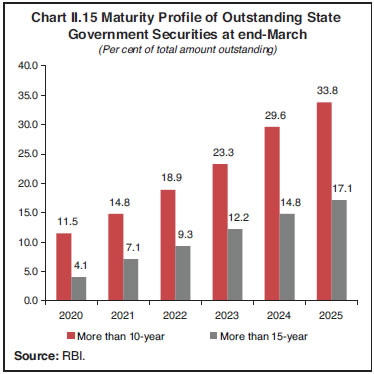 2.28 The maturity structure of State Government Securities (SGSs) has witnessed a gradual elongation in recent years, with the share of SGS with maturity of more than 10 years and 15 years in total outstanding SGSs increasing steadily (Chart II.15). SGSs with 10-year maturity accounted for 14.5 per cent of the total amount of issuances in 2024-25 down from 20.3 per cent a year ago. The remaining 85.5 per cent was spread across maturities ranging between 2 and 35 years. Few States viz., Kerala, Tamil Nadu, Telangana and Jammu and Kashmir have consciously made efforts in issuing SGSs of more than 20 years. As at end-March 2025, 7.2 per cent of outstanding SGSs had a maturity of more than 20 years (Table II.6) | Table II.6: Maturity Profile of Outstanding State Government Securities | | (As at end-March 2025) | | (Per cent of total amount outstanding) | | State/UT | less than 1 Year | 1 to 5 Years | 5 to 10 Years | 10 to 20 Years | Above 20 Years | | 1 | 2 | 3 | 4 | 5 | 6 | | Andhra Pradesh | 4.6 | 17.1 | 27.0 | 47.8 | 3.5 | | Arunachal Pradesh | 1.8 | 46.6 | 37.9 | 13.7 | 0.0 | | Assam | 5.9 | 31.7 | 53.6 | 8.8 | 0.0 | | Bihar | 7.2 | 31.4 | 44.8 | 16.7 | 0.0 | | Chhattisgarh | 9.3 | 42.8 | 46.0 | 1.9 | 0.0 | | Goa | 7.6 | 40.7 | 45.7 | 6.1 | 0.0 | | Gujarat | 8.6 | 50.3 | 40.2 | 1.0 | 0.0 | | Haryana | 6.5 | 25.4 | 33.9 | 34.2 | 0.0 | | Himachal Pradesh | 5.2 | 26.0 | 38.7 | 30.1 | 0.0 | | Jammu and Kashmir | 3.1 | 30.2 | 17.8 | 21.0 | 27.9 | | Jharkhand | 10.6 | 41.1 | 36.7 | 11.7 | 0.0 | | Karnataka | 4.5 | 27.5 | 37.3 | 30.7 | 0.0 | | Kerala | 6.6 | 25.2 | 16.3 | 29.6 | 22.3 | | Madhya Pradesh | 5.6 | 21.4 | 23.9 | 40.4 | 8.7 | | Maharashtra | 5.5 | 25.8 | 43.2 | 23.4 | 2.0 | | Manipur | 5.2 | 33.4 | 36.2 | 25.2 | 0.0 | | Meghalaya | 9.0 | 41.2 | 44.6 | 5.3 | 0.0 | | Mizoram | 3.0 | 23.1 | 30.9 | 43.0 | 0.0 | | Nagaland | 6.6 | 28.0 | 65.4 | 0.0 | 0.0 | | Odisha | 5.9 | 24.9 | 31.2 | 32.2 | 5.9 | | Puducherry | 8.3 | 35.0 | 38.9 | 17.8 | 0.0 | | Punjab | 4.9 | 21.1 | 25.7 | 44.2 | 4.1 | | Rajasthan | 7.6 | 28.2 | 36.0 | 20.0 | 8.3 | | Sikkim | 4.7 | 29.6 | 65.7 | 0.0 | 0.0 | | Tamil Nadu | 5.6 | 27.0 | 33.9 | 11.0 | 22.4 | | Telangana | 4.6 | 13.3 | 12.3 | 41.6 | 28.2 | | Tripura | 6.1 | 70.3 | 7.5 | 16.1 | 0.0 | | Uttar Pradesh | 5.8 | 36.7 | 40.8 | 16.6 | 0.0 | | Uttarakhand | 8.6 | 43.9 | 47.4 | 0.0 | 0.0 | | West Bengal | 4.5 | 21.8 | 20.8 | 49.5 | 3.4 | | All States and UTs | 5.8 | 27.5 | 32.9 | 26.6 | 7.2 | | Source: RBI. | 2.29 The weighted average yield (WAY) of SGSs fell to 7.2 per cent in 2024-25 from 7.5 per cent in 2023-24. The weighted average spread (WAS) over comparable Central Government Securities (CGSs) fell to 30 bps in 2024-25 from 31 bps in 2023-24 while the inter-State spread on 10-year tenor securities rose to 4 bps in 2024-25 from 3 bps in 2023-24 (Table II.5). In H1:2025-26, yields have hardened due to both domestic and global factors (Chart II.16). Financial Accommodation to States 2.30 Based on the recommendations made by the Group (consisting of select States Finance Secretaries) constituted by the Reserve Bank, Ways and Means Advances (WMA) limits of the States/UTs were revised up from July 01, 2024, to ₹60,118 crore from ₹47,010 crore. States/UTs can avail overdraft (OD) for 14 consecutive days and can be in OD for a maximum number of 36 days in a quarter. During 2024-25, 16 States/UTs availed Special Drawing Facility (SDF), 13 States/ UTs resorted to WMA, and 9 States/UTs availed OD. Cash Management of State Governments 2.31 As on March 31, 2025, States/UTs on an aggregate basis maintained a surplus that was invested in Intermediate Treasury Bills (ITBs) and Auction Treasury Bills (ATBs) (Table II.7). States’ Reserve Funds 2.32 Given the increasing borrowing requirements of the States and their contingent liabilities, it is desirable to keep adequate buffers to minimise the potential fiscal stress that could arise from redemption pressure and unforeseen liabilities. States maintain Consolidated Sinking Fund (CSF) and Guarantee Redemption Fund (GRF) with the Reserve Bank as a buffer for repayment of their future and contingent liabilities. States can also avail SDF at a discounted rate from the Reserve Bank against funds invested in CSF and GRF. As on March 31, 2025, 25 States and two UTs had set up CSF. Similarly, 21 States and one UT had become members of GRF. Outstanding investments in CSF and GRF stood at ₹2,40,348 crore and ₹16,019 crore, respectively, at end-March 2025, as against ₹2,06,441 crore and ₹12,259 crore, respectively, at end-March 2024 (Table II.8). | Table II.7: State Governments’ Investments in Treasury Bills | | (Outstanding as on March 31) | | (₹ Crore) | | Item | 2021 | 2022 | 2023 | 2024 | 2025 | | 1 | 2 | 3 | 4 | 5 | 6 | | 14-Day (ITBs) ATBs | 2,05,230 41,293 | 2,16,272 87,400 | 2,12,758 58,913 | 2,66,805 51,258 | 1,88,072 88,781 | | Total | 2,46,523 | 3,03,672 | 2,71,671 | 3,18,063 | 2,76,853 | | Source: RBI | 7. Outstanding Liabilities 2.33 The consolidated debt of States declined to 28.1 per cent of GDP at end-March 2024, from a peak of 31 per cent at end-March 2021 (Table II.9). The improvement reflects both fiscal consolidation efforts and favourable debt dynamics, as robust nominal GDP growth during 2021-23 outpaced the increase in debt stock, leading to a gradual correction in the debt ratio. The outstanding debt stock is budgeted to increase again to 29.2 per cent of GDP by end-March 2026. Disaggregated data of major States indicate that the debt-GSDP ratio ranges between 17.8 per cent and 46.3 per cent at end-March 2026 with several of them having debt levels above 30 per cent of GSDP. The elevated debt levels necessitate a clear, transparent, and time bound glide path for debt consolidation by States. 2.34 In terms of composition, States’ outstanding debt continues to be dominated by market borrowings. Its share has risen steadily over time and is budgeted at 69 per cent by end-March 2026 (Table II.10). This increasing reliance on market borrowings reflects the progressive deepening of the market for SGS and gradual substitution away from other liabilities. Loans from the Centre have also gained prominence in recent years, primarily due to the Special Assistance Scheme for Capital Investment, which provides 50-year interest-free loans aimed at fostering productive investment and infrastructure creation. In contrast, the shares of NSSF loans and public account liabilities have declined. | Table II.8: Investment in CSF/GRF by States/UTs (March 31, 2025) | | (₹ Crore) | | State/UT | CSF | GRF | CSF as per cent of Outstanding Liabilities | | 1 | 2 | 3 | 4 | | Andhra Pradesh | 1,17,30 | 1,155 | 2.1 | | Arunachal Pradesh | 2,786 | 7 | 10.9 | | Assam | 7,487 | 92 | 4.2 | | Bihar | 12,660 | - | 3.4 | | Chhattisgarh | 8,345 | 497 | 5.0 | | Goa | 1,095 | 463 | 3.1 | | Gujarat | 15,494 | 675 | 3.3 | | Haryana | 2,651 | 1,731 | 0.7 | | Himachal Pradesh | - | - | - | | Jammu & Kashmir UT | 37 | 36 | 0.04 | | Jharkhand | 2,440 | - | 1.9 | | Karnataka | 20,556 | 760 | 2.8 | | Kerala | 3,273 | - | 0.7 | | Madhya Pradesh | - | 1,292 | - | | Maharashtra | 72,804 | 2,182 | 8.6 | | Manipur | 70 | 142 | 0.3 | | Meghalaya | 1,291 | 110 | 5.5 | | Mizoram | 510 | 81 | 3.8 | | Nagaland | 1,915 | 47 | 8.7 | | Odisha | 18,543 | 2,073 | 9.5 | | Puducherry UT | 588 | - | 4.3 | | Punjab | 9,257 | 0 | 2.4 | | Rajasthan | 1,818 | - | 0.3 | | Tamil Nadu | 3,479 | - | 0.4 | | Telangana | 8,019 | 1,757 | 1.8 | | Tripura | 1,337 | 30 | 5.0 | | Uttarakhand | 5,372 | 262 | 5.6 | | Uttar Pradesh | 12,799 | 1,578 | 1.5 | | West Bengal | 13,993 | 1,049 | 1.9 | | Total | 2,40,348 | 16,019 | 2.6 | ‘-’: Indicates no fund is maintained.
Note: 1. UT of J&K became a member to CSF/GRF post March 31, 2024.
2. Rajasthan became a member to CSF post March 31, 2024.
3. Total may not add due to rounding off.
Source: RBI. |
| Table II.9: Outstanding Liabilities of State Governments and UTs | | Year | Amount | Annual Growth | Debt /GDP | | (End-March) | (₹ Lakh crore) | (Per cent) | | 1 | 2 | 3 | 4 | | 2015 | 27.43 | 9.3 | 22.0 | | 2016 | 32.59 | 18.8 | 23.7 | | 2017 | 38.59 | 18.4 | 25.1 | | 2018 | 42.92 | 11.2 | 25.1 | | 2019 | 47.87 | 11.5 | 25.3 | | 2020 | 53.51 | 11.8 | 26.6 | | 2021 | 61.55 | 15.0 | 31.0 | | 2022 | 68.76 | 11.7 | 29.1 | | 2023 | 75.93 | 10.4 | 28.2 | | 2024 | 84.66 | 11.5 | 28.1 | | 2025 (RE) | 93.86 | 10.9 | 28.4 | | 2026 (BE) | 104.28 | 11.1 | 29.2 | RE: Revised Estimates. BE: Budget Estimates.
Sources: 1. Budget documents of State governments.
2. Combined finance and revenue accounts of the Union and the State governments in India, Comptroller and Auditor General (CAG) of India.
3. Ministry of Finance, Government of India.
4. Reserve Bank records.
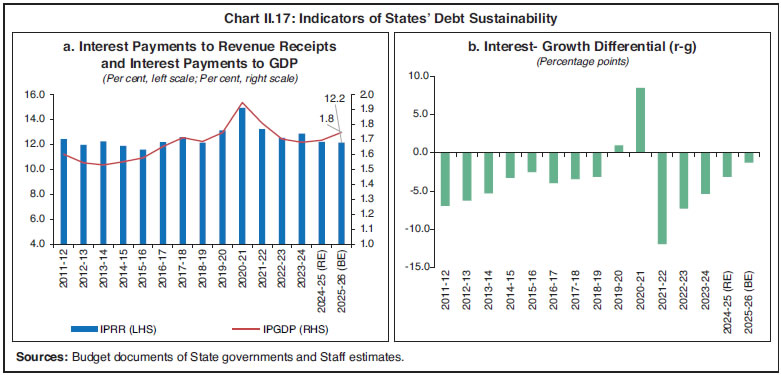
5. Finance accounts of the Union government, Government of India. | 2.35 Notwithstanding elevated debt levels, the burden of interest payments relative to GDP (IP-GDP) has remained broadly stable, fluctuating within a narrow range of 1.5-1.9 per cent during 2011-12 to 2025-26 (Chart II.17a). The interest payments-to-revenue receipts (IP-RR) ratio has improved in the post-COVID period, as revenue mobilisation outpaced the growth in interest obligations, thereby enhancing debt-servicing capacity. While, the interest-growth differential (r-g) continues to be negative, the gap is narrowing (Chart II.17b). | Table II.10: Composition of Outstanding Liabilities of State Governments and UTs | | (As at end-March) | | (Per cent) | | Item | 2020 | 2021 | 2022 | 2023 | 2024 | 2025 RE | 2026 BE | | 1 | 2 | 3 | 4 | 5 | 6 | 7 | 8 | | Total Liabilities (1 to 4) | 100.0 | 100.0 | 100.0 | 100.0 | 100.0 | 100.0 | 100.0 | | 1. Internal Debt | 73.5 | 74.0 | 73.0 | 72.5 | 73.4 | 74.0 | 75.0 | | of which: | | | | | | | | | (i) Market Loans | 57.2 | 60.5 | 61.6 | 62.9 | 65.2 | 67.1 | 69.0 | | (ii) Special Securities Issued to NSSF | 7.7 | 6.1 | 5.1 | 4.1 | 3.3 | 2.7 | 2.1 | | (iii) Loans from Banks and Financial Institutions | 4.8 | 4.2 | 3.8 | 3.5 | 3.3 | 3.1 | 2.8 | | 2. Loans and Advances from the Centre | 3.0 | 5.1 | 7.2 | 7.7 | 7.4 | 8.5 | 9.2 | | 3. Public Account (i to iii) | 23.4 | 20.8 | 19.7 | 19.7 | 19.1 | 17.5 | 15.7 | | (i) State PF, etc. | 9.8 | 8.8 | 8.4 | 7.9 | 7.3 | 6.8 | 6.4 | | (ii) Reserve Funds | 3.8 | 3.4 | 3.4 | 3.8 | 4.0 | 3.5 | 3.1 | | (iii) Deposits & Advances | 9.7 | 8.6 | 7.9 | 8.0 | 7.8 | 7.1 | 6.3 | | 4. Contingency Fund | 0.1 | 0.1 | 0.1 | 0.1 | 0.1 | 0.1 | 0.1 | RE: Revised Estimates. BE: Budget Estimates.
Sources: 1. Budget documents of State governments.
2. Combined finance and revenue accounts of the Union and the State governments in India, Comptroller and Auditor General (CAG) of India.
3. Ministry of Finance, Government of India.
4. Reserve Bank records.
5. Finance accounts of the Union government, Government of India. |
 2.36 The concessional nature of interest-free loans from the Centre, has been instrumental in containing debt-servicing pressures. During 2024-25, fiscal deficit aggregating to 0.5 per cent of GDP was financed through 50-year, interest-free loans from the Centre, which dampens debt-servicing costs and channels borrowing into productive capital formation (Chart II.18). Contingent Liabilities 2.37 Outstanding guarantees of States increased from 2 per cent of GDP at end-March 2017 to 3.9 per cent at end-March 2024 (Table II.11). Data from 18 States and UTs indicate that outstanding guarantees increased by 6.9 per cent at end-March 2025. | Table II.11: Guarantees Issued by State Governments | | Year (End-March) | Outstanding Guarantees | | ₹ Lakh crore | As per cent of GDP | | 1 | 2 | 3 | | 2015 | 4.28 | 3.4 | | 2016 | 3.64 | 2.6 | | 2017 | 3.12 | 2.0 | | 2018 | 4.29 | 2.5 | | 2019 | 5.38 | 2.8 | | 2020 | 6.33 | 3.2 | | 2021 | 7.79 | 3.9 | | 2022 | 9.21 | 3.9 | | 2023 | 10.31 | 3.8 | | 2024 | 11.60 | 3.9 | | Sources: State governments; and CAG. | 8. Conclusion 2.38 After remaining below 3 per cent of GDP for three successive years during 2021-22 to 2023-24, the consolidated GFD of States widened to 3.3 per cent of GDP in 2024-25. The deficit exceeding 3 per cent mainly reflects 50-year interest free loans from the Centre under Special Assistance to States for Capital Insvestment, which is over and above the normal net borrowing ceiling of the States. States’ quality of expenditure improved with higher capital outlay and social sector expenditure. Going forward, the temporary revenue loss on account of GST rate rationalisation is expected to be offset by higher private consumption. Similarly, higher capital outlay is likely to be offset by moderation in revenue expenditure. On balance, States are likely to achieve their budgetary targets. 2.39 The outstanding liabilities of States have remained sticky downwards, partly reflecting an increase in loans from the Centre in lieu of GST compensation and 50-years interest free loans under scheme for Special Assistance to States for Capital Investment. Given the interest free nature of these loans, despite overall increase in the debt level, there will be no commensurate increase in debt-servicing pressure.
| Annex II.1: States’ Expenditure on Research and Development (R&D) | | (₹ Crore) | | Item | 2021-22 | 2022-23 | 2023-24 | 2024-25 (RE) | 2025-26 (BE) | | 1 | 2 | 3 | 4 | 5 | 6 | | Arunachal Pradesh | | Total R&D (a to g) | 1,289.9 | 1,224.2 | 2,266.5 | 2,051.4 | 2,058.7 | | | (3.9) | (3.5) | (5.8) | (4.4) | (4.0) | | a. Education | - | - | - | - | - | | b. Medical, Health, Family Welfare and Sanitation | 1,289.1 | 1,223.1 | 2,265.4 | 2,050.3 | 2,057.3 | | c. Agricultural Research | 0.4 | 0.5 | 0.5 | 0.5 | 0.6 | | d. Industrial Research | - | - | - | - | - | | e. Environmental Research | 0.4 | 0.6 | 0.6 | 0.6 | 0.7 | | f. Infrastructure Research | 1.7 | 1.5 | 1.8 | 2.0 | - | | g. Others | - | - | - | - | - | | Bihar | | Total R&D (a to g) | - | 291.3 | 398.0 | 427.3 | 375.6 | | | - | (0.0) | (0.0) | (0.0) | (0.0) | | a. Education | - | 61.2 | 189.7 | 64.5 | 68.1 | | b. Medical, Health, Family Welfare and Sanitation | - | 0.7 | 0.7 | 9.0 | 16.0 | | c. Agricultural Research | - | 101.0 | 37.2 | 51.7 | 60.5 | | d. Industrial Research | - | - | - | - | - | | e. Environmental Research | - | - | - | - | - | | f. Infrastructure Research | - | 62.1 | 95.9 | 130.4 | 82.7 | | g. Others | - | 66.4 | 74.4 | 171.7 | 148.3 | | Chhattisgarh | | Total R&D (a to g) | 764.1 | 1,396.0 | 1,287.5 | 2,516.4 | 2,984.6 | | | (0.2) | (0.3) | (0.3) | (0.4) | (0.5) | | a. Education | 8.4 | 8.8 | 8.2 | 20.0 | 21.4 | | b. Medical, Health, Family Welfare and Sanitation | 325.9 | 404.3 | 584.8 | 950.8 | 1,144.3 | | c. Agricultural Research | 246.6 | 235.4 | 299.6 | 472.1 | 544.8 | | d. Industrial Research | 1.2 | 1.6 | 1.9 | 6.3 | 53.0 | | e. Environmental Research | 4.15 | 7.8 | 7.7 | 88.2 | 39.2 | | f. Infrastructure Research | 165.7 | 727.6 | 372.1 | 955.5 | 1,146.1 | | g. Others | 12.2 | 10.5 | 13.2 | 23.6 | 35.7 | | Haryana | | Total R&D (a to g) | 73.4 | 83.7 | 83.7 | 91.0 | 27.9 | | | (0.0) | (0.0) | (0.0) | (0.0) | (0.0) | | a. Education | 10.4 | 23.3 | 21.9 | 25.5 | 26.9 | | b. Medical, Health, Family Welfare and Sanitation | 1.0 | 0.3 | 0.3 | 0.0 | 0.1 | | c. Agricultural Research | 56.3 | 57.2 | 60.9 | 63.7 | 0.0 | | d. Industrial Research | 0.0 | 0.0 | 0.0 | 1.2 | 0.0 | | e. Environmental Research | 5.7 | 2.9 | 0.7 | 0.5 | 0.9 | | f. Infrastructure Research | - | - | - | - | - | | g. Others | 0.0 | 0.0 | 0.0 | 0.2 | 0.0 | | Himachal Pradesh | | Total R&D (a to g) | 1,047.1 | 1,479.4 | 1,300.5 | 1,549.8 | 1,403.1 | | | (0.6) | (0.8) | (0.6) | (0.7) | (0.5) | | a. Education | 2.9 | 3.4 | 2.8 | 3.0 | 3.3 | | b. Medical, Health, Family Welfare and Sanitation | 781.2 | 1,168.6 | 1,030.3 | 1,284.7 | 1,158.4 | | c. Agricultural Research | 244.6 | 292.4 | 257.4 | 247.8 | 234.5 | | d. Industrial Research | 0.5 | 0.6 | 0.5 | 0.6 | 0.5 | | e. Environmental Research | 2.40 | 1.2 | 0.9 | 0.7 | 0.1 | | f. Infrastructure Research | 0.0 | 0.2 | 0.0 | 0.0 | 0.0 | | g. Others | 15.6 | 13.2 | 8.6 | 13.0 | 6.4 | | Jammu and Kashmir | | Total R&D (a to g) | 80.5 | 113.9 | 74.0 | 106.8 | 52.0 | | | (0.0) | (0.1) | (0.0) | (0.0) | (0.0) | | a. Education | 4.8 | 1.4 | 0.1 | 0.6 | 0.1 | | b. Medical, Health, Family Welfare and Sanitation | 0.6 | 0.5 | 0.1 | 0.1 | 1.1 | | c. Agricultural Research | 60.2 | 76.5 | 44.6 | 50.1 | 14.8 | | d. Industrial Research | 0.0 | 0.0 | 0.0 | 0.0 | 0.0 | | e. Environmental Research | 2.9 | 4.5 | 4.7 | 5.2 | 5.6 | | f. Infrastructure Research | 7.3 | 27.9 | 17.9 | 44.4 | 22.5 | | g. Others | 4.6 | 3.1 | 6.7 | 6.4 | 7.9 | | Kerala | | Total R&D (a to g) | - | - | - | - | 4,039.4 | | | - | - | - | - | (0.28) | | a. Education | - | - | - | - | 1,810.2 | | b. Medical, Health, Family Welfare and Sanitation | - | - | - | - | 1,015.0 | | c. Agricultural Research | - | - | - | - | 566.9 | | d. Industrial Research | - | - | - | - | 370.2 | | e. Environmental Research | - | - | - | - | 16.3 | | f. Infrastructure Research | - | - | - | - | 87.4 | | g. Others | - | - | - | - | 173.4 | | Nagaland | | Total R&D (a to g) | 0.8 | 0.9 | 0.9 | 0.9 | 0.9 | | | (0.0) | (0.0) | (0.0) | (0.0) | (0.0) | | a. Education | 0.1 | 0.1 | 0.1 | 0.1 | 0.1 | | b. Medical, Health, Family Welfare and Sanitation | 0.2 | 0.2 | 0.3 | 0.3 | 0.3 | | c. Agricultural Research | 0.1 | 0.1 | 0.1 | 0.1 | 0.1 | | d. Industrial Research | 0.0 | 0.0 | 0.0 | 0.0 | 0.0 | | e. Environmental Research | 0.1 | 0.1 | 0.1 | 0.1 | 0.1 | | f. Infrastructure Research | 0.3 | 0.3 | 0.3 | 0.3 | 0.3 | | g. Others | 0.1 | 0.1 | 0.1 | 0.1 | 0.1 | | Odisha | | Total R&D (a to g) | 550.7 | 879.5 | 1,602.8 | 2,702.0 | 2,517.9 | | | (0.0) | (0.0) | (0.1) | (0.1) | (0.1) | | a. Education | 195.3 | 296.7 | 562.2 | 1,237.1 | 1,116.3 | | b. Medical, Health, Family Welfare and Sanitation | 29.8 | 69.2 | 95.0 | 131.2 | 152.2 | | c. Agricultural Research | 96.6 | 123.8 | 214.4 | 243.7 | 258.1 | | d. Industrial Research | 2.0 | 3.1 | 23.1 | 92.2 | 43.0 | | e. Environmental Research | 12.9 | 29.8 | 37.8 | 77.1 | 47.0 | | f. Infrastructure Research | 56.9 | 79.4 | 188.6 | 171.0 | 191.3 | | g. Others | 157.3 | 277.5 | 481.7 | 749.7 | 710.1 | | Puducherry | | Total R&D (a to g) | 2.1 | 1.6 | 1.5 | 1.8 | 2.7 | | | (0.0) | (0.0) | (0.0) | (0.0) | (0.0) | | a. Education | 0.3 | 0.2 | 0.1 | 0.1 | 0.3 | | b. Medical, Health, Family Welfare and Sanitation | - | - | - | - | - | | c. Agricultural Research | - | - | - | - | - | | d. Industrial Research | - | - | - | - | - | | e. Environmental Research | 0.0 | 0.0 | 0.0 | 0.1 | 0.2 | | f. Infrastructure Research | - | - | - | - | - | | g. Others | 1.8 | 1.4 | 1.4 | 1.6 | 2.3 | | Rajasthan | | Total R&D (a to g) | 3,554.8 | 5,109.2 | 4,082.3 | 5,697.4 | 7,319.0 | | | (0.3) | (0.4) | (0.3) | (0.3) | (0.4) | | a. Education | 16.8 | 52.3 | 46.3 | 73.1 | 62.0 | | b. Medical, Health, Family Welfare and Sanitation | 2,571.8 | 4,012.2 | 3,509.5 | 5,094.4 | 6,645.2 | | c. Agricultural Research | 318.6 | 393.6 | 422.9 | 389.9 | 370.4 | | d. Industrial Research | 0.2 | 0.8 | 0.1 | 0.1 | 0.1 | | e. Environmental Research | 5.0 | 8.0 | 3.0 | 4.1 | 5.8 | | f. Infrastructure Research | 214.9 | 213.2 | 51.0 | 69.1 | 134.9 | | g. Others | 427.4 | 429.1 | 49.6 | 66.7 | 100.6 | | Sikkim | | Total R&D (a to g) | 2.9 | 4.4 | 6.0 | 7.0 | 6.6 | | | (0.0) | (0.0) | (0.0) | (0.0) | (0.0) | | a. Education | 0.3 | 0.7 | 0.1 | - | 0.2 | | b. Medical, Health, Family Welfare and Sanitation | - | - | 0.7 | - | - | | c. Agricultural Research | - | - | - | - | - | | d. Industrial Research | - | - | - | - | - | | e. Environmental Research | 1.7 | 1.6 | 1.6 | 1.8 | 2.1 | | f. Infrastructure Research | - | - | 0.1 | 0.1 | 0.0 | | g. Others | 1.0 | 2.1 | 3.6 | 5.1 | 4.3 | | Tamil Nadu | | Total R&D (a to g) | 4,574.8 | 5,791.2 | 5,880.4 | 6,620.2 | 8,522.6 | | | (0.2) | (0.2) | (0.2) | (0.2) | (0.2) | | a. Education | 1,342.1 | 2,447.1 | 1,706.4 | 1,999.2 | 2,560.5 | | b. Medical, Health, Family Welfare and Sanitation | 1,096.8 | 1,188.3 | 1,303.6 | 1,339.6 | 1,540.6 | | c. Agricultural Research | 1,238.8 | 1,033.5 | 1,037.4 | 1,095.7 | 1,127.7 | | d. Industrial Research | 325.1 | 578.0 | 631.0 | 608.9 | 724.9 | | e. Environmental Research | 10.9 | 40.9 | 34.9 | 51.7 | 49.5 | | f. Infrastructure Research | 96.8 | 164.1 | 323.2 | 384.9 | 973.9 | | g. Others | 464.3 | 339.2 | 843.9 | 1,140.1 | 1,545.6 | Note: Figures in parentheses are per cent of GSDP.
Source: State governments. |
|