|
VII CURRENCY MANAGEMENT
VII.1 The Reserve Bank’s currency management operations pursued the objectives of ensuring adequate availability of banknotes and coins, improving the quality of banknotes in circulation and upgrading customer ser vice, including public awareness. Steps were taken during 2004-05 towards progressive mechanisation of verification, processing and sorting of banknotes at currency chests and, in general, enhancing efficiency of all underlying processes constituting the currency management function. This enabled the Reserve Bank to reduce annual expenditure on security printing. As part of anti-counterfeiting measures during 2005, banknotes with additional/new security features will be issued in a phased manner. The Reserve Bank’s Monetary Museum was inaugurated by the President of India on November 18, 2004, and opened to the public on January 1, 2005.
VII.2 This Section reviews currency management operations during 2004-05 covering the currency chest network, issue of new banknotes and coins, distribution strategies and the growing modernisation in cash and banking requirements of the public. Besides the various initiatives taken to ensure the quality of banknotes in circulation, this Section sets out the initiatives undertaken to expand the use of computerisation in currency management as part of the overall drive to upgrade customer service. The Monetary Museum and the Bharatiya
Reserve Bank Note Mudran Pvt. Ltd. are also covered in this Section.
Currency Operations
VII.3 The currency operations are performed by the Reserve Bank through its 20 regional offices/sub-offices and a wide network of currency chests and small coin depots spread across the country. The total number of currency chests increased marginally during the year ended June 2005. Currency chests with Treasuries fell consequent upon the implementation of the policy to progressively convert and/or close currency chests held with the State Treasuries. Commercial banks including foreign and private banks expanded their currency chest operations. The State Bank Group dominates the currency chest system with about 72 per cent of total currency chests (Table 7.1).
Table 7.1: Currency Chests
|
Category |
No. of Currency Chests |
| |
June 30, 2005 |
June 30, 2004 |
| |
|
|
|
1 |
2 |
3 |
| |
|
|
|
Treasuries |
149 |
214 |
|
State Bank of India |
2,198 |
2,173 |
|
SBI Associate Banks |
1,008 |
1,004 |
|
Nationalised Banks |
983 |
943 |
|
Private Sector Banks |
72 |
58 |
|
Co-operative Banks |
1 |
1 |
|
Foreign Banks |
4 |
4 |
|
Reserve Bank |
20 |
20 |
|
Total |
4,435 |
4,417 |
BANKNOTES IN CIRCULATION
VII.4 During 2004-05, the value
of banknotes in circulation registered a growth of 12.2 per cent as compared
with 15.8 per cent during the previous year. In terms of volume, however, there
was a reduction of around four per cent, mainly due to change in denomination-wise
mix of banknotes based on region-wise and currency chest-wise demand, increasing
number of automated teller machines and a gradual rise in the number of users
of e-banking. The ratio of currency to broad money (M3) increased marginally
(15.7 per cent) from its level in the previous year (Chart VII.1).
Table 7.2: Fresh Banknotes and Coins in 2004-05
|
|
|
|
|
|
Bank notes
|
Coins
|
|
|
Pieces
|
Amount
|
Pieces
|
Amount
|
|
(in Million)
|
(Rupees
|
(in Million)
|
(Rupees
|
|
|
crore)
|
|
crore)
|
|
1
|
2
|
3
|
4
|
5
|
|
Indent
|
14,855
|
1,78,530
|
2,500
|
6,00
|
|
Supply
|
12,593
|
1,43,102
|
896
|
193
|
VII.5 Banknotes and coins supplied during the year constituted 85 per cent and 35 per cent, respectively, of the indent (Table 7.2). Accordingly, steps were taken to ensure that the available supplies are distributed judiciously to meet demand.
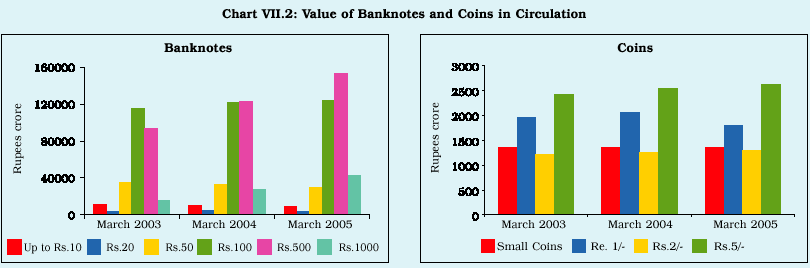
VII.6 In the case of banknotes, the shor tfall between indent and supply during 2004-05 was bridged by retrieval and recirculation of good quality banknotes out of remittances received from currency chests. In terms of value, the largest share in circulation was of Rs.500 denominations. Banknotes of Rs.100 denomination had the largest share in terms of volume. Banknotes of Rs.100 and Rs.500 denominations together accounted for 76.4 per cent of the total circulation in terms of value (Table 7.3).
VII.7 There has been a consistent shift from lower denomination notes to higher denomination notes. The demand for Rs.500 denomination notes has increased shar ply mainly due to the growing network of Automated Teller Machines (ATMs) (Box VII.1).
VII.8 The total value of coins in circulation declined by about two per cent during 2004-05 as against an
Table 7.3: Circulation of Banknotes and Coins (end-March 2005)
| |
|
|
|
|
| |
Value |
|
Volume |
|
Denomination |
Rupees |
Share |
Million |
Share |
| |
crore |
(percent) |
Pieces |
(percent) |
| |
|
|
|
|
|
1 |
2 |
3 |
4 |
5 |
|
Banknotes |
|
|
|
|
|
Rs.2 & Rs.5 |
2,548 |
0.7 |
6,484 |
17.5 |
|
Rs.10 |
6,770 |
1.9 |
6,770 |
18.3 |
|
Rs.20 |
3,876 |
1.1 |
1,938 |
5.2 |
|
Rs.50 |
29,941 |
8.3 |
5,988 |
16.2 |
|
Rs.100 |
1,23,282 |
34.1 |
12,328 |
33.3 |
|
Rs.500 |
1,52,728 |
42.3 |
3,055 |
8.3 |
|
Rs.1000 |
42,082 |
11.6 |
421 |
1.1 |
|
Total |
3,61,229 |
100.0 |
36,984 |
100.0 |
|
Coins |
|
|
|
|
|
Small Coins |
1353 |
19.2 |
54,051 |
64.8 |
|
Re coins |
1,790 |
25.4 |
17,896 |
21.5 |
|
Rs.2 |
1,290 |
18.3 |
6,449 |
7.7 |
|
Rs.5 |
2,619 |
37.1 |
5,238 |
6.3 |
|
Total |
7,052 |
100.0 |
83,631 |
100.0 |
increase of 3.8 per cent in 2003-04, mainly due to falling
demand for small coins (Chart VII.2). The demand for Rs.5 coins recorded subdued
growth due to the parallel issue of banknotes of Rs.5 denomination. The coins
of smaller denominations such as 5 paise, 10 paise and 20 paise are no more
in demand. Consequently, it has been decided to phase out from circulation all
coins of lower denomination i.e., of 5 paise, 10 paise and 20 paise -irrespective
of their metal composition - and cupro-nickel coins of 25 paise, 50 paise and
one rupee denomination. Banks have been directed to accept and remit these coins
to the Government Mints.
Box VII.1
Growth of ATMs and Demand for Higher Denomination Banknotes
Ever since the first automated teller machine (ATM) was introduced
in the late 1960s, the usage of ATM has grown exponentially. The cash dispenser
and the ATMs have gradually become the electronic face of banking. It is estimated
that there are 49 billion cash withdrawals worldwide through ATMs in a year.
Foreign banks in India were the first to introduce experimental
ATMs in 1988. Usage picked up in the 1990s. Although a number of services are
offered through fully functional ATMs, about 98 per cent people use the ATM
primarily for withdrawing cash. Banks have devised competitive strategies around
the ATMs, recognising that ATMs can be a potent source of value added service
to consumers through access to banking services at any time and at a large number
of outlets, thereby increasing customer convenience as well as cost effectiveness
in banking functions.
With the increase in the usage of ATMs, a shift has taken place
towards stocking higher denomination banknotes - particularly Rs.100 and Rs.500
denominations - as banks do not find it commercially viable to stock the machines
with all denominations of banknotes. Lower denomination banknotes run out sooner
and increase both capital cost and operating costs. The Reserve Bank has accordingly
been facing an increasing demand for fresh banknotes in Rs.500 and Rs.100 denominations.
In the context of the increased demand for ATM-fit banknotes, emphasis has been
laid on banks using desktop sorters to salvage good quality banknotes for use
in ATMs.
VII.9 There was a reverse flow of coins during the year (442
million pieces), which compensated for the shortfall in supply relative to the
indent. In response to complaints from public regarding non-acceptance of coins
at bank branches, the Reserve Bank advised all the banks to accept coins of
all denominations and also made arrangements with the Government of India Mints
to take back coins in excess of public demand.
CLEAN NOTE POLICY
VII.10 There has been a marked improvement in the quality of
banknotes in circulation due to various measures initiated by the Reserve Bank
and the Government of India. These measures include speedier disposal of soiled
banknotes; discontinuance of the practice of stapling of banknote packets; appeal
to the members of the public not to fold and write on the banknotes; gradual
phasing out of Ashoka Pillar series banknotes from circulation; mopping
up of soiled and mutilated banknotes of lower denominations; increased mechanised
processing capacity at the Reserve Bank offices; progressive mechanisation in
the currency chests; regular removal of soiled banknotes from the currency chests;
and regular supply of adequate quantity of fresh banknotes on a timely basis.
Disposal of Soiled Banknotes
VII.11 During 2004-05, Rs.100 denomination banknotes constituted
the largest share of soiled banknotes that were processed and disposed off,
followed by Rs.10 and Rs.50 denominations (Table 7.4).
Mechanisation
VII.12 Mechanisation of verification, processing, sorting and disposal of soiled
banknotes through on-
Table 7.4: Disposal of Soiled Banknotes in 2004-05
|
Denomination |
Million pieces |
As percentage |
to total |
| |
|
|
|
|
1 |
2 |
|
3 |
|
Rs.1000 |
5 |
|
0.0 |
|
Rs.500 |
257 |
|
2.2 |
|
Rs.100 |
4,324 |
|
36.8 |
|
Rs.50 |
2,490 |
|
21.2 |
|
Rs.20 |
485 |
|
4.1 |
|
Rs.10 |
3,716 |
|
31.6 |
|
Up to Rs.5 |
475 |
|
4.0 |
|
Total |
11,752 |
|
100.0 |
line shredding has been a thrust area in currency management. With a view to augmenting banknote processing capacity, six Currency Verification and Processing Systems (CVPS) machines and one Shredding and Briquetting Systems (SBS) are proposed to be installed at Lucknow in addition to the existing 48 CVPS and 27 SBSs installed at 18 Issue Offices. In contrast to the conventional furnaces (used earlier in the Reserve Bank’s offices for disposal of non-issuable banknotes) which caused environmental pollution, SBS machines provide shredding, granulation and briquetting of soiled currency banknotes in a secured and eco-friendly manner. The banknotes processed on these machines increased from 3,290 million pieces during 2003-04 to 5,672 million pieces in 2004-05 through better utilisation of these machines by the Reserve Bank offices by diversion of soiled banknotes from offices with higher accumulation to offices having spare capacity and extended hours of CVPS operations, achieving and even exceeding the rated capacity of these machines and by judicious distribution of soiled banknotes among Regional Offices of the Reserve Bank so as to avoid both accumulation of soiled banknotes and underutilisation of CVPS machines.
Table 7.5: Counterfeit Banknotes Detected
| |
|
|
|
|
| |
|
|
|
|
|
|
| |
|
2004-05 |
|
|
2003-04 |
|
| |
|
|
|
|
|
|
|
Denomination |
No. of pieces |
Value (in Rs.) |
Counterfeit |
No. of pieces |
Value (in Rs.) |
Counterfeit |
| |
|
|
banknotes (per |
|
|
banknotes (per |
| |
|
|
million pieces |
|
|
million pieces |
| |
|
|
in circulation) |
|
|
in circulation) |
| |
|
|
|
|
|
|
|
1 |
2 |
3 |
4 |
5 |
6 |
7 |
| |
|
|
|
|
|
|
|
Rs.1000 |
759 |
7,59,000 |
1.8 |
248 |
2,48,000 |
0.9 |
|
Rs.500 |
14,400 |
72,00,000 |
4.7 |
17,783 |
88,91,500 |
7.2 |
|
Rs.100 |
161,797 |
1,61,79,700 |
13.1 |
182,361 |
1,82,36,100 |
15.0 |
|
Rs.50 |
4,737 |
2,36,850 |
0.8 |
4,701 |
2,35,050 |
0.7 |
|
Rs.20 |
156 |
3,120 |
0.1 |
56 |
1,120 |
0.0 |
|
Rs.10 |
79 |
790 |
0.0 |
77 |
770 |
0.0 |
|
Total |
1,81,928 |
2,43,79,460 |
|
2,05,266 |
2,76,12,540 |
|
Counterfeit Banknotes
VII.13 The value of counterfeit banknotes detected during 2004-05 declined marginally in relation to 2003-04. The number of counterfeit banknotes detected in Rs.500 and Rs.100 denominations declined considerably. On the other hand, there was an increase in detection of Rs.1000 denomination banknotes (Table 7.5).
VII.14 Banks were advised to install note sorting machines capable of detecting counterfeit banknotes at currency chests. Banks with less than 100 currency chests were given time up to the end of May, 2005 for installing such sorting machines in each of the currency chests. Banks with 100 or more currency chests were given time up to November, 2005.
VII.15 The Reserve Bank’s Regional Offices were advised to publicise the security features of Indian banknotes in local languages by using electronic and print media. The security features of Indian banknotes were also placed on the website of the Reserve Bank. The Reserve Bank continued to provide training on detection of counterfeit banknotes to the officials of bank branches, Government departments, police and para military forces.
Additional/New Security Features of Indian Banknotes
VII.16 Security features of banknotes are reviewed continuously and updated from time to time in order to take advantage of latest innovations and with the objective of making counterfeiting difficult. Mahatma Gandhi series banknotes in denominations of Rs.100 and Rs.10 with enhanced security features were introduced in 1996, followed by Rs.50 and Rs.500 in 1997, Rs.1000 in the year 2000 and Rs.20 and Rs.5 in 2001. Introduction of additional/improved/ new security features is envisaged for denominations of Rs.50, Rs.100, Rs.500 and Rs.1000 to be put into circulation during 2005-06. The changes in security features, inter alia, include: increase in grammage; reduction in font size of numerals and shift in colour from new green to new blue optically variable ink (OVI) font in Rs.500 and Rs.1000 denominations; one-side Intaglio printing; electrolyte watermark in addition to Mahatma Gandhi portrait watermark; colour shift magnetic machine readable security thread for denominations of Rs.100 and above; and dual coloured fluorescent fibres in banknotes of all denominations (Box VII.2).
Computerisation of Currency Management
VII.17 The Reserve Bank has taken up the task of putting in place an Integrated Computer ised Currency Operations and Management System (ICCOMS) with a view to ushering in greater operational efficiency, improved customer service and providing decision suppor t tools for policy making in the area of currency management. The project includes computerisation and networking of the currency chests with the Reserve Bank’s offices to facilitate prompt, efficient and error-free reporting and accounting of the currency chest transactions in a secure manner. The system will provide a uniform computing platform across all the Regional Offices for transaction processing, accounting and management infor mation systems relating to currency. It would lead to migration from the existing computer systems used for the Issue accounting functions.
Box VII.2
Security Features in Banknotes
In the wake of increasing circulation of high value counterfeit banknotes, particularly Rs.100 and Rs.500 denominations, the Government of India appointed a High Level Committee in February, 2000. The Committee, inter alia, recommended incorporation of Additional/new security features and improvement of certain existing security features in banknotes. The proposed security features to be incorporated in banknotes are as under:
|
Feature |
Denomination |
Proposed specification/ Security feature |
| |
|
|
|
Paper |
All |
Grammage |
| |
|
90 GSM (±3) for Rs.10 to Rs.1000 |
| |
|
Caliper thickness |
| |
|
110 microns (±5) for Rs.10 to Rs.1000 |
| |
|
|
|
Security thread |
Rs.1000 |
Machine-readable windowed demetalised clear text magnetic security |
| |
Rs.500 |
thread with inscriptions ‘Bharat’ (in Hindi) and RBI on notes of Rs.100 |
| |
Rs.100 |
and Rs 500, and additionally 1000 for Rs 1000 with exclusive colour |
| |
|
shift. Colour of the thread shall shift from green to blue when viewed |
| |
|
from different angles. It will fluoresce in yellow on the reverse and |
| |
|
the text will fluoresce on the obverse under UV light. |
| |
|
|
| |
|
Width: 3 mm for Rs.1000 and Rs.500 |
| |
|
2 mm for Rs.100 |
| |
|
|
| |
Rs.50 and below |
Machine readable windowed demetalised clear text magnetic security |
| |
|
thread with inscriptions ‘Bharat’ (in Hindi) and RBI which fluoresces |
| |
|
in yellow on both sides under U.V. light (Generic). |
| |
|
|
| |
|
Width: 1.4 mm |
| |
|
|
|
Electrolyte watermark |
All |
Highlight watermark of denominational numeral to be located |
| |
|
alongside Mahatma Gandhi watermark. |
| |
|
|
|
Omron anti photocopying feature |
Rs.50 and above |
To be included in Rs.100 and Rs.50 also. |
| |
|
|
|
Year of printing |
All |
Year of printing to be incorporated at the printing stage on the reverse |
| |
|
of the bank note. |
| |
|
|
|
Optically variable ink (OVI) |
Rs.500 and Rs.1000 |
Reduced size of font for numerals and revised colour shift from new |
| |
|
green to new blue. |
| |
|
Rs.500: 12mmx27.5mm(330 sq mm). |
| |
|
Rs.1000: 12mmx34mm(408 sq mm). |
| |
|
|
|
See through effect |
All |
Existing security features will continue with improvement. |
| |
|
|
|
Latent image |
Rs.20 and above |
Existing security features will continue with improvement. |
| |
|
|
|
Intaglio printing |
Rs.20 and above |
Intaglio effect to be made more prominent with 130 microns in plate |
| |
|
making stage only on the obverse of the notes. |
| |
|
Notes of Rs.500 and Rs.1000 also will have intaglio printing only on |
| |
|
the obverse. |
| |
|
|
|
Identification mark |
Rs.20 and above |
Engraving depth to be increased from 83 microns to 160 microns. |
| |
|
|
|
Optical fibres |
All |
Dual coloured optical fibres. |
Customer Service
VII.18 During the year, the Reserve Bank stepped up efforts for improvement of customer services in matters relating to issue of coins, acceptance of coins from the public and exchange of soiled and mutilated banknotes. Scheduled commercial banks were directed to issue coins, accept coins and soiled banknotes in transactions or for exchange without any restriction. Efforts were continued to provide timely and efficient customer service not only at the Reserve Bank Offices but also at bank branches. The Reserve Bank revised the Citizens’ Charter and placed it on the website. All Issue offices have implemented the major recommendations of the Committee on Procedures and Performance Audit on Public Services (Chairman: Shri S.S. Tarapore) on services relating to individuals on currency management.
VII.19 The Reserve Bank decided to opt for ISO certification of currency management. Accordingly, a Core Group has been set up to ensure smooth implementation of the ISO standards. Kolkata and Hyderabad offices have been identified for the pilot project. All the Regional Offices have been advised to initiate necessar y steps towards achieving international standards in customer service in currency management.
Reserve Bank Monetary Museum
VII.20 The President of India Dr. A.P.J. Abdul Kalam inaugurated the Reserve Bank of India Monetary Museum on November 18, 2004. The President noted in the visitor’s book, '; It is a beautiful idea and well presented. Hearty congratulations.'; The Reser ve Bank’s Monetar y Museum aims at documenting, preserving and presenting India’s monetary heritage. The Museum was opened to the public from January 1, 2005. The Museum is the first of its kind in the country and aims at depicting the history of currency and the evolution of money in India. The Museum exhibits collections of Indian coinage, paper currency as well as financial instruments and curiosities down the ages. The exhibits on display have been selected so as to give a feel of the objects that have served as money at various points of time. The main exhibit sections of the Museum relate to concepts, ideas and curiosities; coinage; from coins to banknotes and advent of banking in India; paper currency; financial instruments; the Reserve Bank’s functions; and currency management.
Issue Department Manual
VII.21 Revised and updated version of the Issue Depar tmental manual was brought out during 2004. The manual was first brought out in 1937 and subsequently revised/ updated in 1952 and in 1972.
The Bharatiya Reserve Bank Note Mudran Pvt. Ltd.
VII.22 The Bharatiya Reserve Bank Note Mudran Pvt. Ltd. (BRBNMPL), incorporated as a wholly owned subsidiary of the Reserve Bank, was set up in 1996 to take over the work of the new Note Press Project. It operates the single business of printing banknote form in its two printing presses at Mysore (Kar nataka) and Salboni (West Bengal). The Presses put together have an installed capacity of 8,400 million pieces of banknotes per annum in a single shift depending on the mix of denominations. The total production of banknotes by the two presses increased by 9.4 per cent to 8,625 million pieces during 2004-05. The Company achieved a net profit of Rs.135 crore during 2003-04 as compared with Rs.274 crore during 2002-03. The Company has been re-cer tified as being fully compliant with the requirement of ISO 9001:2000 for a further period of three years. Smt. K.J. Udeshi, Deputy Gover nor, was appointed ex-officio chairperson of the BRBNMPL from April 1, 2005. A Board-level Strategic Planning and Technology Implementation Committee has been set up to study the scope for further technology absorption and to monitor research and development efforts on an ongoing basis.
Outlook
VII.23 The Reser ve Bank would continue to conduct its currency management operations with a view to ensuring optimal customer service through an adequate supply of good quality and secure banknotes and coins in the country. Clean banknotes and intensified anti-counterfeiting measures will be a concurrent objective, alongside continuous upgradation of security features. The Reserve Bank intends to implement the Integrated Computerised Currency Operations and Management System (ICCOMS) in all its offices and major currency chests during 2005-06. It is expected that the modernisation of the technological infrastructure, the diffusion of IT initiatives in computerisation of bank branch operations and the advances in the communication facilities will improve customer satisfaction and create the necessary environment for ongoing improvements in currency management.
VII.24 The Reserve Bank will continue to ensure production and circulation of high quality banknotes and coins, to influence banknote circulation to meet the needs of the consumers, and to contribute to the integrity and security of the banknotes. Efforts will continue to ensure availability of coins and banknotes to the consumers in their day-to-day cash transactions; to minimise the risk of counterfeits; to withdraw, authenticate and sort banknotes which are not fit to be re-issued; to examine the existing technological options as well as innovations to increase the circulation life of banknotes; to ensure printing of banknotes to very strict quality rules/standards; to make currency operations ISO accredited; to review the banknotes and coins handling practices including recycling of banknotes and coins; to adopt/develop improved banknote security features, and to contribute to the integrity and security of the banknotes by providing regular training in this area to the professional handlers of cash, by promoting the secur ity features to consumers through the public information materials, and by processing lodgement of higher denomination banknotes within the shortest possible time to help improve counterfeit detection. Strategic plans that are in place will be continuously reviewed as part of an on-going process to take the Reserve Bank’s currency management to a level to meet the ISO requirements and specifications.
|