RBI/2026-27/
DOR.MRG.REC.__/00-00-001/2026-27 XX 2026 Reserve Bank of India (Commercial Banks – Forthcoming Instructions) Amendment Directions, 2026 - Draft for comments Please refer to Chapter II & III of the Reserve Bank of India (Commercial Banks – Forthcoming Instructions) Directions, 2025 dated November 28, 2025, which specify the methodology for minimum capital requirements for counterparty credit risk. Upon review and to ensure greater alignment with international standards, there is a felt need to amend these instructions. 2. Accordingly, in exercise of the powers conferred by Section 35A of the Banking Regulation Act, 1949 and all other provisions / laws enabling the Reserve Bank of India (RBI) to issue instructions in this regard, the Reserve Bank being satisfied that it is necessary and expedient in the public interest so to do, hereby, issues the Amendment Directions hereinafter specified. 3. (i) These instructions shall be called the Reserve Bank of India (Commercial Banks – Forthcoming Instructions) Amendment Directions, 2026. (ii) These Amendment Directions shall come into effect from April 1, 2027. 4. The Reserve Bank of India (Commercial Banks – Forthcoming Instructions) Directions, 2025 are amended as provided below: (i) The existing Annex shall be renamed Annex 1, and two new annexures viz. Annex 2 and Annex 3 respectively shall be inserted. (ii) In the Directions, the paragraphs 7 to 21 are hereby substituted by paragraphs 6A to 21, while Annex 2 and 3 are inserted after Annex 1, as detailed below: - “A. Definitions 6 A. In these Directions, unless the context states otherwise, the terms herein shall bear the meanings assigned to them below: (1) ‘Central Counterparty’ (CCP) is a clearing house that interposes itself between counterparties to contracts traded in one or more financial markets, becoming the buyer to every seller and the seller to every buyer and thereby ensuring the future performance of open contracts. A CCP becomes counterparty to trades with market participants through novation, an open offer system, or another legally binding arrangement. For the purposes of the capital framework, a CCP is a financial institution. (2) ‘Clearing Member’ is a member of, or a direct participant in, a CCP that is entitled to enter into a transaction with the CCP, regardless of whether it enters into trades with a CCP for its own hedging, investment or speculative purposes or whether it also enters into trades as a financial intermediary between the CCP and other market participants. Explanation: For the purpose of these Directions, where a CCP has a link to a second CCP, that second CCP is to be treated as a clearing member of the first CCP. Whether the second CCP’s collateral contribution to the first CCP is treated as initial margin or a default fund contribution will depend upon the legal arrangement between the CCPs. In such cases, RBI shall be consulted for determining the treatment of such initial margin and default fund contributions. (3) ‘Client’ is a party to a transaction with a CCP through either a clearing member acting as a financial intermediary, or a clearing member guaranteeing the performance of the client to the CCP. (4) ‘Counterparty Credit Risk (CCR)’ is the risk that the counterparty to a transaction could default before the final settlement of the transaction’s cash flows. An economic loss would occur if the transactions or portfolio of transactions with the counterparty has a positive economic value at the time of default. Unlike a firm’s exposure to credit risk through a loan, where the exposure to credit risk is unilateral and only the lending bank faces the risk of loss, CCR creates a bilateral risk of loss: the market value of the transaction can be positive or negative to either counterparty to the transaction. The market value is uncertain and can vary over time with the movement of underlying market factors. (5) ‘Credit Valuation Adjustment’ is an adjustment to the mid-market valuation of the portfolio of trades with a counterparty. This adjustment reflects the market value of the credit risk of the counterparty or the market value of the credit risk of both the bank and the counterparty. (6) ‘Cross-product netting’ refers to the inclusion of transactions of different product categories within the same netting set. (7) ‘Current Exposure’ is the larger of zero, or the current market value of a transaction or portfolio of transactions within a netting set with a counterparty that would be lost upon the immediate default of the counterparty, assuming no recovery on the value of those transactions in bankruptcy. Current exposure is often also called Replacement Cost. (8) ‘Default funds’, also known as clearing deposits or guarantee fund contributions (or any other names), are clearing members’ funded or unfunded contributions towards, or underwriting of, a CCP’s mutualised loss sharing arrangements. The description given by a CCP to its mutualised loss sharing arrangements is not determinative of their status as a default fund; rather, the substance of such arrangements will govern their status. (9) ‘Hedging Set’ is a set of transactions within a single netting set within which full or partial offsetting is recognized for the purpose of calculating the PFE add-on of the standardised approach for counterparty credit risk (SA-CCR). (10) ‘Independent Collateral Amount’ (ICA) means (i) the collateral other than variation margin posted by the counterparty that the bank may seize upon default of the counterparty, the amount of which does not change in response to the value of the transactions it secures and / or (ii) the Independent Amount (IA) parameter as defined in standard industry documentation. ICA can change in response to factors such as the value of the collateral or a change in the number of transactions in the netting set. Explanation: For example, the 1992 (Multicurrency-Cross Border) Master Agreement and the 2002 Master Agreement published by the International Swaps & Derivatives Association, Inc. (ISDA Master Agreement). The ISDA Master Agreement includes the ISDA Credit Support Annexes: the 1994 Credit Support Annex (Security Interest – New York Law), or, as applicable, the 1995 Credit Support Annex (Transfer – English Law) and the 1995 Credit Support Deed (Security Interest – English Law). (11) ‘Initial margin’, in relation to exposures to a CCP, means a clearing member’s or client’s funded collateral posted to the CCP to mitigate the potential future exposure (PFE) of the CCP to the clearing member arising from the possible future change in the value of their transactions. For the purposes of calculation of counterparty credit risk capital requirements, initial margin does not include contributions to a CCP for mutualised loss sharing arrangements (i.e., in case a CCP uses initial margin to mutualise losses among the clearing members, it shall be treated as a default fund exposure). Initial margin also includes collateral deposited by a clearing member or client in excess of the minimum amount required, provided the CCP or clearing member may, in appropriate cases, prevent the clearing member or client from withdrawing such excess collateral. (12) ‘Long settlement transactions’ are transactions where a counterparty undertakes to deliver a security, a commodity, or a foreign exchange amount against cash, other financial instruments, or commodities, or vice versa, at a settlement or delivery date that is contractually specified as more than the lower of the market standard for this particular instrument and five business days after the date on which the bank enters into the transaction. (13) ‘Margining Agreement’ is a contractual agreement or provisions to an agreement under which one counterparty must supply variation margin to a second counterparty when an exposure of that second counterparty to the first counterparty exceeds a specified level. (14) ‘Margin lending transactions’ are transactions in which a bank extends credit in connection with the purchase, sale, carrying or trading of securities. Margin lending transactions do not include other loans that happen to be secured by securities collateral. Generally, in margin lending transactions, the loan amount is collateralised by securities whose value is greater than the amount of the loan. (15) ‘Margined netting sets’ are netting sets covered by a margin agreement under which the bank’s counterparty has to post variation margin; all other netting sets, including those covered by a one-way margin agreement where only the bank posts variation margin, are treated as unmargined netting sets for the purposes of SA-CCR. (16) ‘Margin period of risk’ is the time period from the last exchange of collateral covering a netting set of transactions with a defaulting counterparty until that counterparty is closed out and the resulting market risk is re-hedged. (17) ‘Margin threshold’ is the largest amount of an exposure that remains outstanding until one party has the right to call for variation margin. (18) ‘Multi-level client structure’ is one in which a bank can centrally clear as indirect client; that is, when clearing services are provided to the bank by an institution which is not a direct clearing member but is itself a client of a clearing member or another clearing client. For exposures between clients and clients of clients, the term higher-level client is used for the institution providing clearing services; and the term lower-level client is used for the institution clearing through that client. (19) ‘Netting Set’ is a group of transactions with a single counterparty that are subject to a legally enforceable bilateral netting arrangement and for which netting is recognised for regulatory capital purposes. Each transaction that is not subject to a legally enforceable bilateral netting arrangement that is recognised for regulatory capital purposes should be interpreted as its own netting set for the purpose of these Directions. (20) ‘Net Independent Collateral Amount’ (NICA) represents the amount of collateral that a bank may use to offset its exposure on the default of the counterparty. NICA means the amount of segregated or unsegregated collateral posted by the counterparty to the bank, less the unsegregated collateral posted by the bank to the counterparty. With respect to ‘Independent Amount’ parameter defined in standard industry documentation, NICA takes into account the differential of Independent Amount required for the bank minus Independent Amount required for the counterparty. (21) ‘Offsetting transaction’ means the transaction leg between the clearing member and the CCP when the clearing member acts on behalf of a client (e.g., when a clearing member clears or novates a client’s trade). (22) ‘One-Sided Credit Valuation Adjustment’ is a credit valuation adjustment that reflects the market value of the credit risk of the counterparty to the bank but does not reflect the market value of the credit risk of the bank to the counterparty. (23) ‘Qualifying central counterparty’ (QCCP) is an entity that is licensed to operate as a CCP (including a license granted by way of confirming an exemption) and is permitted by the appropriate regulator / overseer to operate as such with respect to the products offered. This is subject to the provision that the CCP is based and prudentially supervised in a jurisdiction where the relevant regulator / overseer has established, and publicly indicated that it applies to the CCP on an ongoing basis, domestic rules and regulations that are consistent with the Principles for Financial Market Infrastructures issued by the Committee on Payments and Market Infrastructures and the International Organization of Securities Commissions. In addition, for a CCP to be considered a QCCP, the requirements of paragraphs 17.4(a) and 17.4(b) of these Directions must be met to permit each clearing member bank to calculate its capital requirement for its default fund exposures in accordance with paragraphs 17 to 20 of these Directions. (24) ‘Securities Financing Transactions’ (SFTs) are transactions such as repurchase agreements, reverse repurchase agreements, security lending and borrowing, and margin lending transactions, where the value of the transactions depends on market valuations and the transactions are often subject to margin agreements. (25) ‘Trade exposures’ include the current and potential future exposure of a clearing member or a client to a CCP arising from over-the-counter derivatives, exchange traded derivatives transactions or securities financing transactions, as well as initial margin. For the purpose of this definition, the current exposure of a clearing member includes the variation margin due to the clearing member but not yet received. (26) ‘Variation margin’ means a clearing member’s or client’s funded collateral posted on a fixed periodicity (e.g., daily or intraday basis) to a CCP based upon price movements of their transactions. B Scope of counterparty credit risk 6 B. The scope of application of counterparty credit risk shall be as under: (1) A bank shall calculate counterparty credit risk charge for all exposures that give rise to counterparty credit risk, with the exception of those transactions listed in paragraph 6B.2 of these Directions below. (i) The categories of transactions that give rise to counterparty credit risk are over the counter (OTC) derivatives, exchange-traded derivatives, securities financing transactions, and long-settlement transactions in the banking book. (ii) The categories of transactions include OTC derivatives, repo-style and other transactions booked in the trading book, separate from the capital requirement for market risk. The risk weights used in this calculation shall be consistent with those used for calculating the capital requirements in the banking book. Thus, a bank shall use the standardised approach risk weights in the trading book. The calculation of the counterparty credit risk charge for collateralised OTC derivative transactions is the same as the rules prescribed for such transactions booked in the banking book. Note - The treatment for unsettled foreign exchange and securities trades shall be as provided in paragraph 86 of the Commercial Banks - Prudential Norms on Capital Adequacy Directions, 2025. (2) Exemptions and Caps (i) For ‘sold options’ and for ‘credit default swaps where the bank is the protection seller’, that are outside netting and margin agreements, a bank may cap the counterparty credit risk exposure at the amount of unpaid premia. In order to apply the cap, a bank may remove such derivative transactions from their legal netting sets and treat them as individual unmargined transactions. (ii) While applying the counterparty credit risk charge, a bank may exclude credit default swaps (CDS) protection purchased by the bank against a banking book exposure, where the capital requirement for the hedged exposure is deemed to have been substituted as provided in paragraph 129 of the Commercial Banks - Prudential Norms on Capital Adequacy Directions, 2025. (iii) A bank may defer premium on options subject to the following: (a) A bank may, at its discretion, defer the premium on permissible options (generic or structured) sold by it to users subject to the following conditions: 1. the bank shall satisfy itself that the user is able to adhere to the premium deferment schedule, in accordance with its Board / Risk Management Committee of the Board approved policy in this regard, before extending this facility to the users; 2. the deferment of premium shall not extend beyond the maturity date of the original contract; and 3. the premium shall be received uniformly over the maturity of the contract and the periodicity of such payment shall be at least once in a quarter. Provided that, the above facility shall not be available to an intermediary bank which does not have its own option book but offers the product to corporate clients on a completely covered basis, since an intermediary bank itself is not a ‘user’. Provided further that, options and option structures shall continue to be governed by instructions on suitability and appropriateness laid down in the Master Direction – Reserve Bank of India (Market-makers in OTC Derivatives) Directions, 2021. (b) A bank shall include the amount of premium deferred on options, as per para (a) above, in the Replacement Cost (RC) for calculation of CCR exposure. (c) While computing the credit exposure, a bank may exclude ‘sold options’ that are outside netting and margin agreements, provided the entire premium / fee or any other form of income is received / realised. For ‘sold options’ (outside netting and margin agreements) where the premium / fee or any other form of income is not fully received / realised, the PFE add-on amount shall be capped such that the CCR exposure (i.e., RC + PFE) does not exceed such unpaid amounts. C. Methodology to calculate counterparty credit risk 6 C. A bank shall calculate counterparty credit exposure using the following methods: (1) For exposure arising from OTC derivatives, exchange-traded derivatives and long settlement transactions, standardised approach for measuring counterparty credit risk exposures (SA-CCR) as set out in paragraphs 10 to 14 of these Directions. This treatment is applicable to transactions booked in both banking and trading book. (2) For securities financing transactions (SFTs) that are not cleared through a CCP, the methodology as provided in paragraphs 157 to 165 of the Commercial Banks - Prudential Norms on Capital Adequacy Directions, 2025. This treatment is applicable to transactions booked in both banking and trading book. (3) For exposures that are cleared through a CCP, a bank shall apply the methodology as provided in paragraphs 15 to 20 of these Directions. 7. A bank shall ensure that the exposure amount for a given counterparty, under the methods outlined above, is equal to the sum of the exposure amounts calculated for each netting set with that counterparty, subject to the exception outlined in paragraph 8 of these Directions. 8. A bank shall ensure that the exposure amount for a given OTC derivative counterparty is the greater of zero and the difference between the sum of exposure amounts across all netting sets with the counterparty and the credit valuation adjustment (CVA) for that counterparty which has already been recognised by the bank as an incurred write-down (i.e., a CVA loss). A bank shall calculate CVA loss as a prudent valuation adjustment as per paragraph 213 of the Commercial Banks - Prudential Norms on Capital Adequacy Directions, 2025, without taking into account any offsetting debit valuation adjustments (DVA) which have been deducted from capital (in terms of paragraph 28.5 of the Commercial Banks - Prudential Norms on Capital Adequacy Directions, 2025). This reduction of exposure by incurred CVA losses does not apply to the determination of the CVA risk capital requirement. 9. A bank shall calculate the risk weighted assets for counterparty credit risk by multiplying the applicable risk weight and the exposure amount for the counterparty. Chapter II: Standardised Approach for Counterparty Credit Risk (SA-CCR) 10. Overview (1) Subject to paragraph 13 of these Directions, a bank shall calculate counterparty exposure to a single counterparty arising from OTC derivatives, exchange-traded derivatives, and long settlement transactions separately for each margined and unmargined netting set as follows: where: (i) alpha = 1.4 (ii) RC = the replacement cost calculated according to methodology given in paragraph 11 of these Directions, and (iii) PFE = the amount for potential future exposure calculated according to the methodology given in paragraph 12 of these Directions. (2) A bank shall calculate the replacement cost (RC) and the potential future exposure (PFE) differently for margined and unmargined netting sets. A bank shall cap the exposure for a margined netting set at the exposure of the same netting set calculated on an unmargined basis. Explanation: The cap addresses the possible issue resulting from a high threshold (TH) under margin agreement which could lead to higher values of replacement cost for margined transactions vis-a-vis replacement cost under unmargined transaction. (3) Requirements for recognition of netting agreement (i) For the purpose of these Directions, a bank may net transactions subject to novation under which any obligation between a bank and its counterparty to deliver a given currency on a given value date is automatically amalgamated with all other obligations for the same currency and value date, legally substituting one single amount for the previous gross obligations. In case RBI is not satisfied about enforceability under relevant laws, the benefit of netting while computing exposure amount cannot be obtained. A bank may also net transactions subject to any legally valid form of bilateral netting not covered in the preceding sentence, including other forms of novation. In every such case where netting is applied, a bank shall satisfy that it has: a) A netting contract with the counterparty or other agreement which creates a single legal obligation, covering all included transactions, such that the bank would have either a claim to receive or obligation to pay only the net sum of the positive and negative mark-to-market values of included individual transactions in the event a counterparty fails to perform due to any of the following: default, bankruptcy, liquidation, or similar circumstances. Note - The netting contract shall not contain any clause which, in the event of default of a counterparty, permits a non-defaulting counterparty to make limited payments only, or no payments at all, to the estate of the defaulting party, even if defaulting party is a net creditor. b) Written and reasoned legal reviews that, in the event of a legal challenge, the relevant courts and administrative authorities would find the bank’s exposure to be such a net amount under: (i) The law of the jurisdiction in which the counterparty is incorporated and, if the foreign branch of a counterparty is involved, then also under the law of the jurisdiction in which the branch is located. (ii) The law that governs the individual transactions; and (iii) The law that governs any contract or agreement necessary to effect the netting. c) Procedures in place to ensure that the legal characteristics of netting arrangements are kept under review in light of the possible changes in relevant law. (4) The detailed illustrations on computation of counterparty credit risk exposure are given in Annex II. 11. Replacement Cost (RC) (1) For unmargined transactions, a bank shall calculate RC for each netting set using the following formula: where, i) V is the current market value of the derivative transactions in the netting set; and ii) C is the haircut value of net collateral held (i.e., Net Independent Collateral Amount (NICA) adjusted by applying the standard supervisory haircuts provided in paragraph 163 of the Commercial Banks - Prudential Norms on Capital Adequacy Directions, 2025 such that the value of non-cash collateral posted by the bank to its counterparty is increased and the value of the non-cash collateral received by the bank from its counterparty is decreased). Note - As set out in paragraph 6A.15 of these Directions, netting sets that include a one-way margin agreement in favour of the bank’s counterparty (i.e., the bank posts, but does not receive variation margin) are treated as unmargined for the purposes of SA-CCR. For such netting sets, C also includes, with a negative sign, the variation margin amount posted by the bank to the counterparty. (2) For unmargined transactions, RC is defined as the greater of: (i) the current market value of the derivative contracts less net haircut collateral held by the bank (if any), and (ii) zero. The RC intends to capture the loss that would occur if a counterparty were to default and were closed out of its transactions immediately. This is consistent with the use of replacement cost as the measure of current exposure, meaning that when the bank owes the counterparty money it has no exposure to the counterparty if it can instantly replace its trades and sell collateral at current market prices. (3) For the purpose of paragraph 11.1 of these Directions, while applying the formula provided in paragraph 163.8 of the Commercial Banks - Prudential Norms on Capital Adequacy Directions, 2025, for calculating haircuts, a bank shall use the maturity of the longest transaction in the netting set as the value for NR, capped at 250 days, to scale haircuts for unmargined transactions. A bank shall cap the haircut calculated at 100 per cent. (4) The formulation set out in paragraph 11.1, does not permit the replacement cost, which represents today’s exposure to the counterparty, to be less than zero. However, a bank may sometime hold excess collateral (even in the absence of a margin agreement) or have out-of-the-money trades which can further protect the bank from the increase of the exposure. As discussed in paragraphs 12.1 to 12.4, the SA-CCR allows such over-collateralisation and negative mark-to-market value to reduce PFE, but they are not permitted to reduce replacement cost. (5) For margined transactions, a bank shall calculate the replacement cost for each netting set using the following formula: where, i) V is the current market value of the derivative transactions in the netting set. ii) C is the haircut value of net collateral held (i.e., net variation margin and NICA adjusted by applying the standard supervisory haircuts provided in paragraph 163.8 of the Commercial Banks - Prudential Norms on Capital Adequacy Directions, 2025, such that the value of non-cash collateral posted by the bank to its counterparty is increased and the value of the non-cash collateral received by the bank from its counterparty is decreased). Note - In calculating the net variation margin, the amount received by the bank is accounted with a positive sign and the amount posted by the bank is accounted with a negative sign. iii) TH is the positive threshold before the counterparty must send the bank collateral. iv) MTA is the minimum transfer amount applicable to the counterparty; and v) NICA is the net independent collateral amount. (6) For margined trades, the RC intends to capture the loss that would occur if a counterparty were to default at the present or at a future time, assuming that the closeout and replacement of transactions occur instantaneously. (7) TH + MTA – NICA represents the largest exposure that would not trigger a VM call and it contains levels of collateral that need always to be maintained. For example, without initial margin or IA, the greatest exposure that would not trigger a variation margin call is the threshold plus any minimum transfer amount. In the adapted formulation, NICA is subtracted from TH + MTA. This makes the calculation more accurate by fully reflecting both the actual level of exposure that would not trigger a margin call and the effect of collateral held and / or posted by a bank. The calculation is floored at zero, recognising that the bank may hold NICA in excess of TH + MTA, which could otherwise result in a negative replacement cost. (8) For the purposes of paragraph 11.3 of these Directions, while applying the formula provided in paragraphs 163(10) of the Commercial Banks - Prudential Norms on Capital Adequacy Directions, 2025 for calculating haircuts, a bank shall use the margin period of risk of the transaction as the value for NR. 12. Potential Future Exposure (PFE) (1) There may be a period (the margin period of risk) between the last exchange of collateral before default and replacement of the trades in the market. The PFE add-on represents the potential change in value of the trades during this time period. A bank shall calculate PFE for each netting set using the following formula: where, (i) exp(…) is the exponential function. (ii) Floor is 5 per cent. (iii) V and C are calculated in accordance with paragraph 11.1 of these directions for unmargined netting sets or paragraph 11.5 of these directions for margined netting sets, whichever is applicable. (2) As a general principle, over-collateralisation should reduce capital requirements for counterparty credit risk. A bank may hold excess collateral (i.e., collateral greater than the net market value of the derivatives contracts) precisely to offset potential increases in exposure represented by the add-on. As discussed in paragraph 11.1 and 11.4, collateral may reduce the replacement cost component of the exposure under the SA-CCR. The PFE component also reflects the risk-reducing property of excess collateral. (3) When the collateral held is less than the net market value of the derivative contracts (“under-collateralisation”), the current replacement cost is positive, and the multiplier is equal to one (i.e., the PFE component is equal to the full value of the aggregate add-on). Where the collateral held is greater than the net market value of the derivative contracts (“over-collateralisation”), the current replacement cost is zero and the multiplier is less than one (i.e., the PFE component is less than the full value of the aggregate add-on). (4) The multiplier will also be activated when the current value of the derivative transactions is negative. This is because out-of-the-money transactions do not currently represent an exposure and have less chance to go in-the-money. Aggregate add-on across asset classes (5) A bank shall calculate the aggregate add-on using the following formula (i.e., without recognising diversification benefits across asset classes): Allocation of derivative transactions to one or more asset classes (6) Subject to paragraph 12.8 of these Directions, a bank shall allocate each derivative transaction to one of the asset classes on the basis of the primary risk driver of the transaction, defined by the transaction’s underlying instrument. Explanation: For example, an interest rate curve is the primary risk driver for an interest rate swap, a reference entity is the primary risk driver for a credit default swap, and a foreign exchange rate is the primary risk driver for a foreign exchange call option. (7) For more complex transactions that may have more than one risk driver, a bank shall take sensitivities and volatility of the underlying into account for determining the primary risk driver. Explanation: Examples of transactions with more than one risk driver include multi-asset derivative transactions or hybrid derivative transactions. (8) RBI may require a bank to allocate more complex transactions to more than one asset class, resulting in the same position being included in multiple asset classes. In such case, for each asset class to which the position is allocated, a bank shall determine appropriately the sign and supervisory delta adjustment of the relevant risk driver. General steps for calculating the PFE add-on for each asset class (9) A bank shall determine the primary risk factor or factors for each transaction and attribute them to one or more of the five asset classes, including interest rate, foreign exchange, credit, equity, and commodity. The add-on for each asset class is calculated using asset-class specific formulas. Explanation: The formulas for calculating the asset class add-ons represent stylised Effective expected positive exposure calculations under the assumption that all trades in the asset class have zero current mark-to market value (i.e., they are at the money). (10) Although the formulas for the asset class add-ons vary between asset classes, they all use the following general steps: (i) A bank shall calculate the effective notional (D) for each derivative (i.e., each individual trade) in the netting set. The effective notional is a measure of the sensitivity of the trade to movements in underlying risk factors (i.e., interest rates, exchange rates, credit spreads, equity prices and commodity prices). The effective notional is calculated as the product of the following parameters (i.e., D = d * MF * δ) (a) The adjusted notional (d) is a measure of the size of the trade. For foreign exchange derivatives, it is the notional value of the foreign currency leg of the derivative contract, converted to the domestic currency. For equity and commodity derivatives, it is the current price of the relevant share or unit multiplied by the number of shares or units referenced by the derivative. For interest rate and credit derivatives, the notional amount is adjusted by a measure of the instrument’s duration to account for the greater sensitivity of longer-duration instruments to movements in underlying risk factors (i.e., interest rates and credit spreads). (b) The maturity factor (MF) is a parameter that takes account of the time period over which the potential future exposure is calculated. The calculation of the maturity factor varies depending on whether the netting set is margined or unmargined. (c) The supervisory delta (δ) is used to ensure that the effective notional take into account the direction of the trade, i.e., whether the trade is long or short, by having a positive or negative sign. It also considers whether the trade has a non-linear relationship with the underlying risk factor (which is the case for options and collateralised debt obligation tranches). (ii) A supervisory factor (SF) is identified for each individual trade in the netting set. The supervisory factor is the supervisory specified change in value of the underlying risk factor on which the potential future exposure calculation is based, which has been calibrated to take into account the volatility of underlying risk factors. (iii) The trades within each asset class are separated into supervisory specified hedging sets. The purpose of the hedging sets is to group together trades within the netting set where long and short positions should be permitted to offset each other in the calculation of potential future exposure. (iv) Aggregation formulas are applied to aggregate the effective notionals and supervisory factors across all trades within each hedging set and finally at the asset-class level to give the asset class level add-on. The method of aggregation varies between asset classes and for credit, equity and commodity derivatives it also involves the application of supervisory correlation parameters to capture diversification of trades and basis risk. Time period parameters (11) There are four time period parameters that are used in the SA-CCR methodology (all expressed in years) (i) For all asset classes, the maturity Mi of a contract is the time period (starting today) until the latest day when the contract may still be active. This time period appears in the maturity factor defined in paragraphs 12.35 to 12.39 that scales down the adjusted notionals for unmargined trades for all asset classes. (ii) For interest rate and credit derivatives, Si is the period of time (starting today) until start of the time period referenced by an interest rate or credit contract. If the derivative references the value of another interest rate or credit instrument (eg swaption or bond option), a bank shall determine the time period on the basis of the underlying instrument. Si appears in the definition of supervisory duration defined in paragraph 12.31 (i). (iii) For interest rate and credit derivatives, Ei is the period of time (starting today) until the end of the time period referenced by an interest rate or credit contract. If the derivative references the value of another interest rate or credit instrument (eg swaption or bond option), a bank shall determine the time period on the basis of the underlying instrument. Ei shall be used in the computation of supervisory duration defined in paragraph 12.31(i). Further, Ei shall be used for allocating derivatives in the interest rate asset class to maturity buckets, which are used in the calculation of the asset class add-on as explained paragraph 12.17(c). (iv) For options in all asset classes, Ti is the time period (starting today) until the latest contractual exercise date as referenced by the contract. This period shall be used for the determination of the option’s supervisory delta as explained in paragraph 12.33. (12) Table 1 includes example transactions and provides each transaction’s related maturity M, start date S and end date E. | Table 1 | | Instrument | Mi | Si | Ei | | Interest rate or credit default swap maturing in 10 years | 10 years | 0 | 10 years | | 10-year interest rate swap, forward starting in 5 years | 15 years | 5 years | 15 years | | Forward rate agreement for time period starting in 6 months and ending in 12 months | 1 year | 0.5 year | 1 year | | Cash-settled European swaption referencing 5-year interest rate swap with exercise date in 6 months | 0.5 year | 0.5 year | 5.5 years | | 10-year Bermudan swaption with annual exercise dates | 10 years | 1 year | 10 years | | Interest rate cap or floor specified for semi-annual interest rate with maturity 5 years | 5 years | 0 | 5 years | | Option on a bond maturing in 5 years with the latest exercise date in 1 year | 1 year | 1 year | 5 years | | 3-month Eurodollar futures that matures in 1 year | 1 year | 1 year | 1.25 years | | Futures on 20-year treasury bond that matures in 2 years | 2 years | 2 years | 22 years | | 6-month option on 2-year futures on 20-year treasury bond | 2 years | 2 years | 22 years | Allocation of derivative transactions within each asset class to hedging sets (13) Subject to paragraph 12.14 and 12.15 of these Directions, a bank shall group transactions into hedging sets within each asset class as follows: a) Interest rate derivatives into separate hedging sets for each currency. b) Foreign exchange derivatives into separate hedging set for each currency pair. c) Credit derivatives into a single hedging set. d) Equity derivatives into a single hedging set; and e) Commodity derivatives into four separate hedging sets according to the broad categories of commodity derivatives: energy, metals, agricultural and other commodities. (14) A bank shall group derivative transactions that reference the basis between two risk factors and are denominated in a single currency (i.e., basis transactions) into separate hedging sets within the corresponding asset class (examples of specific basis include a 3-month OIS versus 6-month T-Bill). Derivatives with two floating legs that are denominated in different currencies (such as cross-currency swaps) are not subject to this treatment; rather, they should be treated as non-basis foreign exchange contracts. A bank shall have a separate hedging set for each pair of risk factors (i.e., for each specific basis) and shall determine the long and short positions within the hedging set with respect to the basis. For hedging sets consisting of basis transactions, the supervisory factor applicable to a given asset class must be multiplied by one-half. (15) A bank shall group derivative transactions that reference the volatility of a risk factor (i.e., volatility transactions, examples include variance and volatility swaps and options on realized or implied volatility) into separate hedging sets within the corresponding asset class. A bank shall apply to volatility hedging sets the same hedging set construction as provided in paragraph 12.13 of these Directions. Add-on for interest rate derivatives (16) The calculation of the add-on for the interest rate derivative asset class captures the risk of interest rate derivatives of different maturities being imperfectly correlated. It does this by allocating trades to maturity buckets, in which full offsetting of long and short positions is permitted, and by using an aggregation formula that only permits limited offsetting between maturity buckets. This allocation of derivatives to maturity buckets and the process of aggregation (steps 3 to 5 of sub-para (17) below) are only used in the interest rate derivative asset class. (17) A bank shall calculate the add-on for the interest rate derivative asset class AddOnIR within a netting set using the following steps: a) Step 1: Calculate the transaction-level effective notional for each transaction ‘i’ in the netting set that is in the interest rate derivative asset class using the following formula: b) Step 2: Allocate the transactions in the interest rate derivative asset class to hedging sets in accordance with paragraph 12.13 of these Directions. In the interest rate derivative asset class, the hedging set consist of all the derivatives that reference the same currency. c) Step 3: Allocate the interest rate derivative transactions within each hedging set to one of the following three maturity buckets based on the end date (Ei) of the transactions as defined in paragraph 12.11(iii) of these Directions: (i) Maturity Bucket 1: for transactions with Ei less than one year. (ii) Maturity Bucket 2: for transactions with Ei between one and five years; and (iii) Maturity Bucket 3: for transactions with Ei more than five years. e) Step 5: Calculate the effective notional for hedging set ‘j’ by using either of the two following aggregation formulas: Explanation: The latter is to be used if a bank chooses not to recognise offsets between long and short positions across maturity buckets. f) Step 6: Calculate the hedging set-level add-on for hedging set ‘j’ using the following formula: g) Step 7: Calculate the asset class-level add-on for interest rate derivative asset class using the following formula: Add-on for foreign exchange (including gold) derivatives (18) The calculation of the add-on for the foreign exchange asset class recognise full offsetting of long and short positions within the hedging sets. (19) A bank shall calculate the add-on for the foreign exchange derivative asset class AddOnFX within a netting set using the following steps: a) Step 1: Calculate the transaction-level effective notional for each transaction ‘i’ in the netting set that is in the foreign exchange derivative asset class using the following formula: b) Step 2: Allocate the transactions in the foreign exchange derivative asset class to hedging sets in accordance with paragraph 12.13 of these Directions. c) Step 3: Calculate the hedging set-level effective notional for hedging set ‘j’ by using the following formula: d) Step 4: Calculate the hedging set-level add-on for hedging set ‘j’ using the following formula: (20) For the purpose of calculation of the add-on for the foreign exchange derivative asset class as prescribed in paragraph 12.19 above, a bank shall use the same ordering convention for each currency pair consistently across the bank. The bank shall choose the ordering convention that corresponds to the market practice for how derivatives in the respective currency pair are quoted and traded. Add-on for credit derivatives (21) The computation of the add-on for the credit derivative asset class only gives full recognition of the offsetting of long and short positions for derivatives that reference the same entity while partial offsetting is recognised between derivatives that reference different entities. Explanation: A bank is currently not permitted to engage in index credit derivative transactions. (22) A bank shall calculate the add-on for the credit derivative asset class AddOnCredit within a netting set using the following steps: a) Step 1: Calculate the transaction-level effective notional for each transaction ‘i’ in the netting set that is in the credit derivative asset class using the following formula: where, b) Step 2: Calculate the combined effective notional for all credit derivatives that reference the same entity. The combined effective notional in the netting set that reference the same entity ‘k’ is calculated using the following formula: c) Step 3: Calculate the add-on for entity ‘k’ using the following formula: d) Step 4: Calculate the asset class-level add-on for credit derivative asset class using the following formula: (23) The formula to recognise partial offsetting in step 4 above, is a single-factor model, which divides the risk of the credit derivative asset class into a systematic component and an idiosyncratic component. The entity-level add-ons are allowed to offset each other fully in the systematic component; whereas, there is no offsetting benefit in the idiosyncratic component. These two components are weighted by a correlation factor which determines the degree of offsetting/hedging benefit within the credit derivatives asset class. The higher the correlation factor, the higher the importance of the systematic component, hence the higher the degree of offsetting benefits. (24) A higher or lower correlation does not necessarily mean a higher or lower capital requirement. For portfolios consisting of long and short credit positions, a high correlation factor would reduce the charge. For portfolios consisting exclusively of long positions (or short positions), a higher correlation factor would increase the charge. If most of the risk consists of systematic risk, then individual reference entities would be highly correlated and long and short positions should offset each other. If, however, most of the risk is idiosyncratic to a reference entity, then individual long and short positions would not be effective hedges for each other. Add-on for equity derivatives (25) The computation of the add-on for the equity derivative asset class allows full recognition of offsetting between long and short positions only for derivatives referencing the same entity. Partial offsetting is recognised between derivatives referencing different entities. Explanation: A bank is not permitted to engage in transactions in equity derivatives. Hence, this instruction is applicable only in respect of CCR exposure that arise when a bank acts as clearing member of an exchange in equity derivatives segment, subject to the applicable RBI guidelines. (26) A bank shall calculate the add-on for the equity derivative asset class AddOnEquity within a netting set using the following steps: (a) Step 1: Calculate the transaction-level effective notional for each transaction ‘i’ in the netting set that is in the equity derivative asset class using the following formula: (b) Step 2: Calculate the combined effective notional for all equity derivatives that reference the same entity. Each separate equity index that is referenced by derivatives in the equity derivative asset class shall be treated as a separate entity. The combined effective notional in the netting set that reference the same entity ‘k’ is calculated using the following formula: (c) Step 3: Calculate the add-on for entity ‘k’ using the following formula: (d) Step 4: Calculate the asset class-level add-on for equity derivative asset class using the following formula: (27) A bank shall not make any modelling assumptions in the calculation of the PFE add-on, including estimating volatilities or taking publicly available estimates of beta. Therefore, it shall only use the two values of supervisory factors that are defined for equity derivatives, one for single entities and one for indices. Add-on for commodity derivatives (28) The computation of the add-on for the commodity derivative asset class allows full offsetting of long and short positions for derivatives referencing the same type of underlying commodity. Partial offsetting is recognised between derivatives that reference different types of commodities. However, such partial offsetting is permitted only within each of the four hedging sets of the commodity derivative asset class, where the different commodity types are more likely to demonstrate some stable, meaningful joint dynamics. Offsetting between hedging sets is not recognised. For example, a forward contract on crude oil cannot hedge a forward contract on corn. Note - A bank is not permitted to engage in transactions in commodity derivatives. Hence, this instruction is applicable only in respect of CCR exposure that arise when a bank acts as clearing member of an exchange in commodity derivatives segment, subject to the applicable RBI guidelines. It may be noted that transactions in gold derivatives are treated as foreign exchange derivatives. (29) A bank shall calculate the add-on for the commodity derivative asset class AddOncom within a netting set using the following steps: a) Step 1: Calculate the transaction-level effective notional for each transaction ‘i’ in the netting set that is in the commodity derivative asset class using the following formula: b) Step 2: Allocate the transactions in commodity rate derivative asset class to hedging sets in accordance with paragraph 12.13 of these Directions. c) Step 3: Calculate the combined effective notional for all commodity derivatives with each hedging set that reference the same commodity type (eg all derivative that reference copper within the metals hedging set). The combined effective notional of the commodity type is calculated by adding together the trade level effective notional calculated in step 1 in the hedging set ‘j’ that reference the same commodity type1 by using the following formula: Explanation: The calculation of combined effective notional for all derivatives within each hedging set shall reference the same commodity type. For example, all derivative that reference copper within the metals hedging set. d) Step 4: Calculate the add-on for each commodity type ‘k’ within the hedging set using the following formula: e) Step 5: Calculate the hedging-set level add-on for hedging set ‘j’ using the following formula: f) Step 6: Calculate the asset class level add-on for commodity derivative asset class using the following formula: Effective notional for options (30) For the purposes of paragraphs 12.16 to 12.29 of these Directions, a bank shall calculate the effective notional of an option as follows: (a) For single-payment options, a bank shall calculate the effective notional using the following specification, (i) For European, Asian, American and Bermudan call and put options, a bank shall calculate the supervisory delta adjustment using the formula specified in paragraph 12.33 of these Directions. In the case of American and Bermudan options, Ti is the period of time (starting from the current reporting date) until the latest allowed exercise date of the option. In the case of Asian options, a bank shall set Pi referred to in these Directions to the current value of the average used in the payoff. (ii) For Bermudian swaptions, a bank shall set the start date Si to the earliest allowed exercise date while the end date Ei should be equal to the end date of the underlying swap. (iii) For digital options, the payoff of each digital option (bought or sold) with strike Ki shall be approximated via the “collar” combination of bought and sold European options of the same type (call or put), with the strikes set equal to 0.95* Ki and 1.05* Ki. The size of the position in the collar components shall be such that the digital option’s payoff is reproduced exactly outside the region between the two strikes. The effective notional shall then be computed for the bought and sold European components of the collar separately, using the option formula for the supervisory delta specified in paragraph 12.33 to 12.34 of these Directions (the exercise date Ti and the current value of the underlying Pi of the digital option). The absolute value of the digital-option effective notional shall be capped by the ratio of the digital payoff to the relevant supervisory factor. (iv) If a trade’s payoff can be represented as a combination of European option payoffs, each European option component must be treated as a separate trade. Explanation: Examples include collar, butterfly/calendar spread, straddle, strangle. (b) For the purposes of effective notional calculations, multiple-payment options may be represented as a combination of single-payment options. In particular, interest rate caps/ floors may be represented as the portfolio of individual caplets/floorlets, each of which is a European option on the floating interest rate over a specific coupon period. For each caplet/floorlet, S and T are the time periods starting from the current date to the start of the coupon period, while E is the time period starting from the current date to the end of the coupon period. Explanation: A bank may decompose options (such as interest rate caps/floors that may be represented as the portfolio of individual caplets/floorlets) in a manner consistent with paragraph 12.30(b). The bank shall not decompose linear products (eg. ordinary interest rate swaps). Trade-level adjusted notional amount (for transaction i of asset class a): Dia (31) The adjusted notionals are defined at the trade level and take into account both the size of a position and its maturity dependency, if any. (i). For the purposes of paragraph 12.16 to 12.29 of these Directions, a bank shall calculate the transaction-level adjusted notional amount as follows: a) For interest rate and credit derivatives, the transaction-level adjusted notional amount is the product of the transaction notional amount converted to the domestic currency, and the supervisory duration SDi which is calculated using the following formula: (i) Si and Ei (expressed in years) are the periods of time (starting from the current reporting date) until the start and end, respectively, of the time period referenced by the interest rate or credit derivative, as applicable. In case the start date has occurred (e.g., an ongoing interest rate swap), a bank shall set Si to zero; and (ii) SDi is subject to a minimum of ten business days. b) For foreign exchange derivatives, the adjusted notional amount is defined as the transaction notional amount of the foreign currency leg of the contract converted to the domestic currency. In case both legs of a foreign exchange derivative are denominated in currencies other than the domestic currency, the notional amount of each leg is converted to the domestic currency and the leg with the larger domestic currency value is the adjusted notional amount. c) For equity and commodity derivatives, the adjusted notional amount is defined as the product of the current price of one unit of the stock or commodity and the number of units referenced by the transaction. (32) For the purpose of paragraph 12.31 of these Directions, a bank shall use the transaction notional amount stated in the contract in the case where it is stated clearly and fixed until maturity. In other cases, the bank shall determine the transaction notional amount as follows: a) For transactions where the notional amount is a formula of market values, the bank shall calculate the transaction notional amount by using current market values in the formula. b) For all interest rate and credit derivatives with variable notional amounts specified in the contract, the bank shall calculate the transaction notional amount as the time-weighted average notional over the remaining life of the derivative. This treatment does not apply to transactions where the transaction notional amount varies due to price changes (examples include foreign exchange derivatives). Note - Examples of derivatives with variable notional amounts include amortising and accreting swaps. c) For leveraged swaps, the bank shall calculate the transaction notional amount by converting the stated notional amount into the notional amount of an equivalent unleveraged swap. Where all rates in a swap are multiplied by a factor, the bank shall calculate the transaction notional amount as the product of the stated notional amount and the factor on the rates. d) For a derivative contract with multiple exchanges of principal, the bank shall calculate the transaction notional amount as the product of the stated notional amount and the remaining number of exchanges of principal in the derivative contract. e) For a derivative contract that is structured such that on specified dates any outstanding exposure is settled and the terms are reset so that the fair value of the contract is zero, the bank shall calculate the remaining maturity based on the next reset date. Supervisory delta adjustments: δi (33) For the purposes of paragraph 12.16 to 12.29 of these Directions, a bank shall calculate the appropriate supervisory delta adjustment δi for transaction ‘i’ to reflect the direction of the transaction and its non- linearity (if applicable) as follows: | | Long in the primary risk factor | Short in the primary risk factor | | Instruments that are not options or CDO tranches | δi = +1 | δi = -1 | where,
“Long in the primary risk factor” means that the market value of the instrument increases when the value of the primary risk factor increases; and
“Short in the primary risk factor” means that the market value of instrument decreases when the value of the primary risk factor increases. | Note - The delta adjustment under negative sign is relevant only for those transactions which are within the legally enforceable netting agreements. For those transactions which are not covered under such a netting agreement, the delta adjustment will be positive in all cases, i.e., for both long and short positions.
(34) A bank shall treat an nth-to-default transaction on a pool of m reference names as a CDO tranche for the purposes of calculating the supervisory delta adjustment for the transaction. The bank shall use an attachment point of A=(n-1)/m and a detachment point of D=n/m to calculate the supervisory delta adjustment for the transaction in accordance with the formula applicable to CDO tranches in paragraph 33 of these Directions. Maturity Factors a) for unmargined transactions, using the following formula: where, (i) Mi (expressed in years) is the remaining maturity of transaction ‘i’, and is based on the time period (starting from the current reporting date) until the latest date when the transaction may still be active; and (ii) Mi is subject to a minimum of 10 business days. Explanation: For example, for a one-month option on a 10-year Treasury bond, Mi of the transaction is one month, (i.e., the one-month to expiration date of the derivative contract) and Ei of the transaction is based on the 10-year remaining maturity on the Treasury bond and is 10 years. b) For margined transactions, using the following formula: where MPORi is the margin period of risk appropriate for the margin agreement containing transaction ‘i ', subject to the floors as specified in paragraph 12.36 of these Directions. (36) For the purposes of paragraph 12.35(b) of these Directions, a bank shall calculate maturity factor using margin period of risk (MPOR), subject to specified floor. The bank shall first estimate the margin period of risk for each of its netting sets. It shall then use the higher of their estimated margin period of risk and the relevant floor in the calculation of the maturity factor. The floor for the margin period of risk are as follows: a) Ten business days for non-centrally-cleared derivative transactions subject to daily margin agreements, b) The sum of nine business days plus the re-margining period for non-centrally cleared transactions which are not subject to daily margining agreements. (37) The following are exceptions to the floors on the minimum margin period of risk set out in paragraph 12.36 (i) 20 business days for netting sets that are not with a central counterparty and where the number of transactions exceed 5,000 at any time during previous quarter. (ii) 20 business days for netting sets containing one or more transactions involving either ‘illiquid collateral’, or an ‘OTC derivative that cannot be easily replaced’, determined in the context of stressed market conditions. Explanation: (1) Examples of situations where transactions are deemed illiquid for this purpose include, but are not limited to, transactions that are not marked daily and transactions that are subject to specific accounting treatment for valuation purposes (e.g., OTC derivatives transactions referencing securities whose fair value is determined by models with inputs that are not observed in the market). (2) Stressed market conditions will be characterised by the absence of continuously active markets where a counterparty would, within two or fewer days, obtain multiple price quotations that would not move the market or represent a price reflecting a market discount (in the case of collateral) or premium (in the case of an OTC derivative). (iii) In case a bank has experienced more than two margin call disputes on a particular netting set over the previous two quarters that have lasted longer than the applicable floor on MPOR [before consideration of this sub-paragraph (iii)], then the bank shall use double the applicable floor on MPOR for that netting set for the subsequent two quarters. Explanation: In the case of non-centrally cleared derivatives, the provision is applicable only to variation margin call disputes. (38) For the purposes of the calculation of the maturity factor for a transaction in accordance with paragraph 12.35 of these Directions, a bank shall use standard market convention to convert business days into years, and vice versa. Explanation: For example, (a) for unmargined transactions, a bank should calculate the floor for Mi as 10/250 to indicate Mi in years, where a year is represented by 250 business days; and (b) for margined transactions, a bank should represent the denominator as 250 business days if the MPOR is expressed in business days. (39) If a derivative transaction has another derivative transaction as its underlying and may be physically exercised into the underlying derivative transaction (i.e., the bank would assume a position in the underlying derivative transaction in the event of exercise), then a bank shall set Mi referred to in paragraph 12.35(a) of these Directions as the time period (starting today) until the final settlement date of the underlying derivative transaction. Explanation: Example of a derivative transaction that has another derivative transaction as its underlying includes swaptions. Supervisory parameters (40) For the purposes of paragraph 12.16 to 12.29 of these Directions, a bank shall apply the supervisory parameters for the supervisory factor, correlation factor and supervisory option volatility as provided in Table 2 of these Directions, except in the following cases: a) for a hedging set consisting of basis transactions, the bank shall adjust the applicable supervisory factor as provided in Table 2 of these Directions by multiplying it by a factor of 0.5; and b) for a hedging set consisting of volatility transactions, the bank shall adjust the applicable supervisory factor as provided in Table 2 of these Directions by multiplying it by a factor of 5. | Table 2 | | Asset Class | Sub-Class | Supervisory Factor | Correlation Factor | Supervisory Option Volatility | | Interest Rate | - | 0.50% | Not Applicable | 50% | | Foreign Exchange | - | 4.00% | Not Applicable | 15% | | Credit, Single Name | AAA | 0.38% | 50% | 100% | | AA | 0.38% | 50% | 100% | | A | 0.42% | 50% | 100% | | BBB | 0.54% | 50% | 100% | | BB | 1.06% | 50% | 100% | | B | 1.60% | 50% | 100% | | CCC | 6.00% | 50% | 100% | | Credit, Index | IG | 0.38% | 80% | 80% | | SG | 1.06% | 80% | 80% | | Equity | Single name | | 32% | 50% | 120% | | Index | | 20% | 80% | 75% | | Commodity | Electricity | 40% | 40% | 150% | | Oil/Gas | 18% | 40% | 70% | | Metals | 18% | 40% | 70% | | Agricultural | 18% | 40% | 70% | | Other | 18% | 40% | 70% | | Note - A bank is currently not permitted to engage in index credit derivative transactions. | 13. Treatment of multiple margin agreements and multiple netting sets (1) In the case where a single netting set consists of both margined and unmargined transactions or where a single netting set consists of margined transactions covered by multiple variation margin agreements, a bank shall divide the netting set into sub-netting sets that align with their respective margin agreements. The bank shall: a) calculate the RC for the entire netting set in accordance with paragraph 11.5 of these Directions where: (i) V is the current market value of all derivative transactions (i.e., margined and unmargined) in the netting set. (ii) C is the haircut value of net collateral held by the bank for all derivative transactions within the netting set (i.e., variation margin and NICA adjusted by applying the standard supervisory haircuts provided in paragraph 163 of the Commercial Banks - Prudential Norms on Capital Adequacy Directions, 2025, for the margin period of risk of the transactions, such that the value of non-cash collateral posted by the bank to its counterparty is increased, and the value of non-cash collateral received by the bank from its counterparty is decreased). (iii) TH is the sum of the counterparty thresholds across all variation margin agreements within the netting set; and (iv) MTA is the sum of the minimum transfer amounts across all variation margin agreements within the netting set. b) calculate the PFE of the entire netting set as the product of the aggregate add-on and the multiplier where: (i) the multiplier is calculated in accordance with paragraph 12.1(b) of these Directions, with the inputs V and C calculated in accordance with paragraphs 13.1(a)(i) and 13.1(a)(ii) of these Directions; and (ii) the aggregate add-on is calculated as the sum of the aggregated add-ons for each sub-netting set where: a. all unmargined transactions within the netting set form a single sub-netting set; and b. all margined transactions within the netting set that share the same MPOR form a single sub-netting set. (2) In case a single margin agreement applies to multiple netting sets, a bank shall: a) calculate the replacement cost for the entire margin agreement as follows: where, (i) the summation NS∈MA is across the netting sets covered by the margin agreement. (ii) VNS is the current mark to market value of the netting set NS; and (iii) CMA is the haircut value of all currently available collateral under the margin agreement. Explanation: The first term is equal to the unmargined current exposure of the bank to the counterparty aggregated across all netting sets within the margin agreement reduced by positive current net collateral (i.e., collateral is subtracted only when the bank is a net holder of collateral). The second term is equal to the current net posted collateral (if any) reduced by the unmargined current exposure of the counterparty to the bank aggregated across all netting sets within the margin agreement (i.e., it is non- zero only when the bank is a net poster of collateral). Net collateral available to the bank should include both VM and NICA. b) allocate the available collateral C to the netting sets, for the calculation of multiplier, as follows: (i) in case the bank is a net receiver of collateral (C>0), all individual collateral amounts that are allocated to the individual netting sets shall be positive or zero. The bank shall first allocate to netting sets with positive market values, collaterals up to the amount of the market values of the respective netting sets. The bank may attribute surplus collateral freely among all other netting sets only after all the netting sets with positive market values have been compensated. (ii) in case the bank is a net provider of collateral (C<0), all individual collateral amounts that are allocated to the individual netting sets shall be negative or zero. The bank shall first allocate to netting sets with negative market values, collaterals up to the amount of the market values of the respective netting sets. In case the collateral provided is larger than the sum of the negative market values of the netting sets, the bank shall set all multipliers to 1; and (iii) the bank shall ensure that the allocated collaterals add up to the total amount of collaterals available for the margin agreement. c) calculate the amount for potential future exposure for the entire margin agreement as the sum of netting set-level PFEs calculated using the formulas for unmargined transactions, as follows: 14. Treatment of collateral taken outside of netting sets (1) A bank shall treat eligible collateral, which is taken outside a netting set but is available to the bank to offset losses due to counterparty default on one netting set only, as an independent collateral amount associated with the netting set and used within the calculation of the replacement cost in accordance with paragraph 11.1 and 11.5 of these Directions (depending on whether the netting set is unmargined and margined). (2) A bank shall treat eligible collateral, which is taken outside a netting set but is available to the bank to offset losses due to counterparty default on more than one netting set, as collateral taken under a margin agreement applicable to multiple netting sets and calculate RC and PFE in accordance with paragraph 13.2 of these Directions. (3) In cases where the eligible collateral is available to offset losses on non-derivative as well as exposures determined using the SA-CCR, a bank shall use only the portion of the collateral assigned to the derivatives to reduce the derivatives exposure. Chapter III: Exposures to central counterparties (CCP) 15. Overview (1) A bank shall include the exposures arising from OTC derivatives transactions, exchange traded derivatives transactions, securities financing transactions (SFTs), and long settlement transactions for calculating exposures to a central counterparty (CCP). While calculating exposures to CCPs, a bank shall not include the exposures arising from the settlement of cash transactions which are subject to the requirements in paragraph 86 of the Commercial Banks - Prudential Norms on Capital Adequacy Directions, 2025. Explanation: Settlement of cash transactions include equities, fixed income, spot foreign exchange. (2) Where the clearing member-to-client leg of an exchange-traded derivative transaction is conducted under a bilateral agreement, a bank shall, whether it is a clearing member or a client in the transaction, or a lower-level client or higher-level client in the case of a multi-level client structure, capitalise that transaction as an OTC derivative transaction. (3) For treating a CCP as a qualifying CCP (QCCP), a bank shall ensure that the CCP meets the definition of QCCP as provided in paragraph (6A)(23)) of these Directions. (4) Subject to paragraph 15.5 of these Directions, a bank shall calculate the risk weighted assets (RWA) for exposures to a QCCP as the sum of: a) RWA for QCCP trade exposures calculated in accordance with paragraph 16 of these Directions. b) RWA for default fund exposures, calculated as the capital requirement in accordance with paragraphs 17 to 20 of these Directions multiplied by a factor of 12.5. Note - A bank shall apply 0 per cent risk weight to its contributions to prepaid default funds covering settlement-risk-only products. (5) Where a bank’s RWA for exposures to a QCCP is higher than the RWA that would have applied if the CCP was a non-qualifying CCP (calculated in accordance with paragraph 15.6 of these Directions), the bank shall calculate its RWA for exposures to QCCP in accordance with paragraph 15.6 of these Directions. (6) A bank shall calculate the RWA for exposures to a non-qualifying CCP as the sum of: a) RWA for non-qualifying CCP trade exposures calculated by applying the applicable risk weight in accordance with the Standardised Approach for credit risk. b) 1250 per cent of default fund exposures, including both the funded and the unfunded contributions which are liable to be paid if the CCP so requires. Where there is unlimited liability for unfunded contributions arising from unlimited binding commitments of a bank to the default fund of a CCP, RBI will review in its Pillar 2 assessments the amount of unfunded commitments to which a 1250 per cent risk weight has been applied. Note - A bank shall apply 0 per cent risk weight to its contributions to prepaid default funds covering settlement-risk-only products. (7) In case a CCP ceases to meet the requirements to be treated as a QCCP set out in paragraph 15.3 of these Directions, a bank may continue to calculate RWA for exposures to CCP as if the exposures are with a QCCP for a period not exceeding three months from the date CCP ceases to qualify as a QCCP, unless the Reserve Bank requires otherwise. After the three months, the bank shall calculate the RWA for exposures to such a CCP in accordance to rules applicable for non- QCCP, provided in paragraph 15.6 of these Directions. (8) Regardless of whether a CCP is classified as a QCCP or not, a bank shall ensure that it maintains adequate capital for its exposures to a CCP. A bank shall consider as part of its Internal Capital Adequacy Assessment Process (ICAAP) whether it should hold capital in excess of the requirements set out in paragraph 15.4 and 15.6 of these Directions, including where: a) its dealings with the CCP give rise to riskier exposures. b) given the context of that bank’s dealings with the CCP, it is unclear that the CCP meets the definition of a QCCP as provided in paragraph (6A)(23) of these Directions; or c) an external assessment has found material shortcomings in the CCP or the regulation of CCPs, and the CCP and/or the CCP regulator have not since publicly addressed the issues identified. Explanation: Example of an external assessment include Financial Sector Assessment Program of International Monetary Fund. (9) Where a bank is acting as a clearing member of a CCP, the bank shall assess through appropriate scenario analysis and stress testing whether the level of capital held against exposures to a CCP adequately addresses the inherent risks of those transactions. In the assessment, the bank shall include potential future or contingent exposures resulting from future drawings on default fund commitments, and from secondary commitments to take over or replace offsetting transactions from clients of another clearing member in case of this clearing member defaulting or becoming insolvent. (10) A bank shall monitor and report to senior management and the appropriate committee of the Board on a regular basis (quarterly or at more frequent intervals) all of its exposures to CCPs, including exposures arising from trading through a CCP and exposures arising from CCP membership obligations such as default fund contributions. Explanation: Example of appropriate committee of the Board include Risk Management Committee. 16. Trade Exposures to QCCPs Clearing member exposures to QCCPs (1) Where a bank acts as a clearing member of a QCCP for its own purposes, the bank shall apply a risk weight of 2 per cent to the bank’s trade exposure to the QCCP in respect of OTC derivatives, exchange traded derivative transactions, SFTs, and long-settlement transactions. Where a bank acting as a clearing member of a QCCP offers clearing services to clients, the bank shall apply a risk weight of 2 per cent to its trade exposure to the QCCP that arises when the clearing member is obligated to reimburse the client for any losses due to changes in the value of its transactions in the event that the QCCP defaults. The bank shall calculate its RWA for collateral posted to the QCCP in accordance with paragraphs 16.10 to 16.15 of these Directions. Provided that, a clearing member (bank) is not required to maintain capital for such transactions, for the trade exposure to the QCCP, if it is not obligated to reimburse the client for such losses, provided the bank obtains and maintains an independent, written, and reasoned legal opinion that it is protected from any such liability in case of QCCP defaults. (2) A bank shall calculate the exposure amount for trade exposure to QCCP in accordance with the methods set out in paragraph 6C(1) and 6C(2) of these Directions for derivatives and SFTs respectively. While applying these methods, a bank shall comply with the following requirements: a) Provided that the netting set does not contain illiquid collateral or exotic transactions and provided there are no disputed transactions within the netting set, the bank shall not apply the 20 business days floor for the margin period of risk (MPOR)where the number of trades exceeds 5000. b) the bank shall, in all cases, apply a minimum margin period of risk of 10 business days for computation of trade exposures to QCCPs for OTC derivatives. c) where QCCPs retain variation margin against certain transactions and the collateral posted by a clearing member is not protected against the insolvency of the QCCP, the bank shall ensure that the minimum time risk horizon applied to the bank’s trade exposures on such transactions is the lesser of one year and the remaining maturity of the transactions, subject to a floor of 10 business days. (3) Where the settlement of transactions is legally enforceable on a net basis in an event of default, regardless of whether the counterparty is insolvent or bankrupt, a bank shall calculate the total replacement cost of all contracts relevant to the calculation of trade exposure as a net replacement cost if the applicable close-out netting sets meet the requirements set out in paragraph 87 of the Commercial Banks - Prudential Norms on Capital Adequacy Directions, 2025 for repo-style transactions and paragraph 10.3 of these Directions in the case of derivative transactions. In case the bank is not able to demonstrate that netting agreements meet these requirements, the bank shall treat each single transaction as a netting set of its own for the calculation of trade exposure. Note - The treatment is applicable for any netting agreement that provides legally enforceable rights of set-off in respect of derivative transactions. For example, the membership agreement together with relevant netting provisions contained in a QCCP’s bye laws, rules and regulations are also a type of netting agreement. Clearing member bank exposures to clients (4) A bank that is a clearing member of a CCP shall capitalise its exposures (including potential CVA risk exposure) to clients as bilateral trades, irrespective of whether the clearing member guarantees the trade or acts as an intermediary between the client and the CCP. However, to recognize the shorter close-out period for cleared transactions, a bank that is a clearing member of a CCP may capitalise the exposure to its clients by applying a margin period of risk of at least five business days while computing the trade exposure using the SA-CCR. The reduced exposure shall also be used for the calculation of the CVA capital requirement. (5) In case a clearing member bank collects collateral from a client for client cleared trades and passes this collateral on to the CCP, the clearing member bank may recognise such collateral as credit risk mitigant for capitalising both the CCP-clearing member leg and the clearing member-client leg of the client cleared trade. Therefore, a clearing member bank may recognise the initial margin posted by clients to the clearing member as credit risk mitigant for computing the exposure the clearing member bank has against these clients. Where the bank is part of a multi-level client structure, the bank may apply the same treatment for such collateral, in an analogous fashion, to multi-level client structures (between a higher-level client and a lower-level client). Note - In case a clearing member bank is obligated to reimburse the client for any loss of posted collateral in the event the CCP defaults, it shall compute the capital requirement for the posted collateral held by the CCP as an exposure to the CCP. If it is not obligated to reimburse the client for any loss of such posted collateral in the event the CCP defaults, the clearing member bank may not be subjected to the capital requirements for the posted collateral. Client bank exposures (6) Subject to meeting the conditions set out in paragraph 16.7 of these Directions, a bank shall treat the exposures arising from the following transactions as a trade exposure to CCP and calculate the RWA for such exposure in accordance with paragraphs 16.1 to 16.3 of these Directions: a) A bank’s exposure to clearing member where: (i) the bank is a client of the clearing member; and (ii) the transactions arise as a result of the clearing member acting as a financial intermediary (i.e., the clearing member completes an offsetting transaction with a CCP). b) A bank’s exposure to a CCP resulting from a transaction with the CCP where: (i) the bank is a client of a clearing member; and (ii) the clearing member guaranteeing the performance of the bank’s exposure to the CCP. c) Exposures of lower-level clients to higher level clients in a multi-level client structure, provided that for all client levels in-between the conditions set out in paragraph 16.7 of these Directions are met. (7) For the purpose of paragraph 16.6 of these Directions, the bank shall meet the following conditions: a) The offsetting transactions are identified by the CCP as client transactions. b) The collateral to support the offsetting transaction is held by the CCP and / or the clearing member, as applicable, under arrangements that prevent any losses to the client due to (i) the default or insolvency of the clearing member. (ii) the default or insolvency of the clearing member’s other clients; and (iii) the joint default or insolvency of the clearing member and any of its other clients. Regarding the condition set out in the above paragraph: a. the bank shall ensure that upon the insolvency of the clearing member, there is no legal impediment (other than the need to obtain a court order to which the client is entitled) to the transfer of the collateral belonging to clients of a defaulting clearing member of the CCP, to one or more other surviving clearing members of the CCP or to clients or their respective nominees. b. The bank shall have conducted sufficient legal review (and undertake such further review as necessary to ensure continuing enforceability) and shall have a well-founded basis to conclude that, in the event of legal challenge, the relevant courts and administrative authorities would find that such arrangements mentioned above would be legal, valid, binding and enforceable under the relevant laws of the relevant jurisdiction(s). c) Relevant laws, regulations, rules, contractual, or administrative arrangements provide that the offsetting transactions with the defaulted or insolvent clearing member are highly likely to continue to be indirectly transacted through the CCP, or by the CCP, should the clearing member defaults or becomes insolvent. In such circumstances, the client positions and collateral with the CCP will be transferred at market value unless the client requests to close out the position at market value. While assessing if the offsetting transactions are highly likely to be ported (i.e., indirectly transacted), the bank shall consider (i) whether there is a clear precedent for transactions being ported at a CCP; and (ii) whether the industry intent is for the practice to continue. The fact that CCP documentation does not prohibit client transactions from being ported is not sufficient to say they are highly likely to be ported. (8) For the purpose of paragraph 16.6 of these Directions, where all the conditions set out in paragraph 16.7 of these Directions, other than paragraph 16.7(b)(iii) of these Directions, are met and the concerned CCP is a QCCP, a bank shall apply a risk weight of 4% to the client’s exposure to the clearing member or to higher-level client. Note - Where the collateral is posted by a bank as a client of a clearing member and is not held at the QCCP in a bankruptcy remote manner and where it does not meet the conditions set out in paragraph 16.7 and 16.8, the bank shall apply the relevant risk weight of clearing member (i.e., in accordance with the standardised approach for credit risk) to the collateral posted. (9) For the purpose of paragraph 16.6 of these Directions, where the conditions set out in paragraph 16.7 of these Directions are not met, a bank shall capitalize its exposure (including potential CVA risk exposure) to the clearing member or to the higher-level client as a bilateral transaction. Treatment of posted collateral (10) In all cases, for any assets posted as collateral by a bank, the bank shall also apply the appropriate capital treatment that otherwise applies to such assets under the capital adequacy framework, as if they had not been posted as collateral. That is, collateral posted must receive the banking book or trading book treatment it would receive if it had not been posted to the CCP. (11) In addition to the requirements set out in paragraph 16.10, the posted assets or collateral are subject to the counterparty credit risk requirements, regardless of whether they are in the banking or trading book. This includes the increase in the counterparty credit risk exposure due to the application of haircuts. Explanation: The counterparty credit risk requirements arise where assets or collateral of a clearing member or client are posted with a CCP or a clearing member and are not held in a bankruptcy remote manner. In such cases, the bank posting such assets or collateral must recognise credit risk based upon the assets or collateral being exposed to risk of loss based on the creditworthiness of the entity holding such assets or collateral. (12) Where a bank acts as a clearing member of a CCP, and posts collateral (collateral may include cash, securities, other pledged assets, and excess initial or variation margin, also called over-collateralisation) with the CCP that is included in the definition of trade exposure to CCP as provided in paragraph (6A)(25) of these Directions, the bank shall apply the following treatment: a) in case the collateral is held by a custodian, and is bankruptcy remote from the CCP, the trade exposure for the collateral posted is not subject to a capital requirement for counterparty credit risk (i.e., the related risk weight is equal to zero). Explanation: Custodian may include a trustee, agent, pledgee, secured creditor or any other person that holds property in a way that does not give such person a beneficial interest in such property and will not result in such property being subject to legally-enforceable claims by such persons, creditors, or to a court-ordered stay of the return of such property, should such person become insolvent or bankrupt. b) in case the collateral is held at the CCP and is not held in a bankruptcy remote manner, the bank shall apply a risk weight of 2% to such trade exposure. However, where the bank acts as a clearing member and collects collateral from a client and posts it to a CCP, and the collateral is not held in a bankruptcy remote manner, the bank is not subject to capital requirements for the posted collateral if the bank is not obligated to reimburse the client for any loss of such collateral in the event that the CCP defaults. (13) Where a bank posts collateral as a client of a clearing member of a CCP and the collateral is included in the definition of trade exposure to CCP, the bank shall apply the following treatment: a) in case the collateral is held by a custodian, and is bankruptcy remote from the CCP, the clearing member and other client banks, are not subject to a capital requirement for counterparty credit risk for the trade exposure arising from the posted collateral. b) In case the collateral is held at the CCP on a client’s behalf and is not held in a bankruptcy remote manner, the bank shall: (i) apply a risk weight of 2% to the collateral posted, if the conditions set out in paragraphs 16.6 and 16.7 of these Directions are met; or (ii) apply a risk weight of 4% to the collateral posted, if the conditions set out in paragraph 16.6 and 16.7 of these Directions, other than paragraph 16.7(b)(iii) of these Directions, are met. (iii) apply the risk weight as applicable to an exposure to clearing member not covered under clearing exposure if the conditions to apply the treatment in paragraph 16.13(b)(i) and 16.13(b)(ii) of these Directions are not met. (14) Where a bank posts collateral with a CCP that does not meet the definition of trade exposure to CCP and is not posted as a default fund contribution, the bank shall apply the relevant risk weight of CCP (i.e., in accordance with the standardised approach for credit risk) to the collateral posted. (15) For the purposes of paragraphs 16.11 to 16.14 of these Directions, in calculation of the exposure, the bank shall include collateral that is posted and not held in bankruptcy remote manner in the NICA term in accordance with paragraphs 11(5) to 11(7) of these Directions. 17. Default Fund Exposures (1) A bank shall calculate its capital requirement for default fund exposures to a QCCP in accordance with paragraphs 17.2 to 20 of these Directions. (2) Where a default fund of a CCP is shared between products or types of business with settlement risk only (for example, equities and bonds) and products or types of business which give rise to counterparty credit risk (i.e., OTC derivative transactions, exchange-traded derivative transactions, or SFTs), a bank shall calculate the capital requirement for all of the default fund exposures to the CCP in accordance with paragraphs 17.4 to 20. of these Directions, without apportioning to the different classes or types of business or products. 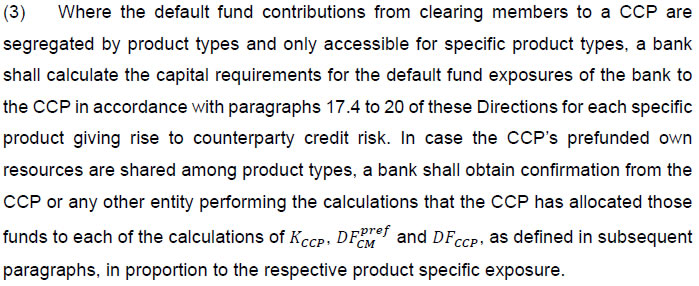 (4) The calculation of a bank’s capital requirement for the default fund exposures to a QCCP using the formulae in paragraphs 18 to 20 of these Directions may be performed by the bank, the QCCP, authority supervising the QCCP or any other entity with access to the required data. The formula considers the size and quality of a qualifying CCP’s financial resources, the counterparty credit risk exposures of such CCP, and the application of such financial resources via the CCP’s loss bearing waterfall, in the case of one or more clearing member defaults. However, the bank shall ensure that the following requirements are met: b) the QCCP, authority supervising the QCCP or any other entity performing the calculations makes available sufficient information of the calculation results to permit the bank to calculate its capital requirement for the default fund exposures to a QCCP and to permit the Reserve Bank to review and confirm such calculations. (18) CCP’s hypothetical capital requirement (KCCP) (1) A bank shall ensure that the KCCP is calculated in accordance with the following formula: where, a) KCCP is the hypothetical capital requirement of the CCP due to its counterparty credit risk exposures to its clearing members and their clients. Note - KCCP is a hypothetical capital requirement for a CCP, calculated on a consistent basis for the sole purpose of determining the capitalisation of clearing member default fund contributions; it does not represent the actual capital requirements for a CCP which may be determined by a CCP and its supervisor. b) RW is a risk weight of 20 per cent. Note - The risk weight of 20 per cent is a minimum requirement. The Reserve Bank may increase the risk weight taking into account, among other things, the credit rating of clearing members in a CCP. Any such increase in the risk weight is to be communicated by the affected bank to the entity performing the calculations. c) EADi is the exposure amount of the CCP to Clearing Member ‘i’, including both (i) the clearing member’s own transactions and client transactions guaranteed by the clearing member; and (ii) all values of collateral, with applicable haircuts, held by the CCP (including the clearing member’s prefunded default fund contribution) against these transactions, relating to the valuation at the end of the regulatory reporting date before the margin called on the final margin call of that day is exchanged. d) The bank shall ensure that the exposure amount of the CCP is calculated by aggregating all clearing member (CM) accounts. (2) For the purposes of paragraph 18(1) of these Directions: a) where a clearing member provides client clearing services, and client transactions and collateral are held in separate (individual or omnibus) sub-accounts to the clearing member’s proprietary business, the transactions and collateral in each such client sub-account shall be included in the sum of EADi separately, i.e., EADi is the sum of the exposure amounts of the client sub-accounts and the exposure amount of any house sub-account. If any of these sub-accounts contains both derivative transactions and SFTs, the exposure amount of that sub-account is the sum of the exposure amount of the derivative transactions and the exposure amount of the SFTs. Explanation: This ensures that the collateral posted by the client and held at the CCP cannot be used to offset the CCP’s exposures to clearing members’ proprietary activity in the calculation of KCCP. b) where collateral is held by the CCP against a clearing member account or client sub-account containing both SFTs and derivative transactions, the prefunded initial margin provided by the clearing member or client of a clearing member shall be allocated to the exposure amounts of the SFTs and derivative transactions in proportion to the respective product specific exposure amounts, calculated in accordance with: (i) paragraph 157 to 165 of the Commercial Banks - Prudential Norms on Capital Adequacy Directions, 2025 for SFTs; and (ii) paragraph 10 to 14 of these Directions for derivative transactions, without including the effects of collateral. c) where the default fund contributions of a clearing member are not split with regards to client and house sub-accounts, such default fund contributions are to be allocated per sub-account according to the respective fraction the initial margin of the sub-account has in relation to the total initial margin posted by or for the account of the clearing member. d) the netting sets that are applicable to regulated clearing members are the same as those referred to in paragraph 16.3 of these Directions. For all other clearing members, the netting rules of the CCP notified to its clearing members shall apply. The Reserve Bank may specify more granular netting sets than laid out by the CCP. e) For derivative transactions, EADi is calculated as the bilateral trade exposure the CCP has against the clearing member ‘i’ using the SA-CCR as provided in paragraph 10 to 14 of these Directions. In applying the SA-CCR: (i) A margin period of risk of 10 business days shall apply (The 20 business days floor on the margin period of risk for netting sets where the number of trades exceeds 5,000 at any point in a quarter does not apply). (ii) All collateral held by the CCP to which the CCP has a legal claim in the event of the default of clearing member ‘i’ or its client, including default fund contributions of clearing member ‘i’, may be used to offset the CCP’s exposure to clearing member ‘i’ or its client through inclusion in the PFE multiplier in accordance with paragraph 12.1 of these Directions. f) For SFTs, EADi is equal to max(EBRMi - IMi - DFi; 0), where: (i) EBRMi is the exposure amount to clearing member ‘i’ before credit risk mitigation in accordance with paragraph 157 to 165 of the Commercial Banks - Prudential Norms on Capital Adequacy Directions, 2025. For the purposes of this calculation, variation margin that has been exchanged (before the margin called on the final margin call of that day) enters into the mark-to-market value of the transactions. (ii) IMi is the initial margin collateral posted by the clearing member ‘i’ with the CCP; and (iii) DFi is the prefunded default fund contribution by the clearing member ‘i’ that will be applied upon the default of the clearing member, either along with or immediately following the initial margin posted by the clearing member, to reduce the CCP’s loss. Capital Requirement for clearing member bank’s default fund exposures to a CCP (19) A bank shall calculate its capital requirement for default fund exposures to a CCP using the following formula, where a 2% risk weight floor is applied to the default fund exposure: where, (20) For the purposes of calculating the bank’s capital requirement for default fund exposures to a QCCP as provided in paragraph 19 of these Directions, a bank shall not subject its exposures for collateral posted as default fund contributions to a QCCP to haircuts. 21. Disclosures (1) A bank shall disclose all exposures in the banking book and trading book that are subject to a counterparty credit risk charge, including the charges applied to exposures to central counterparties (CCPs), as part of its Pillar 3 disclosure requirements. The disclosure requirements under these Directions are: a) Table CCRA - Qualitative disclosure related to CCR b) Template CCR1 - Analysis of CCR exposures by approach c) Template CCR2 - CCR exposures by regulatory portfolio and risk weights d) Template CCR3 - Composition of collateral for CCR exposures e) Template CCR4 - Credit derivatives exposures f) Template CCR5 - Exposures to central counterparties (2) The detailed template and disclosure frequency is provided in Annex III. |