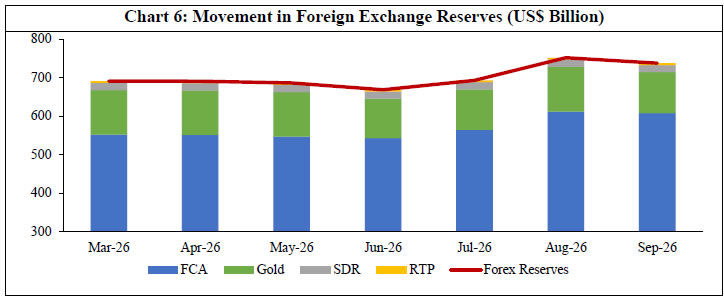
Contents Introduction The Reserve Bank of India publishes half-yearly reports on management of foreign exchange reserves as part of its efforts towards enhanced transparency and disclosures. These reports are prepared half-yearly with reference to the position as of end-March and end-September each year. The present report (47th in the series) is with reference to the position as of end-September 2026. The report is divided into two parts: Part I covers global macroeconomic and financial market developments, the movement of India's foreign exchange reserves, information on the external liabilities vis-à-vis the reserves, and adequacy of reserves, among others, during the half-year under review. Objectives of reserve management, statutory provisions, risk management practices, information on transparency and disclosure practices followed by the Reserve Bank with regard to reserve management are covered in Part II. Part-I Developments during the Half Year ended September 2026 Global Macroeconomic and Financial Market Developments 2. Global markets during April–September 2026 were shaped by the conflict in West Asia, disruptions to energy supplies, concerns about public debt and government borrowing, and resilient economic activity supported partly by investment in Artificial Intelligence (AI). These developments influenced inflation, central bank decisions, sovereign bond yields, currency and gold movements across economies. Renewed inflationary pressures, particularly from higher energy prices, led several major central banks to pivot towards tightening their monetary policy during April to September 2026. The US Federal Reserve, European Central Bank, Bank of Japan and Reserve Bank of Australia raised their policy rates while the Bank of England and Bank of Canada kept rates unchanged (Chart 1). 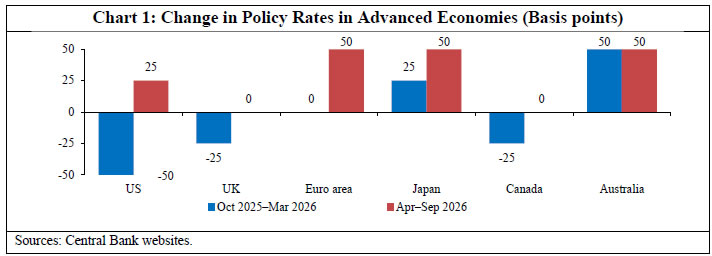 3. During April–September 2026, sovereign bond yields in Advanced Economies (AEs) witnessed a broad-based increase (Chart 2). This reflected tighter monetary policy expectations, higher real yields (returns on bonds after adjusting for expected inflation) and elevated government borrowing requirements1. Increase in AEs yields generated negative spillovers across Emerging Market and Developing Economies (EMDEs) contributing to higher local currency bond yields and borrowing costs for sovereigns and corporates. 4. Major currency movements during the review period reflected interest-rate differentials, safe-haven demand, energy dependence and fiscal credibility (Chart 3). The US Dollar Index 2(DXY) appreciated by approximately 4 per cent between the onset of the West Asia conflict and end-September 2026, driven by safe-haven capital flows, elevated interest rates, and the nation's status as a net energy exporter. 5. Gold prices remained volatile during April–September 2026, declining overall despite continued geopolitical uncertainty. The international price averaged around US$ 4,721 per troy ounce in April 2026 before easing to around US$ 4,319 in September 2026, a decline of approximately 9 per cent3. Prices responded to rising US Treasury yields, a stronger US dollar and expectations of tighter monetary policy. The decline occurred despite continued investor demand for gold as a safe-haven and for portfolio diversification. 6. Global reserve accumulation by central banks has remained stable in the first half of calendar year 2026 (US$ 13.10 trillion in Q1 2026 to US$ 13.22 trillion in Q2 20264). However, the currency composition of reserves has continued to evolve. The share of US dollar declined from 57.18 per cent in Q1 2026 to 56.70 per cent in Q2 2026 and the share of Euro increased from 20.04 per cent in Q1 2026 to 20.60 per cent in Q2 2026 (Chart 4). Looking more closely at the US Treasury market, foreign official holdings of US Treasuries declined from US$ 3.87 trillion in September 2025 to US$ 3.67 trillion in September 2026, while total foreign holdings remained broadly unchaged at about US$ 9.24 trillion, indicating growth in non-official holdings 5(Chart 5). Movement in India's Foreign Exchange Reserves Review of Growth of Foreign Exchange Reserves 7. During the period under review, reserves increased from US$ 691.11 billion as at end-March 2026 to US$ 737.78 billion as at end-September 2026 (Table 1 and Chart 6). Although Foreign Currency Assets (FCA) are maintained in major currencies, the foreign exchange reserves are denominated and expressed in US dollar terms. Movements in the FCA occur mainly on account of purchase and sale of foreign exchange by the Reserve Bank, income arising out of the deployment of the foreign exchange reserves, certain foreign inflows of the Central Government and changes on account of revaluation of the assets. Revaluation of assets can be on account of changes in bond yields, currency exchange rates vis-à-vis US dollar (including that of IMF's SDR) and prices of gold. | Table 1: Movement in Foreign Exchange Reserves | | (in US$ Million) | | Month End | FCA | Gold | SDR | RTP | Forex Reserves | | Mar-26 | 552283 | 115395 | 18621 | 4808 | 691108 | | Apr-26 | 551825 | 115216 | 18789 | 4863 | 690693 | | May-26 | 546923 | 115823 | 18776 | 4826 | 686348 | | Jun-26 | 542619 | 102587 | 18603 | 4781 | 668591 | | Jul-26 | 564680 | 104743 | 18666 | 4778 | 692866 | | Aug-26 | 611824 | 116252 | 18815 | 4906 | 751796 | | Sep-26 | 608261 | 106077 | 18644 | 4803 | 737784 | | Notes: | | (i) Foreign Currency Assets (FCA) are maintained as a multi-currency portfolio comprising major currencies, such as, US dollar, Euro, Pound sterling, Japanese yen, etc. and are valued in terms of US dollars. | | (ii) FCA excludes (a) investment in bonds issued by IIFC (UK) (b) SDR holdings of RBI, which is included under SDR, (c) amount lent under SAARC and ACU Currency Swap Arrangements and (d) RBI's contribution to funding of Nexus Global Payments | | (iii) SDR refers to Special Drawing Rights. | | (iv) RTP refers to the Reserve Tranche Position in the International Monetary Fund (IMF). | | (v) Difference, if any, is due to rounding off. |
 Sources of Accretion to Foreign Exchange Reserves 8. On a balance of payments basis (i.e., excluding valuation effects), foreign exchange reserves decreased by US$ 8.1 billion during April-June 2026 as against an accretion of US$ 4.5 billion during April-June 2025. Foreign exchange reserves in nominal terms (i.e., including valuation effects) decreased by US$ 22.5 billion during April-June 2026 as against an accretion of US$ 29.8 billion in April-June 2025. 9. Table 2 provides details of sources of variation in foreign exchange reserves during April-June 2026 vis-à-vis the corresponding period of the previous year. The valuation loss amounted to US$ 14.4 billion during April-June 2026 as against a valuation gain of US$ 25.3 billion during April-June 2025. | Table 2: Sources of Variation to Foreign Exchange Reserves* | | (in US$ Billion) | | | Items | April-June 2025 | April-June 2026** | | I. | Current Account Balance | -3.4 | -4.2 | | II. | Capital Account (net) (a to f) | 7.9 | -3.9 | | a. | Foreign Investment (i+ii) | 6.9 | -3.5 | | (i) | Foreign Direct Investment | 5.2 | 6.1 | | (ii) | Portfolio Investment | 1.6 | -9.6 | | b. | Banking Capital, [(of which)] | -1.6 | 2.8 | | | NRI Deposits | 3.6 | 2.8 | | c. | Short term credit | -0.1 | 3.5 | | d. | External Assistance | 0.7 | 0.4 | | e. | External Commercial Borrowings | 5.5 | 1.0 | | f. | Other items in capital account | -3.5 | -8.1 | | III. | Valuation change | 25.3 | -14.4 | | | Total (I+II+III) @
Increase in reserves (+) / Decrease in reserves (-) | 29.8 | -22.5 | *: Based on the old format of BoP which may differ from the new format (BPM6) in the treatment of transfers under the current account and ADRs/ GDRs under portfolio investment.
@: Difference, if any, is due to rounding off.
Note: 'Other items in capital account' apart from 'Errors and Omissions' includes SDR allocations, leads and lags in exports/imports, funds held abroad, advances received pending issue of shares under FDI, capital receipts not included elsewhere and rupee denominated debt.
**: Figures available only up to June 2026. | Forwards Outstanding 10. The net forward asset (payable) of the Reserve Bank stood at US$ 239.18 billion as at the end of September 2026. External Liabilities vis-à-vis Foreign Exchange Reserves 11. India's International Investment Position (IIP), which is a summary record of the stock of country's external financial assets and liabilities as at end-June 2026, is furnished in Table 3. During the period between end-June 2025 and end-June 2026, the external assets increased by US$ 35.2 billion and external liabilities decreased by US$ 57.4 billion. | Table 3: International Investment Position of India* | | (in US$ Billion) | | Item | End-June 2025 (PR) | End-June 2026 (P) | | A. Total External Assets | 1,177.3 | 1,212.5 | | 1. | Direct Investment | 279.6 | 316.1 | | 2. | Portfolio Investment | 16.3 | 23.4 | | 3. | Other Investment | 183.3 | 204.4 | | 4. | Foreign Exchange Reserves | 698.1 | 668.6 | | B. Total External Liabilities | 1,490.2 | 1,432.8 | | 1. | Direct Investment | 571.7 | 560.9 | | 2. | Portfolio Investment | 272.6 | 224.0 | | 3. | Other Investment | 646.0 | 647.9 | | C. | Net IIP (A-B) @ | (-) 312.9 | (-) 220.3 | P: Provisional, PR: Partially revised.
@ Difference, if any, is due to rounding off.
*: Updated figures available only up to June 2026. | 12. The net IIP as at end-June 2026 was negative at US$ 220.3 billion as against a negative net IIP of US$ 312.9 billion at end-June 2025, implying that the sum of all external liabilities is more than that of the external assets in both periods6. There has been a decrease in the gap on a year-on-year basis. Adequacy of Reserves 13. At the end of June 2026, foreign exchange reserves cover of imports (on balance of payments basis) stood at 9.8 months (10.6 months at end-March 2026). The ratio of short-term debt (original maturity) to reserves increased to 23.0 per cent at end-June 2026 from 21.6 per cent at end-March 2026. The ratio of volatile capital flows (including cumulative portfolio inflows and outstanding short-term debt) to reserves also rose to 68.0 per cent at end-June 2026 from 66.6 per cent at end-March 20267. Management of Gold Reserves 14. As at end-September 2026, the Reserve Bank held 880.52 metric tonnes of gold, of which 740.13 metric tonnes were held domestically and 140.39 metric tonnes of gold were kept in safe custody with the Bank of England and the Bank for International Settlements (BIS). In value terms (US$), the share of gold in the total foreign exchange reserves decreased from 16.70 per cent as at end-March 2026 to about 14.38 per cent as at end-September 2026. Investment Pattern of the Foreign Currency Assets 15. The foreign currency assets comprise multi-currency assets that are held in multi-asset portfolios as per the existing norms, which conform to the best international practices followed in this regard. As at end-September 2026, out of the total FCA of US$ 608.26 billion, US$ 529.57 billion was invested in securities, US$ 35.95 billion was deposited with other central banks and the BIS and the balance US$ 42.75 billion comprised deposits with commercial banks overseas (Table 4). With the objective of exploring new strategies and products in reserve management while diversifying the portfolio, a small portion of the reserves is being managed by external asset managers. The investments made by the external asset managers are governed by the permissible activities as per the RBI Act, 1934. | Table 4: Deployment Pattern of Foreign Currency Assets | | (in US$ Million) | | | As at end-March 2026 | As at end-September 2026 | | Foreign Currency Assets (FCA) * | 552,283 | 608,261 | | (a) Securities | 465,612 | 529,566 | | | (84.31) | (87.06) | | (b) Deposits with other central banks & BIS | 46,829 | 35,947 | | | (8.48) | (5.91) | | (c) Deposits with commercial banks overseas | 39,841 | 42,747 | | | (7.21) | (7.03) | | * FCA excludes (a) investment in bonds issued by IIFC (UK) (b) SDR holdings of Reserve Bank, which is included under SDR, (c) amount lent under SAARC and ACU currency Swap Arrangement and (d) RBI's contribution to funding of Nexus Global Payments | | Note: Figures in parenthesis indicate percentage to total FCA. Difference, if any, is due to rounding off. | Other Related Developments Transactions with IMF 16. IMF finances its lending and repayment operations in the General Resources Account under the Financial Transaction Plan (FTP). During the half-year under review, there was one purchase transaction for US$ 108.85 million and five repurchase transactions aggregating US$ 126.09 million under FTP of the IMF. 17. The New Arrangements to Borrow (NAB) is a standing set of credit arrangements under which the participants commit to provide supplementary resources to the IMF. India's commitment under the IMF's NAB was last raised to SDR 8,881.82 million from January 01, 2021. The Reserve Bank has NIL subscription under NAB as at end of September 2026. SAARC Swap Arrangement 18. Under the revised Framework on Currency Swap Arrangement for SAARC countries for the period 2024 to 2027, the Reserve Bank has signed Bilateral Currency Swap Agreements with the Royal Monetary Authority of Bhutan (RMAB) and the Maldives Monetary Authority (MMA). RMAB availed a swap of ₹15 billion under the INR Swap Window and ₹10 billion out of the Standby Swap Arrangement on March 23, 2026, which were rolled over for the first time on September 24, 2026. RMAB has also availed an additional swap of ₹15 billion on August 10, 2026, for six months. 19. Maldives Monetary Authority (MMA) has availed a swap facility of US$ 400 million on October 22, 2024, which was rolled over for the second time for six months on October 23, 2025. MMA has repaid the full amount (principal with interest) on April 23, 2026. MMA has availed a swap of ₹30 billion under the INR Swap Window on April 23, 2026, for six months. Investment in bonds issued by IIFC (UK) 20. The Reserve Bank had the mandate to invest up to US$ 5 billion in the bonds issued by the India Infrastructure Finance Company (UK) Limited. As at end-September 2026, the outstanding investments in such bonds stood at US$ 400 million. Part-II Objectives of Reserve Management 21. The guiding objectives of foreign exchange reserve management in India are similar to those of many central banks in the world. The demands placed on the foreign exchange reserves may vary widely depending upon a variety of factors including the exchange rate regime adopted by the country, the extent of openness of the economy, the size of the external sector in a country's GDP and the nature of markets operating in the country. While safety and liquidity constitute the twin objectives of reserve management in India, return optimization is kept in view within this framework. Legal Framework and Policies 22. The Reserve Bank of India Act, 1934 provides the overarching legal framework for deployment of reserves in different foreign currency assets and gold within the broad parameters of currencies, instruments, issuers and counterparties. The essential legal framework for reserve management is provided in sub-sections 17(6A), 17(12), 17(12A), 17(13) and 33 (6) of the above Act. In brief, the law broadly permits the following investment categories: -
deposits with other central banks and the BIS; -
deposits with commercial banks overseas; -
debt instruments representing sovereign/sovereign-guaranteed liability with residual maturity for the debt papers not exceeding 10 years; -
other instruments / institutions as approved by the Central Board of the Reserve Bank in accordance with the provisions of the Act; and -
dealing in certain types of derivatives. Risk Management 23. The broad strategy for reserve management including currency composition and investment policy is decided in consultation with the Government of India. The risk management functions are aimed at ensuring development of sound governance structure in line with the best international practices, improved accountability, a culture of risk awareness across all operations, efficient allocation of resources and development of in-house skills and expertise. The risks attendant on deployment of reserves, viz., market risk, liquidity risk, credit risk and operational risk, and the systems employed to manage these risks are covered in the following paragraphs. Market Risk 24. Market risk for a multi-currency portfolio represents the potential change in valuations that result from movements in financial market prices, viz. changes in interest rates, foreign exchange rates, equity prices and commodity prices. The major sources of market risk for central banks are currency risk, interest rate risk and movement in gold prices. These risks are managed using Value-at-Risk (VaR), Conditional Value-at-Risk (CVaR), scenario analysis, stress testing etc. Further, to manage interest rate risk, duration targets and permitted deviations from it are specified as per the prevailing market conditions. 25. Gains/losses on valuation of FCA and gold due to movements in the exchange rates and/or price of gold are booked under a balance sheet head named the Currency and Gold Revaluation Account (CGRA). The balances in CGRA provide a buffer against exchange rate/gold price fluctuations. The dated foreign securities are valued at market prices at the end of each business day and the appreciation/depreciation arising therefrom is transferred to the Investment Revaluation Account (IRA). The balance in IRA is meant to provide cushion against changes in the security prices over the holding period. a) Currency Risk 26. Currency risk arises due to movements in the exchange rates. Decisions are taken on the long-term exposure to different currencies depending on the likely movements in exchange rates and other considerations over the medium and long-term. The decision-making procedure is supported by reviews of the strategy on a regular basis. b) Interest Rate Risk 27. The crucial aspect of the management of interest rate risk is to protect the value of the investments as much as possible from adverse impact of interest rate movements. The interest rate sensitivity of the portfolio is identified in terms of the benchmark duration and the permitted deviation from the benchmark. Liquidity Risk 28. Liquidity risk involves the risk of not being able to sell an instrument or close a position when required without facing significant costs. Foreign exchange reserves need to have a high level of liquidity at all times in order to be able to meet any unforeseen and emergency needs. Any adverse development on the external front would pose a demand on our forex reserves and, hence, the investment strategy needs a highly liquid portfolio. The choice of instruments determines the liquidity of the portfolio. For example, in some markets, treasury securities could be liquidated in large volumes without much distortion of the price in the market and, thus, can be considered as liquid. This is referred to as market liquidity of the security. Sovereign bonds can also be repo-ed out and cash raised against them. This is referred to as funding liquidity, or the ability to raise cash against security holdings. 29. Except fixed deposits with the BIS/ commercial banks overseas / central banks and funding provided under swaps to SAARC country central banks, almost all other types of investments are highly liquid instruments which could be converted into cash at short notice, either through sale or repo markets. The Reserve Bank closely monitors the portion of the reserves which could be converted into cash at a very short notice to meet any unforeseen/ emergency needs. Credit Risk 30. The Reserve Bank is sensitive to the credit risk it faces on account of the investment of foreign exchange reserves in the international markets. Its investments in bonds/treasury bills represent debt obligations of highly rated sovereigns, central banks and supranational entities. Further, deposits are placed with central banks, the BIS and highly credit-worthy commercial banks overseas. The Reserve Bank follows a systematic and stringent approach to assessing the creditworthiness of issuers and counterparties, based on objective evaluation criteria and clearly defined eligibility parameters. Credit exposure limits are prescribed with due regard to the credit quality and risk profile of counterparties and are reviewed periodically. Credit exposure vis-à-vis sanctioned limits in respect of approved counterparties is monitored continuously. Developments regarding counterparties are constantly reviewed to ensure ongoing assessment of credit quality. Operational Risk and Control System 31. Close attention is paid to strengthen the operational risk control arrangements. Key operational procedures are documented. Internally, there is total separation of the front office and the back-office functions and the internal control systems ensure several checks at the stages of deal capture, deal processing and settlement. The deal processing and settlement system, including generation of payment instructions, is also subject to internal control guidelines. There is a system of concurrent audit for monitoring compliance in respect of the internal control guidelines. Further, reconciliation of accounts is done regularly. In addition to internal audit and independent monitoring, the financial accounts are audited by external statutory auditors. There is a comprehensive reporting mechanism covering significant areas of activity/ operations relating to reserve management. These are provided to the senior management at frequent intervals, depending on the type and sensitivity of information. The Reserve Bank uses SWIFT as the messaging platform to settle its trades and send financial messages to its counterparties, custodians of securities and other business partners. Transparency and Disclosures 32. The Reserve Bank has been making available in the public domain data relating to foreign exchange reserves, its operations in foreign exchange market, position of the country's external assets and liabilities and earnings from deployment of Foreign Currency Assets and gold through periodic press releases of its Weekly Statistical Supplements, Monthly Bulletins, Annual Reports, etc. The Reserve Bank's approach with regard to transparency and disclosure closely follows international best practices. The Reserve Bank has adopted the Special Data Dissemination Standards (SDDS) template of the IMF for publication of the detailed data on Foreign Exchange Reserves. Such data are made available on monthly basis on the Reserve Bank's website.
|