| Shri Anand Gopal Mahindra | 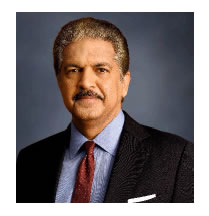
| Shri Anand Mahindra is the Chairman of the Mahindra Group and Mahindra & Mahindra Ltd. His tenure has seen the Group expand domestically and internationally into a range of major industrial sectors from automobiles and agriculture to IT and aerospace. The Group has also grown inorganically through acquisitions such as Swaraj Tractors, Reva Electric Car Company, Satyam Computer Services, Peugeot Motorcycles, Aerostaff Australia, Holiday Club Resorts, and Pininfarina S.p.A. He has served on several influential bodies, national and international. These include the UN Global Compact Board, Global Board of Advisors of the Council on Foreign Relations, World Bank Group’s Advisory Board for Doing Business and the International Advisory Council of Singapore’s Economic Development Board. He has been the President of The Confederation of Indian Industry and served on the boards of the National Stock Exchange of India and the National Council of Applied Economic Research. He is currently on the board of Invest India, the National Investment Promotion and Facilitation Agency. Shri Mahindra has been conferred with the Padma Bhushan Award (2020), India's third highest civilian honour for his contribution to the nation in the field of ‘Trade and Industry’. He has been named in Barron's List of Top 30 CEOs worldwide (2016) and Fortune Magazine’s list of the World’s 50 Greatest Leaders (2014). He was a recipient of the Best Transformational Leader Award by the Asian Centre for Corporate Governance & Sustainability (2012). He was appointed ‘Knight in the National Order of the Legion of Honour’ by the President of the French Republic (2016) and conferred the 'Grand Officer of the Order of the Star of Italy', by the President of Italy (2013). Shri Mahindra is an incisive business commentator and humanitarian with over 8.5 million followers on Twitter. Among his many social change initiatives is the Nanhi Kali programme, which, for the last two decades, has provided over 330,000 under-privileged girls access to high quality education. Shri Mahindra is the Chairman of the Board of Naandi Foundation, India’s leading NGO focused on educating girls, skilling youth and providing sustainable livelihoods to small farmers through biodynamic agriculture. Shri Mahindra also serves on the Founders Board of The Rise Fund, a $2 billion impact fund. He is a strong votary of arts and culture. Mahindra Blues, Mahindra Excellence in Theatre Awards and Mahindra Sanatkada celebrate and nurture music, theatre culture, art and history in India. Shri Mahindra is the member of the Global Advisory Council of the Lincoln Center, New York and has previously served on the Board of Trustees of the Natural History Museum of London. In 2014, Shri Mahindra founded the Pro Kabaddi League to popularize the ancient and popular Indian game of kabaddi. The league, televised through the STAR television network, is aimed at creating a new popular fan following for Kabbadi as an antithesis to cricket. Shri Mahindra graduated from Harvard College (1977) and secured an MBA from Harvard Business School (1981). | | Shri Somanath Sreedhara Panicker | | Dr. Sreedhara Panicker Somanath served as a Distinguished Scientist (Apex) and Secretary, Department of Space and Chairman, ISRO till January 2025. Dr. S. Somanath, having a career spanning nearly 40 years, is an expert in the field of space technology and systems engineering of launch vehicles, and has made significant contributions. Presently he serves as the Prof. Vikram Sarabhai Professor at ISRO, Distinguished visiting professor at IISc, Bangalore, Chancellor of Chanakya University, Bangalore and an Advisor to State Government of Andhara Pradesh. As Secretary of DoS, he had piloted the National Space Policy, engagement of ISRO with private space initiatives and start-ups in space sector. Under his leadership mission Chandrayaan-3 landing near the south pole of the Moon was accomplished. Notable missions during his tenure include Aditya-L1, XpoSat, INSAT-3DS, NVS-01, Oceansat, GSAT-24, SpaDeX & LVM3-OneWeb missions. Under his leadership Small Satellite Launch Vehicle and Test Vehicle were developed and landing experiments of the Re-usable Launch Vehicle (RLV-LEX) were conducted. He played a key role in the architecture of Gaganyaan and accomplished the first mission abort demonstration. He was instrumental in developing the 'Space Vision-2047', where Gaganyaan expansion program, Chandrayaan series and other exploration missions, Bharatiya Antariksha Station development and human mission to Moon, new launch pads were approved by government. He was the Director of Vikram Sarabhai Space Centre (VSSC) during 2018-21 and the Director of Liquid Propulsion Systems Centre (LPSC) during 2015-18. He was System Engineer and the Project Director of LVM3-X/CARE mission which was successfully accomplished in December, 2014. Dr. S. Somanath took his B. Tech in Mechanical Engineering from TKM College of Engineering, Kollam with a university rank, Masters in Aerospace Engineering from IISc, Bangalore with gold medal and PhD from IITM Chennai. He has been bestowed with Honorary Doctorates from 18 universities. He is a Fellow of Indian National Academy of Engineering (INAE), Indian National Academy of Science (INSA), Aeronautical Society of India (AeSI), Astronautical Society of India (ASI), US National Academy of Engineers (US-NAE) and a member of International Academy of Astronautics (IAA). He is the President (Elect) of AeSI and President of Society of Aerospace Quality and Reliability (SAQR). He received 'Hall of Fame' award from International Astronautics Federation (IAF), Von-Karman award from International Academy of Astronautics (IAA), National Aeronautics Prize from AeSI, Space gold medal from ASI, Distinguished alumni award of IISc, Bangalore and IIT Madras, distinguished fellow award from IIT Kanpur, Karnataka Rajyotsava award, Kerala Prabha and Kerala Sasthra Puraskaram. He has published papers in journals and conferences in structural dynamics and control, materials modelling, dynamic analysis of separation mechanisms, vibration and acoustic testing, launch vehicle design and launch services management. Dr. S. Somanath has widely travelled and visited across most global space agencies and facilities, has been a delegate to UN-COPUOS, vice President of International Astronautical Federation (IAF) and participated in International Astronautical Congress (IAC) held at different countries. | | Shri Janmejaya Kumar Sinha | | Janmejaya Sinha is Chairman of Boston Consulting Group’s (BCG) India Practice. Previously, he served as Chairman of Asia-Pacific region between 2009-2018 and as a member of the firm’s Executive Commitee between 2006-2018. He has served clients across the world. He is a co-author of ‘‘Untangling Conflict: An Introspective Guide for Families in Business“ published by Penguine, and “Your Strategy Needs A Strategy“ published by Harvard Business Review Press. He also co-edited the book titled “Own The Future“ published by Wiley. In 2010, the Consulting Magazine named him one of the Top 25 most influential consultants in the world. He serves on the boards of – Centre for Energy Environment and Water; Ananta Centre; The CII-Triveni Water Institute; and the Army Insurance Group. He has been a member of various committees set up by the Government of India, Reserve Bank of India (RBI), and Indian Banks‘ Association IBA). He is a member of the High Level Committee on Non finacial Regulatory Reforms chaired by Mr Rajiv Gauba and was a member of the Committee of Chief Ministers on adoption of Digital Payments. He has been a member of the Confederation of Indian Industry’s (CII), National Council for several years. Prior to joining BCG in 1998, he worked with Bain & Company in Boston between 1996-98. Prior to undertaking his PhD in Princeton Universtity in 1992, he worked with the Reserve Bank of India for ten years starting as a Grade B direct recruit in 1982. He worked across different departments and centers. During his PhD he twice interned with the World Bank. Dr. Sinha has a Ph.D from the Princeton School of Public and International Affairs, Princeton University, US (1992-96), a BA and an MA in Economics from Clare College, Cambridge University, UK (1984-86) and a BA and MA in History from St. Stephen’s College, Delhi University, India (1976-81). | | Shri Syed Akbaruddin | | "Ambassador Syed Akbaruddin is the founding Dean of Kautilya School of Public Policy. He has a distinguished diplomatic career spanning more than three decades. Entering the Indian Foreign Service in 1985, he retired in April 2020, upon completion of his tenure as the Permanent Representative of India to the United Nations. He was the Official Spokesperson of India’s Ministry of External Affairs from 2012 to 2015. He is among the few Indian diplomats who has the distinction of also serving as an international civil-servant in a United Nations entity. From 2006 to 2011, he worked at the International Atomic Energy Agency (IAEA) in Vienna. He was the Head of the External Relations and Policy Coordination Unit and later also the Special Assistant to the Director-General of the IAEA. He has also served as the Consul General of India, Jeddah in the Kingdom of Saudi Arabia from 2000 to 2004. Having served as Counsellor at the Indian High Commission in Islamabad (1998-2000) he is well versed in key issues between India & Pakistan. Also, he has worked at the Permanent Mission of India to the United Nations as First Secretary (1995-98). He was a member of the UN’s apex body, the Advisory Committee on Administrative & Budgetary Questions (ACABQ) during 1997-98. Since his retirement he has written and spoken extensively on global public policy issues. He has a Master’s Degree in International Relations from the Australian National University." | | Shri Sanjay Lohiya | | Shri Sanjay Lohiya, an IAS Officer of 1994 batch (Assam Meghalaya cadre), has joined Department of Financial Services, Ministry of Finance as Special Secretary and took over as Secretary, Department of Financial Services w.e.f. June 1, 2026. Prior to joining as Special Secretary in DFS, he was Additional Secretary in Ministry of Mines. He joined Indian Administrative Service (IAS) after graduating from St. Stephen's College, Delhi University. Before joining as Additional Secretary, Ministry of Mines, he held various positions, which included Principal Secretary to Chief Minister, Government of Assam, Joint Secretary in Ministry of Agriculture, Director in PMO, etc. | |