Global economic activity held up despite a pick-up in geopolitical uncertainty. Domestic economy remained resilient with quarterly results of listed private companies showing strengthening of aggregate sales growth. Industrial activity remained strong, and services sector sustained its healthy growth. The Union Budget 2026-27 reaffirmed Government’s commitment to fiscal consolidation without diluting the focus on long-term growth with stepped up allocation towards capital expenditure. The headline inflation continues to remain benign as per the first print under the revised CPI series. Foreign portfolio investments and Indian rupee staged a comeback with investor sentiments turning around following the India-EU free trade agreement and the interim India-US trade deal. Introduction Global uncertainty continued to decline from its peak in September 2025, though it remained above normal. Geopolitical uncertainty, however, picked-up in January, contributing to elevated financial markets volatility. Despite the headwinds, global economic activity remained resilient with high frequency indicators signalling some improvement in January. The pace of expansion, however, remained depressed with low levels of business optimism in most major economies. New export orders continued to contract amidst softer external demand, with broad-based decline observed across manufacturing and services exports. Global equity markets rallied during January and early February, benefitting from stronger-than-expected economic data and Q4:2025 earnings results, but subsequently corrected due to technology sector sell-offs. Emerging markets outperformed amidst portfolio diversification away from the US and reallocation of AI-related investments towards Asia’s semiconductor manufacturers. Bond markets remained subdued under pressures from elevated sovereign borrowing alongside continued unwinding of central bank bond holdings. Portfolio flows to emerging markets surged to around US$ 100 billion - the highest ever for the month of January - with strong inflows into both equity and debt segments. Global FDI flows increased in 2025, led by inflows to developed economies through investments in data centres and semiconductors, while flows to developing economies moderated. Global commodity prices displayed divergent trends across sectors during January and February so far. The World Bank Commodity Price Index surged to a 10-month high in January, driven by a spike in metal and energy prices. From a record high, gold and silver prices corrected sharply towards the end of January as geopolitical tensions eased and the revised margin requirements triggered gold liquidation to raise cash. Crude oil prices firmed up on concerns of supply chain disruptions in the wake of persistent tensions between the US and Iran. Inflation moderated across major advanced economies (AEs) in January, while exhibiting divergent movements across major emerging market and developing economies (EMDEs). Most central banks maintained status quo in January-February amidst continuing upside risks to inflation and lingering geopolitical uncertainties. Only Australia raised its policy rate amidst elevated service costs and a tight labour market, while Russia reduced its rate to address domestic growth concerns. Domestic economic activity remained resilient in January, driven by strong demand conditions. Quarterly results of listed private companies show strengthening aggregate sales growth. Rabi sowing concluded with higher acreages under all major crops. Industrial activity remained strong, and services sector sustained its healthy growth. The Union Budget 2026–27 balanced growth imperatives with fiscal prudence. By adhering to a credible path of fiscal consolidation, maintaining a strong thrust on capital expenditure, and prioritising infrastructure, innovation, and human capital development, the Government has reinforced the foundations for long-term growth. The containment of revenue expenditure and sustained focus on growth-enhancing investment underscore the continued commitment to quality spending. The National Statistics Office (NSO) released the CPI inflation for January 2026, with an updated base (2024=100) on February 12, 2026. In the first inflation print under the revised series, the headline CPI inflation stood at 2.8 per cent in January with food and core inflation at 2.1 per cent and 3.4 per cent, respectively. After excluding precious metals, core inflation dropped to a low of 1.9 per cent. The Monetary Policy Committee (MPC), in its bi-monthly review of February 2026, unanimously decided to keep the policy repo rate unchanged at 5.25 per cent. The MPC also decided to continue with the neutral stance. The decisions were guided by the resilience of growth momentum and a benign outlook for inflation. Financial conditions showed moderate tightness during the second half of January. Average yields on treasury bills, commercial papers (CPs), and interest rate on certificate of deposits (CDs) increased in January. However, adequate liquidity was restored in February by way of accelerated government spending and RBI’s liquidity measures. Reflecting liquidity conditions, the weighted average call rate transitioned from above the policy repo rate to below it in February. Growth in bank deposit and credit continued to remain robust with the growth in credit outpacing that of deposits. During 2025-26 (up to January 31, 2026), the total flow of financial resources to the commercial sector rose supported by credit from both bank and non-bank sources. Indian equity market remained subdued in January 2026 amidst tariff uncertainties and renewed geopolitical uncertainty. It received a boost through the India-EU trade deal towards the end of the month. It rebounded in early February, buoyed by the announcement of the India-US interim trade deal and return of foreign portfolio investors (FPIs). The rupee also bounced back as net FPI flows turned positive. Set against this, the rest of the article is structured into four sections. Section II covers the rapidly evolving developments in the global economy. Section III provides an assessment of domestic macroeconomic conditions. Section IV encapsulates financial conditions in India, while Section V presents the concluding observations. II. Global Setting Global uncertainty, though remaining elevated, declined for the fourth consecutive month in January, alongside a moderation in policy uncertainty. The geopolitical risk index, however, surged amidst escalating tensions in Venezuela, the Middle East, the Russia–Ukraine conflict, and the row over Greenland. Rising geopolitical tensions were also a key factor, alongside concerns about AI-related disruptions to the software industry, for the pick-up in global financial market volatility (Charts II.1a and II.1b). The global composite PMI improved in January from a six-month low in the preceding month. New export orders, however, remained in contraction, driven by a broad-based decline in export orders in both manufacturing and services (Table II.1). Business activity, as reflected in PMI indices, grew across major AEs, except France and Canada. Among major EMDEs, business activity expansion was led by India, with China and Russia expanding at a relatively modest pace. New export orders remained in contraction across major AEs, barring the UK, Japan and Australia. Among major EMDEs, export orders expanded in India and China, while they remained unchanged in Russia (Charts II.2a and II.2b).  Global commodity prices in January were characterised by divergent price movements across sectors. The World Bank commodity price index surged to a 10-month high in January, driven by a spike in metal and energy prices. In contrast, the Food and Agriculture Organization’s food price index declined in January for the fifth consecutive month, dragged down by lower dairy, meat, and sugar prices (Chart II.3a). The Bloomberg Commodity Index, after witnessing a surge in mid-January, corrected by February, largely driven by sharp movements in gold and silver prices. Gold prices rose sharply in January on safe-haven demand driven by rising geopolitical tensions, before correcting towards the end of the month and into early February on easing of tensions, profit-booking and higher margin requirements. Thereafter, prices regained some strength on renewed risk aversion. Crude oil prices also firmed up in January and early February on elevated geopolitical tensions (Chart II.3b). 
 Inflation moderated across major AEs in January, while exhibiting divergent movements across major EMDEs. In the Euro area, headline inflation eased due to lower energy costs. In the US, inflation softened amidst easing shelter and energy prices, with core inflation declining to its lowest level in five years. In December 2025, Japan’s inflation recorded a sharp decline, largely due to a fall in electricity and energy prices, while inflation in the UK picked up, driven by higher services and food prices (Chart II.4a). Among major EMDEs, inflation in China moderated, after three consecutive months of increase and moved closer to the deflationary zone, mainly on account of lower food prices. Core inflation also eased in China after remaining broadly stable in the preceding three months. Inflation in South Africa and Brazil edged up due to rising food prices. In Russia, inflation picked up again after nine months of decline, following the increase in value added tax by the government (Chart II.4b). Global equity markets rallied during January-February on the back of better-than-expected economic activity data and Q4: 2025 earnings results, before retreating amidst technology sector sell-offs. In Japan, markets continued their bull run, with sentiments supported by prospects of fiscal stimulus measures following the decisive mandate in the February snap elections. European equity indices gained amidst investor portfolio diversification away from the US assets. US markets underperformed relative to other markets amidst persistent domestic policy uncertainties and technology sector sell-offs. Chinese stocks witnessed selling pressures on weak manufacturing activity and growing concerns of taxation on internet firms (Chart II.5a). Within the technology segment of global equity markets, performance diverged between leading artificial intelligence (AI) firms and other software-as-a-service (SaaS) firms. The S&P 500 traditional Software and Services Index declined sharply relative to the Bloomberg Magnificent 7 Index in February, amidst increased competition from generative AIbased products (Chart II.6). 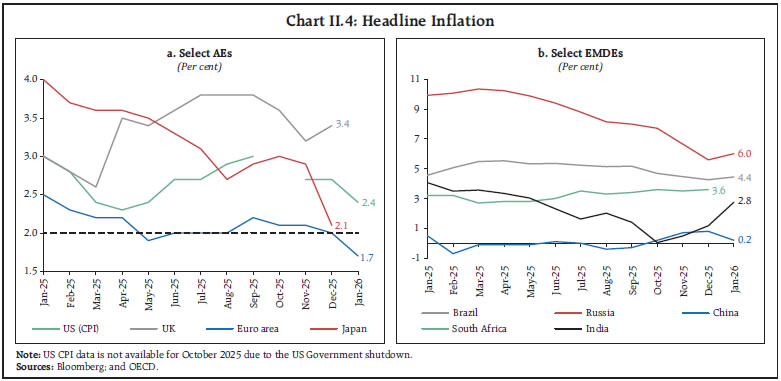
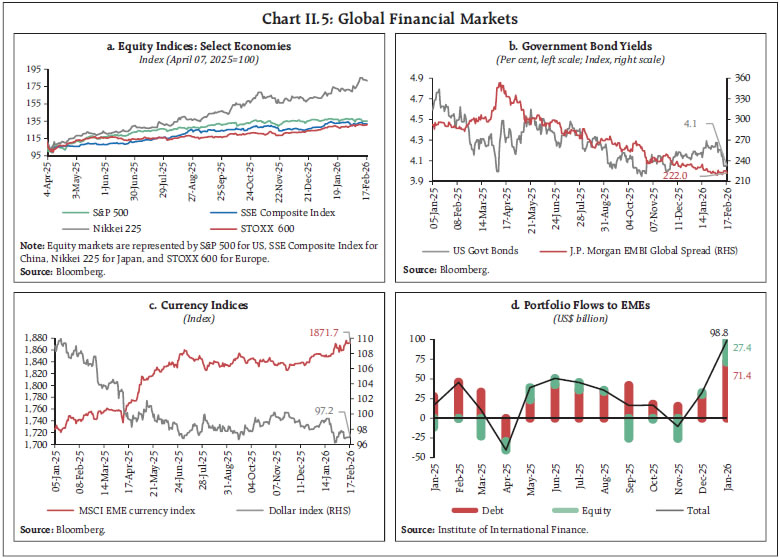 Global bond indices movements were shaped by mounting concerns about elevated public spending alongside continued unwinding of central bank bond holdings. The US Treasury yields hardened in January with stronger-than-expected jobs data dampening expectations of near-term interest rate cuts by the US Federal Reserve. However, yields softened in February, reflecting safe-haven demand following a sell-off in equity markets and softer inflation outturn in January. The Japanese yield curve also steepened sharply in January on fiscal concerns but remained steady thereafter following a softer Q4 GDP print. The JP Morgan emerging market bond yield spread narrowed, reflecting an improved economic outlook for emerging markets (Chart II.5b).  The US dollar held relatively firm till mid of January, before it faced severe downward pressures over the escalation of geopolitical tensions combined with investor concerns before the FOMC meeting and debasement fears. It recovered partly towards end- January and early February on the announcement of new Federal Reserve Chair (Chart II.5c). Portfolio flows to emerging markets rose to a five-year high, supported by an improved outlook for Asia and investor diversification away from the US assets (Chart II.5d). Global foreign direct investment (FDI) flows surged in 2025, led by higher investments in data centres and advanced chips, reflecting rising demand for AI infrastructure and digital networks. While FDI to developed economies recorded a sharp increase, developing economies witnessed a moderation in flows (Chart II.7). In January, most systemic central banks maintained a status quo on policy rates. Among AEs, the US, Japan, Canada, Sweden and South Korea kept their policy rates unchanged amidst persistent upside risks to inflation and lingering geopolitical uncertainties. In the case of EMDEs, Brazil, China, Indonesia, Malaysia and South Africa also held benchmark interest rates steady. In February so far, the UK, the Euro area, Mexico and New Zealand kept their rates unchanged. In contrast, Australia raised its policy rate, while Russia reduced it (Chart II.8).
III. Domestic Developments Economic activity continued to be resilient in January, underpinned by upbeat demand conditions. Quarterly results of listed private companies show strengthening aggregate sales growth. Industrial activity remained strong, and services sector sustained its healthy growth. The Union Budget 2026-27 reaffirmed Government’s commitment to fiscal consolidation without diluting the focus on long-term growth with stepped up allocation towards capital expenditure. The Union Government also accepted most of the recommendations of the 16th Finance Commission, thereby opting for a new formula for horizontal devolution of funds recognising the contribution of states to India’s growth. The Monetary Policy Committee (MPC), in its bi-monthly review of February 2026, unanimously decided to keep the policy repo rate unchanged at 5.25 per cent. The MPC also decided to continue with the neutral stance. The decisions were guided by the resilience of growth momentum and a benign outlook for inflation. Aggregate Demand Economic activity continued to be resilient in January, as evidenced by high-frequency indicators of energy consumption, digital payments, trade and logistics. E-way bills continued to exhibit double-digit growth supported by GST rate rationalisation. Electricity demand sustained its robust growth, primarily due to higher demand on account of the cold wave conditions across northern and eastern regions of the country, as well as from sustained industrial activity. GST revenue growth held steady. Petroleum consumption growth remained resilient, notwithstanding the deceleration. Digital payments registered steady growth in both transaction value and volume. Toll collections in January continued with the declining trend, observed post the introduction of the FASTag Annual Pass scheme in August 2025 (Table III.1).1  Overall demand conditions remained upbeat in January. Rural demand strengthened further with retail sales of two-wheelers and tractors witnessing a pick-up in growth, supported by post-GST momentum and healthy rural cash flows from the kharif harvest and wedding seasons. Retail passenger vehicle sales continued to expand in January, albeit at a slower pace. The sales slowdown reflects normalisation of markets following a period of high demand triggered by GST rate rationalisation. Domestic air passenger traffic recovered after the slump in December caused by the disruption in flight schedules (Table III.2). The all-India unemployment rate declined to 4.8 per cent in Q3:2025-26 from 5.2 per cent in Q2, with reductions observed across rural and urban areas.2 Further, the labour force participation rate and the worker population ratio recorded an uptick in rural areas while urban areas witnessed a slight slowdown. The all-India unemployment rate, however, marginally increased in January from December levels, with both rural and urban rates edging up. The labour force participation rate and worker population ratio declined marginally, reflecting seasonal factors such as winter conditions and post-harvest slack.3 The PMI employment for manufacturing registered an uptick in January, while PMI employment for services entered the expansionary zone. The Naukri JobSpeak Index showed deceleration in fresh hiring despite steady hiring in sectors such as BPO/ITES, hospitality and real estate. Meanwhile, the demand for work under the Mahatma Gandhi National Rural Employment Guarantee Scheme (MGNREGS) continued to decline for the seventh-consecutive month, reflecting an improvement in rural labour market conditions (Table III.3). During April-December 2025, all the key deficit indicators of the Centre, as per cent of revised estimates (RE), were lower than the same period last year (Chart III.1a).4 The lower fiscal deficit was on account of higher non-debt capital receipts and deceleration in revenue expenditure.5 In adherence to fiscal consolidation,6 the Union government has retained its gross fiscal deficit (GFD) for 2025-26 (RE) at 4.4 per cent of GDP, the same as the budget estimates for the year. 
 The Union Budget 2026-27 reaffirmed the focus on fiscal prudence while maintaining the thrust on growth-enhancing capital expenditure. The GFD target for 2026-27(BE) stands at 4.3 per cent of GDP, with the budgeted consolidation primarily envisaged through rationalisation of revenue expenditure and retention of capital expenditure at the same levels.7 Net tax revenue (as per cent of GDP) of the Centre is budgeted slightly lower from last year. Tax reforms such as GST rate rationalisation and simplification of income tax rules under the new Income Tax Act, 2025 are expected to boost collections over the medium run.8 The non-debt capital receipts are budgeted to grow faster than last year reflecting greater asset monetisation of the central public sector enterprises (CPSEs) facilitated by setting up of a dedicated real estate investment trusts (REITs).9 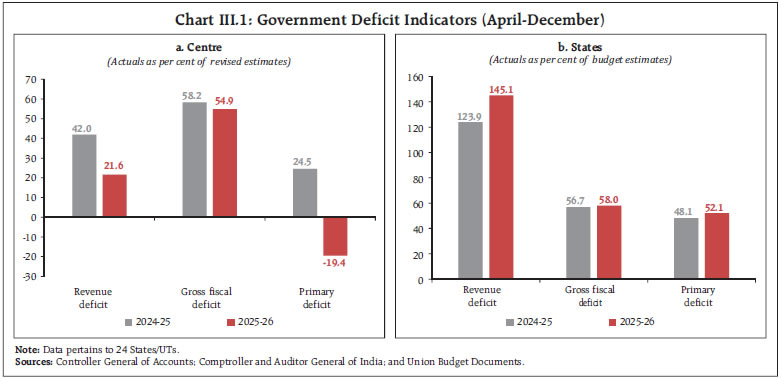 The deficit indicators of states during April-December 2025, as a proportion of BE for the financial year, were higher than the same period last year (Chart III.1b). The higher deficit was primarily led by a moderation in revenue receipts relative to their budget estimates. Within revenue receipts, growth in states’ goods and services tax (SGST), the major source of tax revenue, decelerated.10 States’ revenue expenditure grew at a slower pace than a year ago, while capital expenditure recorded a turnaround from last year’s contraction.11 The Government has accepted most of the recommendations of the 16th Finance Commission Report (Chairman: Dr. Arvind Panagariya) ensuring continuity and predictability in Centre-State fiscal relations, and maintained the states’ share in the Centre’s divisible pool at 41 per cent. The Commission recommended a rebalancing in the horizontal devolution formula by introducing a new criterion - states’ contribution to GDP with a weight of 10 per cent, reflecting India’s growth ambitions and the need to recognise states’ role in driving national economic performance. Greater emphasis has been placed on population, and the weights assigned to area, income distance and demographic performance have been trimmed. While the weight assigned to forest cover has been retained, the earlier tax effort criterion has been removed (Chart III.2). Trade During 2025-26 (April-January), the merchandise trade deficit rose higher than the last year, primarily driven by petroleum products, electronic goods, and gold.12 India’s merchandise exports and imports have expanded during 2025-26 so far.13 In January 2026, the merchandise trade deficit widened reflecting sharper rise in imports (Chart III.3).14 Exports to China continued to be in double digits,15 while exports to the US contracted. Both gold and silver imports registered three-digit growth in January. India concluded landmark deals with two of its major trading partners within a month. India and the EU concluded a Free Trade Agreement on January 27. While India will eliminate or reduce tariffs on 96.6 per cent of EU goods exports to India, around 99 per cent of India’s exports will get preferential access to EU market. The FTA provides comprehensive measures to address non-tariff barriers as well. As regards the interim trade deal with the US announced on February 7, India has agreed to eliminate or reduce tariffs on all US industrial goods and a wide range of US food and agricultural products. The US has agreed to lower the tariff rate to 18 per cent from 50 per cent earlier and allowed zero duty access for Indian agricultural exports such as spices, tea, coffee, fruits, nuts and processed foods. With these agreements in place, the labour-intensive sectors and export-oriented industries in India are expected to receive a major support. Net services exports rose at a faster pace in December, primarily supported by business and software services (Chart III.4).16 Aggregate Supply Agriculture The rabi sowing has concluded with higher acreages under all major crops, supported by conducive soil moisture, sufficient reservoir levels and favourable temperature (Chart III.5).17 However, above-normal temperature has been recorded in some key regions in January and the forecast is of a gradual rise in temperature in February and early March, warranting monitoring of its impact on standing crops (Chart III.6).18
Industry and Services Quarterly results of listed private non-financial companies19 for Q3:2025-26 indicate strengthening of aggregate sales growth.20 Manufacturing companies recorded double-digit sales growth, supported by stronger performances in the automobile, electrical machinery, food products and non-ferrous metal industries despite contraction in the petroleum industry.21 Sales growth of IT companies improved, while that of non-IT services remained broadly stable during the quarter (Chart III.7).
Operating profit of manufacturing companies rose during Q3:2025-26 on a y-o-y basis due to moderation in growth of other expenses. However, operating profit margin moderated on sequential basis. Within the services sector, operating profit growth improved for IT companies, while it moderated for non-IT services companies. Nonetheless, operating profit margin expanded sequentially for both IT and non-IT companies during the quarter (Chart III.8). During Q3:2025-26, revenue growth for listed banking and financial sector companies moderated, while net profit growth increased due to a rise in other income category (Chart III.9).22 On the investment front, total funds raised for capex purposes through different channels during April-December 2025-26 remained higher than in the comparable period since 2019-20, indicating sustained investment optimism (Chart III.10). Although the total cost of capex projects sanctioned by select banks and financial institutions (FIs) during Q3 was lower than the previous quarter, the sanctioned amount in Q3 was above the average for the post-COVID period,23 underscoring the persistence of investment appetite.24 Majority of the intended investment is concentrated in the power, chemical and construction industries. Funds raised through external commercial borrowings (ECBs) and initial public offerings (IPOs) for capex purposes also increased compared to the preceding quarter. Monthly Indicators of Industrial Activity In December, growth in industrial activity, as measured by the year-on-year change in the Index of Industrial Production (IIP), jumped to a 26-month high, primarily driven by a robust growth across all three sectors − manufacturing, mining and electricity. As per the use-based classification, four out of six segments witnessed an uptick in their growth over the previous month. Infrastructure and consumer durables were the best performers with double digit expansion signalling strengthening domestic demand. While growth in the capital goods segments recorded some softening, it continued to remain at elevated levels, reflecting investment revival. The index of eight core industries posted a four-month high growth in December, led by strong growth in steel and cement and turnaround in electricity generation. 
 High-frequency indicators of industrial activity remained strong in January. The manufacturing PMI strengthened, supported by improvements in new orders, output and employment. Automobile production recorded robust growth across segments in January, albeit at a slower pace, reflecting some normalisation following the earlier surge in output on account of the GST rate cuts (Table III.4). The Union Budget 2026-27 has laid down a clear intent to build a climate-ready infrastructure providing further impetus to India’s green transition. For industrial decarbonisation, it has proposed to scale up Carbon Capture, Utilisation and Storage (CCUS) across hard-to-abate industries such as power, steel, cement, refineries and chemicals – supporting the target of reducing their emissions intensity of GDP by 45 per cent from 2005 levels by 2030. As a major strategic manufacturing push and to elevate India’s role in the global semiconductor value chain, India Semiconductor Mission 2.0 has been launched with a budget outlay of ₹1,000 crore. The budget also extends customs duty exemptions on imports of goods required for nuclear projects until 2035.  Over the last two years, solar installed capacity has recorded strong growth, coinciding with the launch of Surya Ghar: Muft Bijli Yojana in 2024, under which rooftop solar deployment has increased to over 20 lakh systems, benefiting around 26 lakh households as of December 2025 (Chart III.11).25 To give further fillip to renewable energy, the Union Budget 2026-27 provides policy support through customs duty incentives for solar components and battery energy storage systems. Monthly Indicators of Services Activity India’s services sector sustained its healthy growth in January. Retail commercial vehicle sales sustained double-digit growth, driven by improving freight sentiment and replacement buying. Port cargo traffic also maintained the growth momentum (Table III.5).
Inflation On February 12, 2026, the National Statistics Office (NSO) released the new CPI series with an updated base (2024=100) along with year-on-year (y-o-y) inflation data for January 2026. The updated series revised the weights based on the Household Consumption Expenditure Survey 2023-24. Apart from the revision of item weights, the CPI 2024 series incorporates changes in classification to align with the United Nation Organization’s Classification of Individual Consumption According to (COICOP) 2018 framework (Annex Box A). Based on the CPI 2024 base year series, headline inflation26 stood at 2.8 per cent (y-o-y) in January. CPI food, fuel and core (CPI excluding food and fuel) inflation inflation were 2.1 per cent, 0.4 per cent and 3.4 per cent, respectively. Excluding precious metals, core inflation was lower at 1.9 per cent, indicating that underlying price pressures remain relatively contained (Table III.6). Core inflation accounted for the bulk of headline inflation in January, followed by food and fuel.27 Within food items, the main positive contributions came from fruits and nuts, milk, dairy products and eggs, meat and oils and fats; while vegetables and pulses exerted downward pressures. Among non-food items, gold/diamond/platinum jewellery contributed around 31 basis points to headline inflation.28 Inflation in the urban and rural region stood at 2.8 per cent and 2.7 per cent respectively, in January. Across states/UTs, inflation varied from 0.1 per cent to 4.9 per cent, with the majority of states experiencing inflation below 4 per cent (Chart III.12). | Table III.6: Year-on-year Inflation in January 2026 Based on the New CPI (2024 =100) Series | | S. No | Divisions | Inflation (per cent) | | 1 | Food and beverages | 2.1 | | 2 | Pan, tobacco and intoxicants | 2.9 | | 3 | Clothing and footwear | 3.0 | | 4 | Housing, water, electricity, gas and other fuels | 1.5 | | 5 | Furnishings, household equipment and routine household maintenance | 1.4 | | 6 | Health | 2.2 | | 7 | Transport | 0.1 | | 8 | Information and communication | 0.2 | | 9 | Recreation, sport and culture | 2.3 | | 10 | Education Services | 3.4 | | 11 | Restaurants and accommodation services | 2.9 | | 12 | Personal care, social protection and miscellaneous goods and services | 19.0 | | 13 | Core (Excluding Food and Fuel) | 3.4 | | 14 | Core excluding precious metals | 1.9 | | Source: NSO. | High-frequency food price data up to 17th February 2026 suggests some pressure in cereal prices. Within pulses, a broad-based increase is evident across gram, moong and tur/arhar dal. Within edible oils, prices of sunflower oil, mustard oil and groundnut oil also increased. On the other hand, among major vegetables, potato, tomato and onion prices have softened in February (Chart III.13).
Retail selling prices of petrol, diesel and LPG remained unchanged in February (up to 17th) while it declined for Kerosene (Table III.7). In January, both manufacturing and services PMI showed an increase in the rate of expansion of input prices. Input cost in manufacturing rose to a four-month high but remained below the long-term average. The rate of expansion in output prices moderated for manufacturing firms, while it increased for services firms (Chart III.14). | Table III.7: Petroleum Products Prices | | Item | Unit | Domestic Prices | Month-over-month (per cent) | | Feb-25 | Jan-26 | Feb-26^ | Jan-26 | Feb-26^ | | Petrol | ₹/litre | 101.1 | 101.2 | 101.2 | 0.0 | 0.0 | | Diesel | ₹/litre | 90.5 | 90.5 | 90.5 | 0.0 | 0.0 | | Kerosene (subsidised) | ₹/litre | 46.4 | 45.1 | 44.1 | -7.4 | -2.2 | | LPG (non-subsidised) | ₹/cylinder | 813.3 | 863.3 | 863.3 | 0.0 | 0.0 | ^: For the period February 1-17, 2026.
Note: Other than kerosene, prices represent the average Indian Oil Corporation Limited (IOCL) prices in four major metros (Delhi, Kolkata, Mumbai and Chennai). For kerosene, prices denote the average of the subsidised prices in Kolkata, Mumbai and Chennai.
Sources: IOCL; Petroleum Planning and Analysis Cell (PPAC); and RBI staff estimates. |
IV. Financial Conditions Overall financial conditions exhibited some tightness from the second half of January till February so far (up to 17th) driven by relative tightening in the corporate bond market (Chart IV.1). From a relatively mild surplus in the second half of January, system liquidity rose towards the end of the month and into February. This rise was primarily induced by the accelerated government spending and a series of liquidity-augmenting measures by the RBI. The Reserve Bank conducted six variable-rate repo (VRR) auctions in the second half of January to address the transient liquidity tightness.29 The Reserve Bank also conducted open market operations (OMOs) purchase auctions amounting to ₹1.5 lakh crore and 3-year USD/INR Buy/Sell Swap auction of USD 10 billion.30 
 Bolstered by adequate liquidity, average net absorption under the liquidity adjustment facility (LAF) increased during January 16, 2026 – February 17, 2026, from the preceding one-month period (Chart IV.2)31, with banks’ availment of the standing deposit facility (SDF) registering a sharp increase. Marginal standing facility (MSF) usage remained broadly stable, suggesting that day-to-day liquidity mismatches were minimal and well-managed.32 Money Market The weighted average call rate (WACR) generally hovered in the upper half of the policy corridor during January, reflecting liquidity pressures arising from goods and services tax outflows and a rise in currency in circulation. Liquidity induced by month-end government spending and RBI’s liquidity augmenting measures guided the WACR below the repo rate in February (Chart IV.3a).33 Overnight rates in the collateralised segments – as measured by the benchmark secured overnight rupee rate (SORR) − generally moved in tandem with the uncollateralised rate. In money markets, yields on treasury bills, commercial papers (CPs), and interest rate on certificate of deposits (CDs) increased in January, reflecting a moderation in surplus liquidity, excess supply due to bunching of redemptions, and typical year-end seasonal pressures (Chart IV.3b).34 As a result, the average risk premium in the money market (the spread between the yields on 3-month commercial paper and 91-day treasury bill) also witnessed an uptick.35 In February, although system liquidity conditions have improved, CP and CD rates have remained elevated. 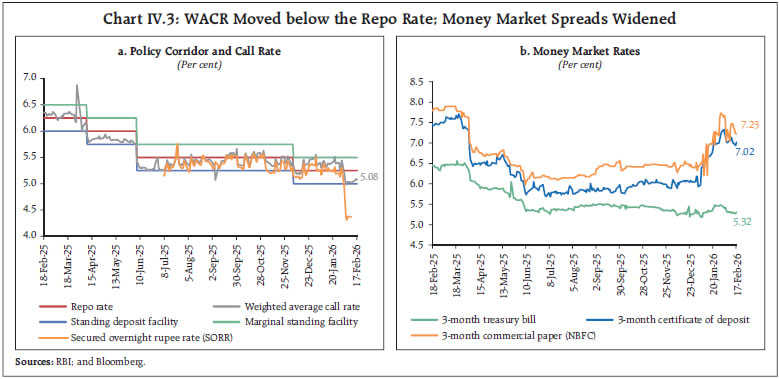 Government Securities (G-Sec) Market In the fixed-income segment, between January 19 and February 17, government security (G-sec) yields declined across the term structure other than at the longer end of the curve (Chart IV.4a & b).36,37
| Table IV.1: Corporate Bonds Yields Hardened | | | Interest Rates (Per cent) | Spread (bps) | | (Over Corresponding Risk-free Rate) | | Instrument | December 16, 2025 – January 14, 2026 | January 16, 2026 – February 16, 2026 | Variation | December 16, 2025 – January 14, 2026 | January 16, 2026 – February 16, 2026 | Variation | | 1 | 2 | 3 | (4 = 3-2) | 5 | 6 | (7 = 6-5) | | (i) AAA (1-year) | 7.12 | 7.53 | 41 | 151 | 181 | 30 | | (ii) AAA (3-year) | 7.20 | 7.31 | 11 | 122 | 122 | 0 | | (iii) AAA (5-year) | 7.34 | 7.50 | 16 | 80 | 91 | 11 | | (iv) AA (3-year) | 8.18 | 8.28 | 10 | 221 | 221 | 0 | | (v) BBB (3-year) | 11.79 | 11.91 | 12 | 581 | 582 | 1 | Note: Yields and spreads are computed as averages for the respective periods.
Source: FIMMDA. | Corporate Bond Market Corporate bond yields hardened across tenors and the rating spectrum, with their spreads over government securities generally widening (Table IV.1). New corporate bond issuances increased in December compared with November. On a cumulative basis, total issuances are lower in the current financial year so far than in the same period last year amidst rising corporate bond yields and the shift towards bank credit.38 Money and Credit During January 2026, reserve money growth (adjusted for CRR) increased, with currency in circulation expanding at a robust pace since October 2025.39 Growth in money supply, notwithstanding the decline in mid-January, rose thereafter, driven by higher aggregate deposits and currency with the public (Chart IV.5).40 Scheduled commercial banks’ (SCBs’) credit and deposit growth continued to be in double digits during the month, with credit growth outpacing deposit growth (Chart IV.6).41 During 2025-26 so far (up to January 31, 2026), total flow of financial resources to the commercial sector increased to ₹34.5 lakh crore from ₹25.5 lakh crore a year ago (Table IV.2a). Non-bank sources − corporate bond issuances, and foreign direct investment to India − showed a marked increase during the year so far. As on January 31, 2026 the total outstanding credit to the commercial sector rose by 14.7 per cent, with non-bank sources registering a growth of 15.1 per cent (Table IV.2b). 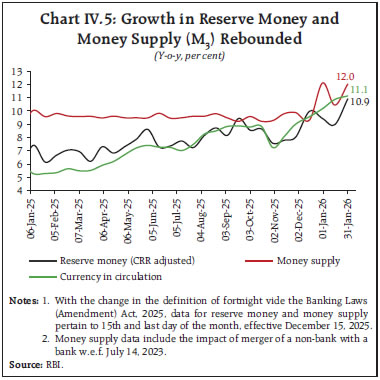
 Overall non-food bank credit42 growth (y-o-y) witnessed strengthening across all major sectors in December (Chart IV.7). Agriculture and industrial credit growth surged to double digits. Within industries, lending to micro, small and medium enterprises (MSMEs) as well as large industries witnessed higher growth. Credit to services sector also registered a sharp uptick in growth, attributable to a steep rise in bank lending to NBFCs, along with robust growth in sectors such as trade and commercial real estate. Growth in personal loans strengthened, led by housing, gold and vehicle loan segments. | Table IV.2a: Flow of Financial Resources to the Commercial Sector | | (₹ lakh crore) | | Source | April-March | Up to January 31 | | 2023-24 | 2024-25 | 2024-25 | 2025-26 P | | A. Non-Food Bank Credit | 21.40 | 17.98 | 14.03 | 21.79 | | B. Non-Bank Sources (B1+B2) | 12.64 | 17.10 | 11.50 | 12.69 | | B1. Domestic Sources | 10.20 | 13.86 | 9.14 | 9.59 | | B2. Foreign Sources | 2.43 | 3.25 | 2.36 | 3.10 | | C. Total Flow of Resources (A+B) | 34.04 | 35.09 | 25.53 | 34.47 | P: Provisional.
Notes: 1. Figures in the columns might not add up to the total due to rounding off of numbers.
2. For detailed notes and data, please refer to Current Statistics Table No: 18(a).
Sources: RBI; SEBI; AIFIs; and RBI staff calculations. |
| Table IV.2b: Outstanding Credit to the Commercial Sector | | (₹ lakh crore; Figures in parentheses are y-o-y percentage changes) | | Source | At End-March | As on January 31 | | 2024 | 2025 | 2025 | 2026 P | | A. Non-Food Bank Credit | 164.09 | 182.07 | 178.12 | 203.86 | | | (20.2) | (11.0) | (11.3) | (14.4) | | B. Non-Bank Sources (B1+B2) | 77.57 | 88.86 | 84.30 | 97.02 | | | (4.2) | (14.6) | (12.6) | (15.1) | | B1. Domestic Sources | 56.59 | 66.37 | 62.18 | 72.80 | | | (4.9) | (17.3) | (15.5) | (17.1) | | B2. Foreign Sources | 20.98 | 22.49 | 22.12 | 24.22 | | | (2.4) | (7.2) | (5.2) | (9.5) | | C. Total Credit (A+B) | 241.66 | 270.94 | 262.43 | 300.88 | | | (14.5) | (12.1) | (11.7) | (14.7) | P: Provisional.
Notes: 1. Figures in the columns might not add up to the total due to rounding off of numbers.
2. Data on non-bank sources excludes issuances of equities and hybrid instruments under domestic sources and foreign direct investment in equities under foreign sources.
3. Flows based on outstanding data may not tally with the flows provided in Table IV.2a due to:
(a) Merger of HDFC Limited with HDFC Bank on July 1, 2023;
(b) Conversion of some Housing Finance Companies into Non- Banking Financial Companies; and
(c) Valuation effect in case of foreign sources.
4. For detailed notes and data, please refer to Current Statistics Table No: 18(b).
Sources: RBI; SEBI; AIFIs; and RBI staff calculations. | Deposit and Lending Rates In response to the cumulative 125 basis points reduction in the policy repo rate during February–December 2025, the weighted average lending rate on both fresh and outstanding rupee loans of scheduled commercial banks declined by 105 basis points (bps) and 81 bps, respectively. On the deposit side, repricing has been faster for fresh deposits due to the higher share of short-duration bulk deposits, while outstanding deposit rates have adjusted gradually, reflecting the longer tenors of existing term deposits (Table IV.3). The decline in the weighted average lending rate on fresh and outstanding rupee loans was higher in the case of private banks relative to public sector banks (Chart IV.8). On the deposit side, transmission was higher for public sector banks compared to private banks in case of fresh term deposits. 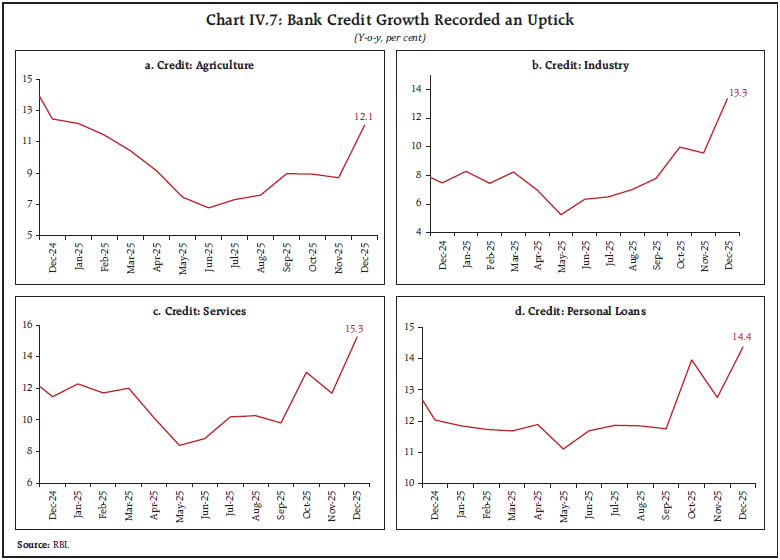
| Table IV.3: Robust Pass-through during the Ongoing Easing Cycle | | (Basis points) | | | | Term Deposit Rates | Lending Rates | | Period | Repo Rate | WADTDR- Fresh Deposits | WADTDR- Outstanding Deposits | EBLR | 1-Year MCLR (Median) | WALR - Fresh Rupee Loans | WALR- Outstanding Rupee Loans | | Overall | Interest Rate Effect# | | (1) | (2) | (3) | (4) | (5) | (6) | (7) | (8) | (9) | | Tightening Period May 2022 to Jan 2025 | 250 | 259 | 206 | 250 | 175 | 182 | 191 | 115 | | Easing Phase Feb 2025 to Dec 2025 | -125 | -95 | -41 | -125 | -55 | -105 | -94 | -81 | #: Calculated at January 2025 weights.
WALR: Weighted average lending rate; WADTDR; Weighted average domestic term deposit rate.
MCLR: Marginal cost of funds-based lending rate; EBLR: External benchmark-based lending rate.
Note: Data on EBLR pertain to 32 domestic banks.
Source: RBI. | Equity Markets Indian equity markets declined in January 2026 amidst uncertainties over US import tariffs and renewed US-Iran geopolitical tensions. The optimism surrounding the India-EU trade deal and the release of GDP growth projections for 2026-27 in the Economic Survey supported the equity markets towards the end of January (Chart IV.9). In February, the equity markets were buoyed by the announcement of an interim India-US trade deal and strong corporate earnings results for Q3:2025-26 even as concerns surrounding artificial intelligence-led disruptions capped the gains. External Sources of Finance During April-December 2025, foreign direct investment (FDI) remained higher than in the same period last year, both in gross and net terms.43 Gross inward FDI remained robust in December, with Singapore, the Netherlands and Mauritius accounting for more than 80 per cent of total inflows. The major recipient sectors were transport, manufacturing, computer services, and electricity and other energy generation, distribution and transmission. In December 2025, however, net FDI remained negative for the fourth consecutive month due to rise in repatriation and outward FDI.44 For outward FDI, key destinations were Singapore, the US, the UAE, the UK and the Netherlands and the major sectors included financial, insurance and business services, and wholesale/retail trade, restaurants, and hotels (Chart IV.10). 


 Foreign portfolio investments (FPIs) staged a comeback in February with investor sentiments turning around following the India-EU free trade agreement and the interim India-US trade deal (Chart IV.11).45 Offshore fund raising via the external commercial borrowings (ECB) route witnessed the highest registrations in the current financial year in December, partly attributable to the rate cut by the US Fed in December. On a cumulative basis, both registrations and net inflows of ECB moderated during April-December 2025 compared to the same period a year ago. The broader decline in offshore funding, amongst other factors, reflects the lower appeal for foreign financing in a domestic rate cut cycle (Chart IV.12).46 India’s foreign exchange reserves remain adequate, providing cover for goods imports for almost a year and around 96 per cent of the external debt outstanding (Chart IV.13).47 While foreign currency assets continue to have the largest share in India’s foreign exchange reserves, gold’s share has increased as on February 06, 2026 over the end-December level due to valuation effects.48
Foreign Exchange Market The Indian rupee (INR) depreciated against the US dollar in January in the wake of foreign portfolio outflows and uncertainty surrounding the India-US trade deal. In February, with net foreign portfolio flows turning positive, the INR recovered from its January lows (Chart IV.14). In real effective terms, the Indian rupee depreciated in January as depreciation of the INR in nominal effective terms more than offset higher prices in India vis-à-vis its major trading partners (Chart IV.15).
V. Conclusion Global economic outlook and financial market conditions are in a state of flux, being pulled by diverse signals, imparting some amount of volatility to market movements. While the simmering geopolitical tensions, public debt sustainability concerns in AEs, stretched valuation of AI firms and disruptions of AI on software services industry, are posing negative risk to outlook, robust macro-economic data releases including corporate earnings, on the other hand, have added to the positive sentiments. The completion of the India-EU free trade negotiations in end-January and the subsequent interim trade agreement between India and US are likely to play a significant role in the coming years by improving market access, enhancing export competitiveness, and integrating Indian firms more deeply into global value chains. In the immediate term, it has led to a change in investor sentiments. Foreign portfolio investment into equity and debt segment staged a comeback in February. On the fiscal front, the continued commitment to fiscal consolidation and debt sustainability signals prudent macroeconomic management. The gradual reduction in the fiscal deficit, combined with a sustained emphasis on capital expenditure, is expected to crowd in private investment and improve productive capacity. Support to states for capital investment is also likely to reinforce sub-national growth and infrastructure development. The near-term economic outlook for the economy remains favorable and is well-positioned to sustain its high growth momentum, driven by consumption, investment, and productivity-enhancing reforms.49 Inflation is expected to remain benign and near the inflation target50, providing a positive growth inflation balance in the near term.
Annex Box A: Salient Features of the Revised Consumer Price Index The price base year of the Consumer Price Index (CPI) has been revised to 2024=100, replacing the previous price base year of 2012=100. The weight reference period for the new base year is based on the Household Consumption Expenditure Survey (HCES) 2023-24, reflecting the contemporary consumption patterns and structural economic changes. The revised series has expanded the coverage of surveyed markets and items (from 299 to 358), along with the integration of online market price data. The revised basket reveals that items with historically higher price volatility have comparatively lower weights. Methodological enhancements include the exclusion of employer-provided housing and free public distribution system items, the introduction of rural housing indices, imputation for certain missing data (including seasonal items), and the adoption of chain-based formulae at the elementary level to better capture quality and specification changes. As there have been changes in classification, the weights between the old and new series are strictly not comparable across categories. Under the new structure, the weight of the food and beverages division has declined from 45.9 per cent in the 2012 series to 36.8 per cent, of which 3.3 per cent is due to reclassification of cooked meals and snacks to a new division named ‘restaurant and accommodation services’. Within food, the weight of cereals has declined from 9.7 per cent to 5.9 per cent, pulses from 2.4 per cent to 1.6 per cent, vegetables from 6.0 per cent to 5.2 per cent, and oils and fats from 3.6 per cent to 2.7 per cent. The weight of CPI core (excluding food and fuel) increases from 47.3 per cent to 57.9 per cent (including restaurants and accommodation services) [Chart A1].
|